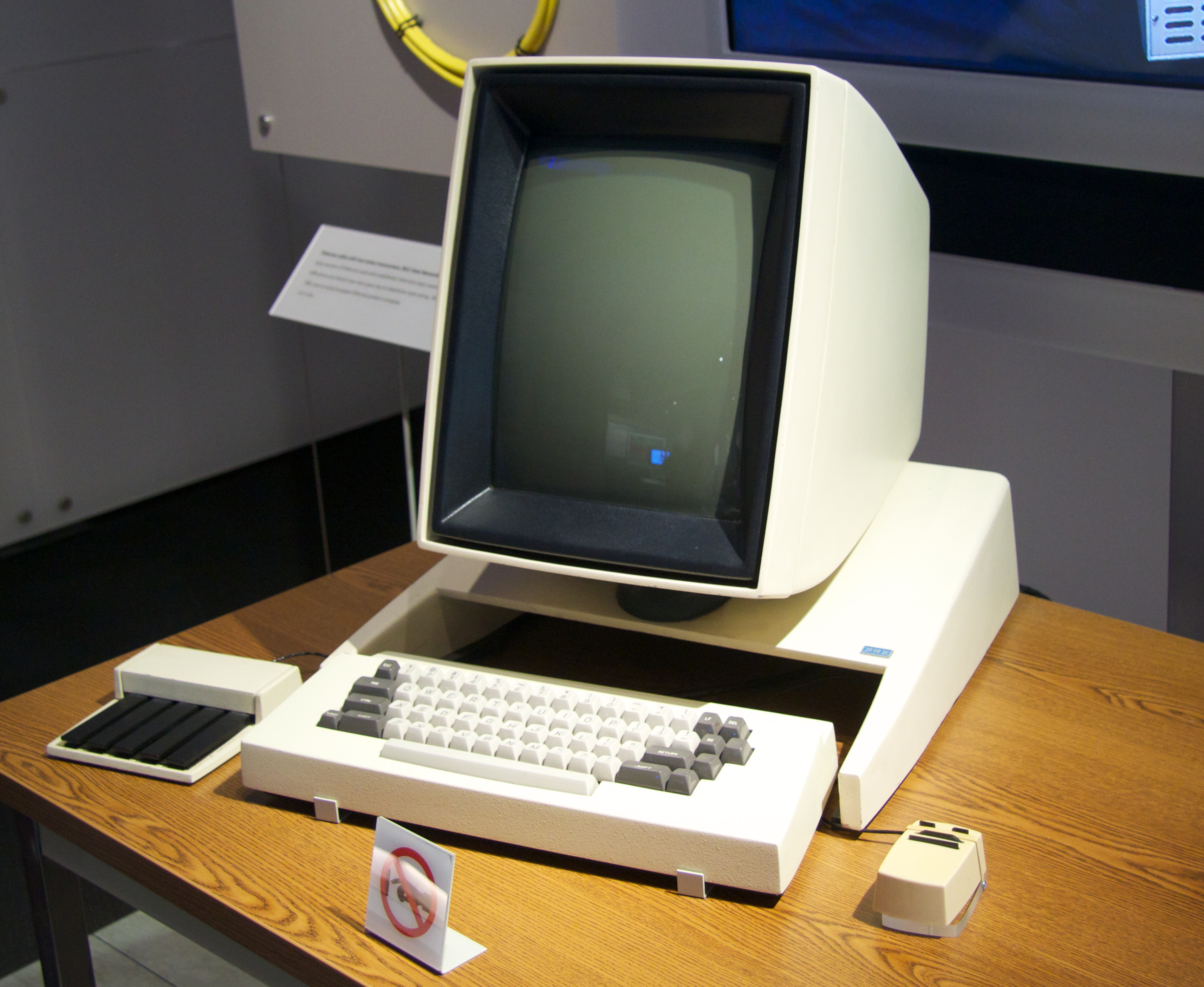
The Xerox Alto
BY MICHAEL V. COPELAND
In 1968, the same year Jimi Hendrix released Electric Ladyland, Doug Engelbart, an engineer from the Stanford Research Institute, sat poised in front of a computer terminal in San Francisco facing an audience of 1,000 fellow engineers. As words began to scroll across the fuzzy screen, Engelbart described his actions to the crowd. Though neither Engelbart nor his audience could have known it then, we’ve been replaying that performance ever since.
Engelbart reorganized lists of words by moving a small, boxy controller to the right of his keyboard, which in turn moved a small arrow across his monitor. A camera connected to the system captured the changes and sent them to another terminal located some 30 miles south of Engelbart’s workstation. The operator of the remote terminal not only saw Engelbart’s work in real-time, but he could make changes to the files concurrently.
Today, of course, we recognize these as familiar descriptions of the mouse and collaborative screen sharing, both standard functions of the modern computer. But on that day what would be described later as “The Mother of All Demos,” was as mind-blowing as Hendrix. Equally astonishing, however, is that more than four decades later Engelbart’s demo at the Fall Joint Computer Conference described a path forward in computing that we are still following.
Engelbart laid modern computing out – everything from the mouse to video conferencing, graphics, and file linking. And Engelbart’s work wasn’t the only technology of that era we are still riffing on. Ask any coder or hardware engineer with a sense of history and they will point to three other technological monsters: Project Xanadu, PLATO and the Xerox Alto.
Project Xanadu
Wind back further from the Mother of All Demos to 1960. Ted Nelson was spearheading the Project Xanadu, which was the first technology to link pieces of virtual content together, creating a new page or document in the process. Today, of course, we call this hyperlinking.
Nelson, however, had a different vision for the structure of the links themselves. Instead of one-way links to a parent source that exists somewhere else, Nelson envisioned links as both modular and bi-directional. As such, authors could now link to another site, or just a paragraph or sentence within it. Also, by using the Xanadu framework, bi-directional links allowed authors of the original source to see who was linking to their content and communicate with them if needed. As a result, hyperlinks became extremely flexible: they were able to seamlessly handle dynamic content, while reducing the number of unintended broken links in the process. Project Xanadu never quite fulfilled its promise or bravado as a product. It would remain incomplete decades after Nelson began documenting his ideas, but it was those ideas that spurred countless others.
PLATO
Around the same time Nelson was working on Xanadu, researchers at the University of Illinois created PLATO, the first e-learning platform. First introduced within academia, PLATO became the basis for many modern day computing functions, such as email, forums, instant messaging, chat rooms, screen sharing and multiplayer online games.
Engelbart’s work in that triumphant 1968 demo built off the work Nelson and others had done on hyperlinking. Engelbart showed how a personal computer might create and organize a structured file system. Using the command line, Engelbart divided content into categories and subcategories, but it was with his newly designed mouse with which he demonstrated how clicking an image could simplify finding a file. It’s a concept that today’s graphical user interfaces rely on.
Xerox Alto
Developed by Xerox PARC in 1973, the Xerox Alto was one of the first computers intended for personal use. Following Engelbart’s demo and the functions of the PLATO system, researchers at Xerox PARC set out to create a desktop version of a computer that included now standard programs, such as email, a WYSIWYG document editor, a primitive paint program and one of the first online multiplayer video games.
Taken together the Xanadu Project, PLATO, Engelbart’s system and the Xerox Alto build a definitive timeline of computing milestones that map directly to much of today’s computer technology and the products and services that flow from it.
Take, for example, Airbnb, Groupon – even Reddit. In simplest terms, these products are types of guided forums/message boards, taking cues from the social aspects of PLATO. Facebook takes PLATO’s social foundation further, layering on user control and customization to a forum or message board. Online education companies like Udacity, Kno, Khan Academy and Coursera leverage the ideas of PLATO’s e-learning capabilities.
Box, Google Docs and Dropbox are products that finally realize the file sharing ideas put forth in Engelbart’s demo, while Skype and Google Hangouts owe hat tips to the video conferencing features he was already anticipating.
Consider video game development. Without the online gaming innovations made possible by the Xerox Alto and PLATO, you can forget about Quake, Final Fantasy, World of Warcraft, EverQuest or even Minecraft .
And as companies increasingly push virtual documents and other relational data structures to the cloud, Xanadu may point the way toward reducing the number of broken hyperlinks.
Which gets us back to Jimi Hendrix. As with foundational musicians, it’s clear there are foundational ideas and technologies that have an influence well beyond a particular computer conference or point in time. Was Engelbart computing’s rock star in his day? Before the Mother of All Demos, people thought he was a bit of a wing nut. Many of the really brilliant ones are.
That his ideas, and the ideas embedded in the Xanadu Project, PLATO and the Xerox Alto, are still being tapped today is evidence of their depth, but also of the timing necessary for good ideas to become useful technologies. No doubt there are other foundational technologies swirling around at conferences, in labs and in people’s heads right now. Sometimes you just need to be a bit of wing nut to recognize them.