This first appeared in the a16z News newsletter. Subscribe to stay on top of the latest news.
On Monday we heard from David Haber why “Firm > Fund”: “Many of our competitors talk about their “platform team”, but they often mean the two people doing recruiting, and a marketer. We have 400 people who spend all day helping companies win. These are not the same!”
Our executive talent team at a16z is a critical part of the machine. If you ever need help with anything, they’ve got your back.
As you think about what a Chief of Staff (CoS) could help you accomplish at your startup, don’t assume you need one just because someone you know has one. “Chief of Staff” can sound like a flashy title to have on your team or in someone’s signature, but you need to be thoughtful about when, how, and why you bring one on. This is especially true because the CoS role varies widely between companies, so it’s up to you to be clear about responsibilities and expectations up front.
This article covers the potential scope of the role, the range of levels this hire can come in at, the different backgrounds Chiefs of Staff often come from, and a framework for assessing candidates. By the end, you’ll be ready to kick off the hiring process, pivot entirely, or revisit whether you need this role at all.
Hiring a Chief of Staff
Cassady Churchill, Jackie McQuistonScope
What a CoS does can be as complex or simple as you need it to be. CoS roles differ based on the unique needs of their leader and organization, as well as expectations for how this role will help accelerate the business. This section will cover the recommended reporting structure, dos and don’ts, common outcomes of the role, and how to think about this individual long-term within your organization.
Defining the role
First, a good CoS should complement you. The CoS should be strong where you are weak (e.g., a technical founder might hire a CoS with a strong finance or operations background; or a visionary CEO will hire a day-to-day operational grinder).
A CoS is most effective when working under a single Executive, typically the founder or CEO. This ensures one person is clearly responsible for monitoring and evaluating CoS performance. While the CoS may support the broader executive team, they should only have dotted-line responsibilities to others if working across multiple functions.
To set expectations, a Chief of Staff is not:
- Only on “special projects”. We have a love-hate relationship with this term. It can be a useful label for the back-burner tasks that come up in a startup, but they should make up only a small part of the job. The role shouldn’t revolve around special projects.
- An Executive or Personal Assistant. Admin and personal tasks should be no more than ~20% of the role. If 70% or more of the role focuses on these tasks, you likely need an Administrative or Executive Assistant instead. There are also part-time and virtual assistant services that can handle calendaring, travel, and similar support for you or your leadership team.
- A substitute for a different functional leader, such as a Head of Operations. If the role is laser-focused in one area, you may have started with the wrong title. Step back and consider whether you actually need a Head of X, Business Operations Lead, or Assistant.
A Chief of Staff is:
- Part of the executive team. They have a seat at the table, and, depending on their level, can be an influential voice in the room.
- A true generalist. Although they bring a key skill set—again, often in an area where you’re less strong—they should also be flexible and eager to learn as the business develops.
- Deeply trustworthy. They follow through, close loops quickly, and take responsibility seriously. If you’re out of office for a week, you can trust them to keep things running.
- A strategic thought partner. They put their founder’s hat on and think like an owner. They understand the nuances of the business within their first 90 days.
- Organizationally savvy. They can lead individual contributors (ICs) with ease and comfort. Typically a trained extrovert, they’re comfortable working solo and navigating complexity with ease.
- The control tower. The CoS keeps the CEO focused, the team aligned, and the priorities moving. Without them, things fall apart.
Responsibilities
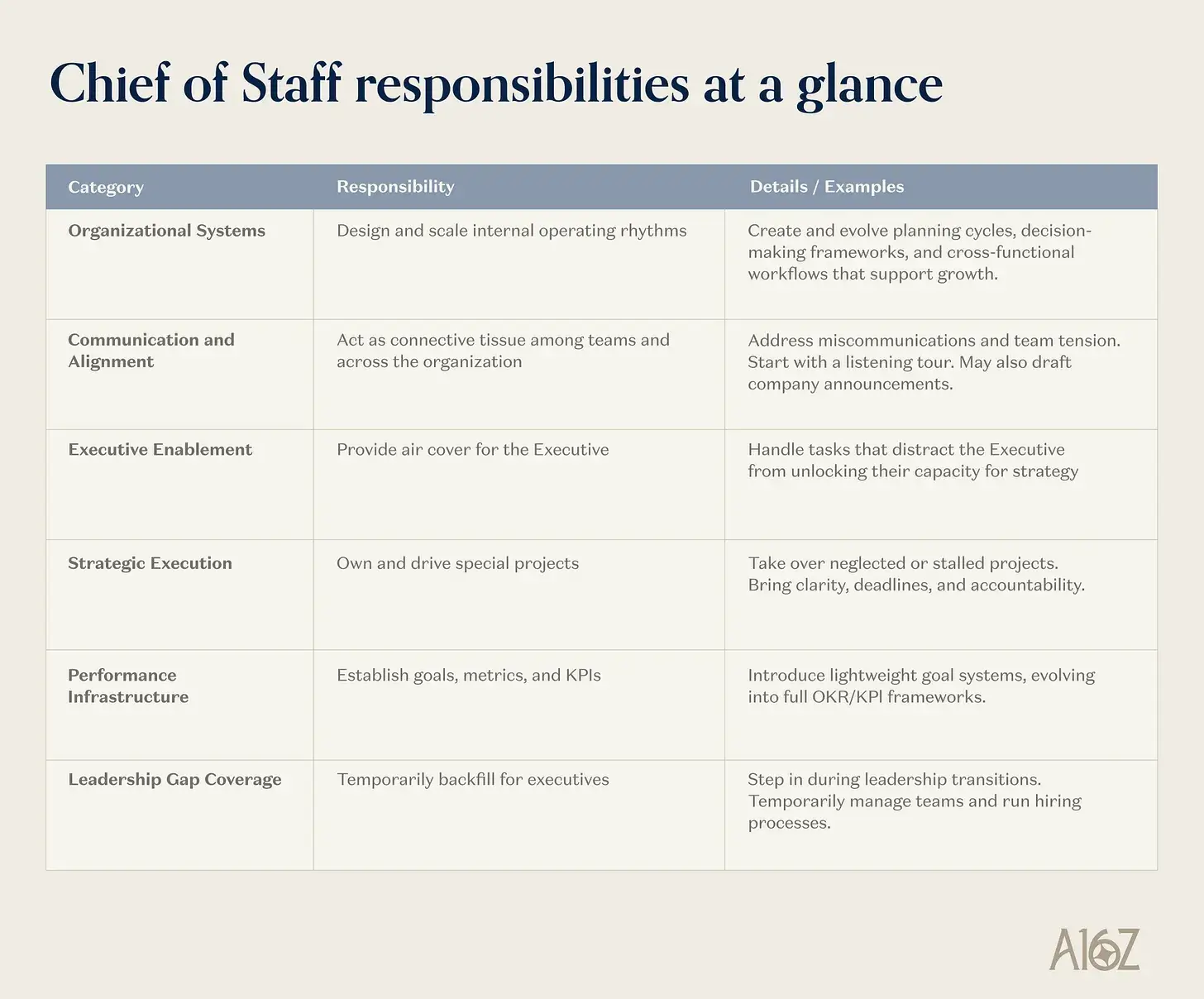
Another important step is evaluating where the idea of hiring for this role comes from. From there, clarify what you want this person to accomplish. Here are responsibilities we’ve seen successful Chiefs of Staff take on:
- Establishing foundational systems that scale. This might include designing the operating cadence, codifying how strategic decisions get made, and creating repeatable frameworks for planning, communication, and accountability. These are the structures that ensure the business doesn’t just grow—it grows with clarity and focus.
- Serving as connective tissue across teams. There may be miscommunications or even conflict in your startup. A strong CoS identifies these problems and addresses them head-on through a diplomatic, tactical, and empathetic approach. This may start with a listening tour, which we suggest doing during onboarding.
- Providing air cover for the Executive. The CoS protects their Executive’s time and focus—without hiding information—so they can stay heads-down on the most critical business initiatives.
- Leading special projects. Be clear about expectations, timelines, and why the CoS is best suited to drive each project. These may be long-overdue things that need project management. (But as we point out above, this won’t be their whole job.)
- Standing up company-wide goals and metrics. There may be nothing in place, but a strong CoS thrives in ambiguity. What starts as a few metrics may evolve into complex and nuanced KPIs.
- Filling in during an absence. Whether an executive leaves or takes time off, the CoS may temporarily manage the team while you hire a replacement. This could mean running the hiring process, including interviews, negotiations, and finalizing the hire.
Because the scope of the role can vary, it’s important to clearly define the responsibilities your CoS will own. Doing this also makes it easier to measure their success in the role.
Don’t expect forever
Unlike a rockstar Executive Assistant that may support you for years, a CoS isn’t a forever role. In most cases, it’s a 2–3 year commitment.
The rationale behind this:
- They can use this role as a springboard into another part of the organization.
- Burnout is real. The intensity of the role makes it difficult to sustain long-term.
- As your company changes, the demands may shift and you may need a different CoS for a different stage.
What comes next
The key is to set expectations early. You and your CoS should be aligned from the start that this role won’t be for more than a few years.
As for what comes next, a CoS who gravitates toward a particular functional area may go on to lead that organization. We’ve seen people step into leadership roles in Finance, Marketing, and Operations. They may also fit in well under a particular leader, such as your CRO or VP of Sales, to run Sales Ops.
If there’s not a strong internal fit at the two-year mark, start to consider how you can support them in their next step. They may want to be the CoS at a different startup or in a different industry. They could also want to pivot into something else entirely with the knowledge they’ve gained from this experience—something we often call a “free MBA.”
Lastly, be clear that you’ll need to find their replacement. Ideally, they’ll help interview and overlap with their backfill to ensure a smooth transition.
Make it your own
Some leaders hesitate to use the more glamorous “Chief of Staff” title when hiring for the role. If that’s you, consider a job title that better fits your style or company culture, like Executive (or Chief) Business Partner, Special Assistant to the CEO, Office of the CEO, Director of Internal Ops, Head of Business Operations, or whatever new title you dream up.
Leveling the role
The CoS role is high-trust, impactful, and notoriously hard to define. The Executive’s needs, the organization’s maturity, and the CoS’s scope of responsibilities will shape the role. While many share the same title, their authority and day-to-day work can look very different.
That’s why leveling is critical. A well-leveled CoS ramps faster, focuses on the right areas, and delivers outsized value from the start. Since the CoS role is often short-term or designed to evolve, it’s especially important to align early on around what success looks like.
The following framework is designed to help you:
- Clarify expectations at each level of the CoS role
- Align the CoS with the right business challenges and priorities
- Identify growth opportunities and guide professional development
The three orientations
Depending on your company’s size, the CoS role typically falls into one of three core orientations: Executive, Leadership Team, or Organization. These aren’t strict phases—they often overlap—but they give you a clear way to evaluate where the CoS is adding value and where they might grow next.
Orientation 1: Small organization (20+ people)
Executive support (Levels 1–2): Early on, the CoS focuses on directly supporting a specific executive (CEO, CTO, VP of Engineering, etc.).
They typically:
- Serve as a thought partner and advisor
- Help with communications, decks, and meeting preparation
- Act as a proxy when needed
- Track key priorities, decisions, and next steps
At this stage, the CoS operates with regular oversight. The goal is to build trust, deliver leverage, and learn the Executive’s working style.
Orientation 2: Scaling organization (75+ people)
Leadership team support (Levels 2–3): In this orientation, the CoS shifts from focusing solely on the Executive to enabling the entire leadership team to operate more effectively. This stage requires a broader skill set—think strategy, facilitation, and alignment.
Focus areas usually include:
- Shaping the strategic agenda
- Running staff meetings and setting team rhythms
- Creating systems for accountability
- Strengthening cross-functional relationships
- Fostering a high-trust, open team dynamic
From the outside, it might look like the CoS just “runs meetings”, but internally, they’re the glue holding the team together.
This support can be divided into five pillars:
- Interact: Help the team work better together
- Interface: Strengthen connections between this team and others
- Plan: Drive planning and strategic execution
- Measure: Track progress and keep goals front and center
- Communicate: Align messaging across the organization
The CoS may also temporarily lead cross-functional projects or take on oversight of emerging teams that don’t yet have a clear owner. At this stage, they may start building a small team—like a communications lead or a project manager—to scale their impact.
Orientation 3: Hypergrowth (150+ people)
Organization-wide support (Levels 3–4): At this level, the CoS zooms out and starts thinking like an operator. The focus shifts to the entire organization—shaping strategy and designing how the business actually delivers on it.
In practice, this is a stealth COO role. It’s less about title and more about function: designing how the organization works, scaling what matters, and closing gaps across teams.
Focus areas usually include:
- Organization design: Partnering with the Executive and team leads to build the right structure
- Business capabilities: Identifying where the organization needs to excel and investing in the right people, processes, and tools
- Interfaces and dependencies: Mapping and managing key touchpoints across functions
- Governance: Establishing rhythms for decision-making and accountability
- Optimization: Spotting inefficiencies and improving workflows
At this level, the CoS isn’t just supporting leadership—they’re shaping how the entire system functions.
Note on Level 5
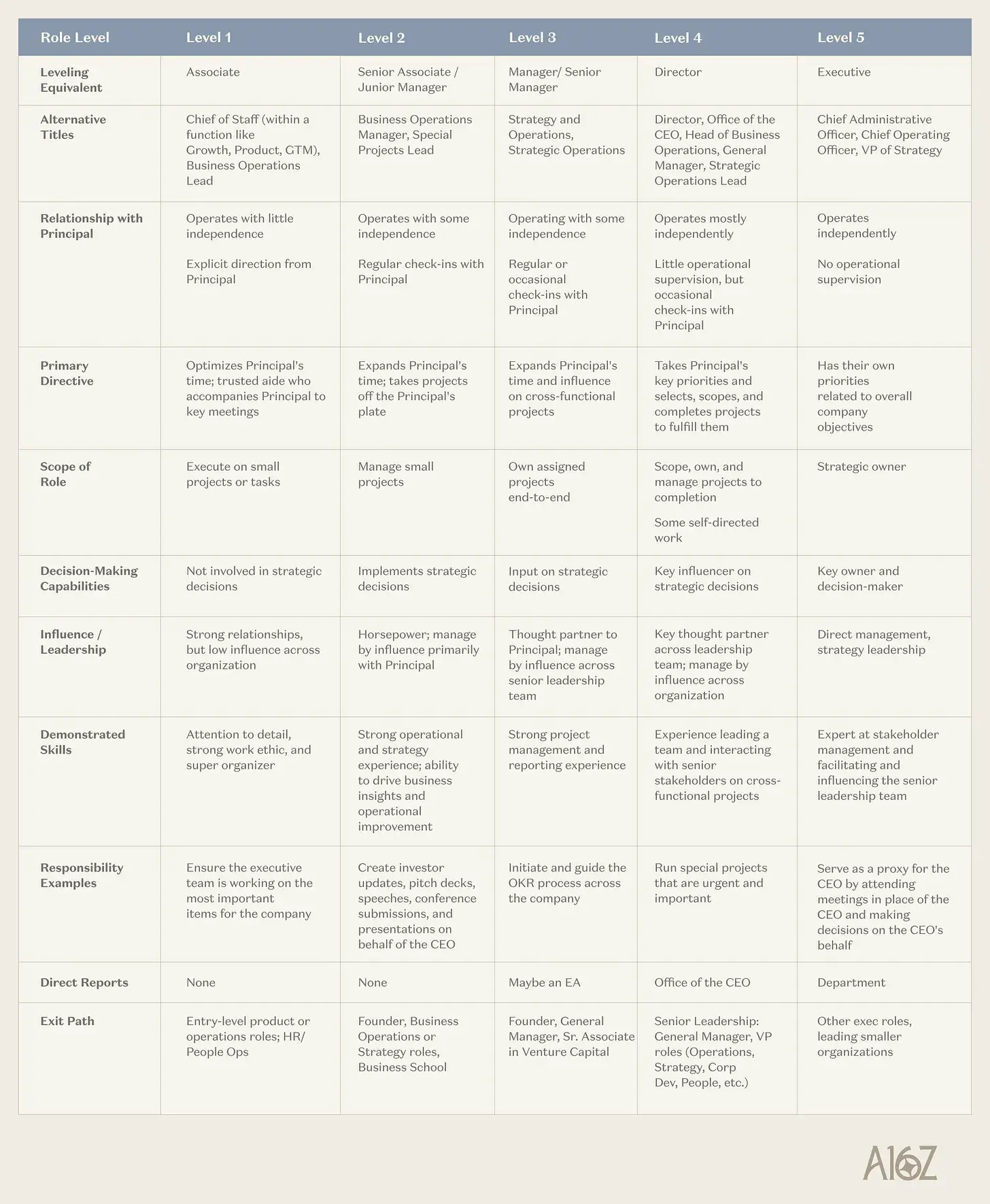
Level 5 is typically an outlier for Chief of Staff roles, especially at early-stage startups. In the table below, you’ll discover more about the scope. While a Level 5 CoS carries greater responsibility, they’re ultimately responsible for a portion of the organization—not acting as a CEO proxy in a management role. C-suite leaders should report directly to the CEO, and lines shouldn’t be blurred.
Below is a visual representation of some ways to level:
? Pro Tip:
Have both the CoS and Executive assess the current role using this framework, then compare notes. Misalignment is common but fixable with the right conversation.
How to use the framework
Start by identifying where the CoS fits today across the three orientations. Use these reflection questions to assess:
- Where are you ahead or behind?
- What do you want to automate, own, or stop doing in the next 12–18 months?
- What would success look like if the CoS leveled up one stage?
- Where are the biggest growth opportunities—with the Executive, the team, or the organization?
Then use the framework to align on expectations, stretch goals, and develop priorities. Referencing a MOC throughout this process will also help get this right.
Role development
The expectations of a CoS shift dramatically as a company grows. A key marker of growth is increasing independence and being able to lead cross-functional work without constant oversight. As this happens, the Executive becomes more of a coach, supporting the CoS as they level up and take on broader ownership.
At Levels 1–2, the CoS typically works under close guidance from their Executive. By Levels 3–4, they operate more autonomously, and check-ins shift from providing direction to aligning on outcomes.
Examples of how the CoS role evolves as the organization scales:
- Early-stage (<50 employees): The CoS is a utility player—filling gaps across HR, operations, or partnerships.
- Growth stage (50–250): As systems break down, the CoS helps build structure and operational discipline.
- Scale-up (250–1,000): The CoS leads cross-functional strategy, owns planning, and drives clarity across functions.
- Enterprise (1,000+): Multiple CoS roles may exist across functions (e.g., CTO, CPO), often collaborating on organization-wide initiatives.
Remember:
Level ≠ title. A Level 2 CoS at a 1,000-person company might operate with the same complexity as a Level 3 CoS at a 250-person organization.
Final notes on leveling
The Chief of Staff role is meant to flex, evolve, and fill the most strategic gaps in an organization. But flexibility doesn’t mean ambiguity has to run the show. Leveling brings clarity around scope, ownership, and impact. It’s not just a snapshot of where your CoS is today—it’s a roadmap for how they can stretch, take on more responsibility, and move up in scope and influence. Whether you’re hiring a CoS or already working with one, this framework offers a shared language to make the role more intentional, more effective, and more valuable.
Archetypes
A CoS can come from all different backgrounds. When you’re sourcing for the role or reviewing inbound interest, don’t discount someone who hasn’t held the CoS title before. For this section, we’ll walk through the common profile types and where they come from.
? Pro Tip:
Regardless of background or experience level, you’re looking for a force multiplier—someone focused not just on doubling outcomes, but on 10x-ing them through processes, tools, and systems.
Here are the archetypes that we have come across:
- Right out of Consulting, Investment Banking, or Private Equity. These candidates are used to ramping quickly across different business models. Their roles are collaborative and intense. They’re not easily fazed, and they have experience working closely with senior leaders and demanding executives. They know what it takes to get things done and are strong generalists.
- Unconventional backgrounds that may seem jumpy on paper, but that variety is a strength. It showcases exposure to multiple business areas, which makes them a strong fit for the CoS role—for example, someone who started as an Account Executive, then moved into Marketing, and later into Partnerships or Growth. They may get bored easily (a good sign), and their curiosity drives them to explore new roles within a company or move between companies.
- Office Manager or Executive Assistant. These individuals may not have had the title, but they’ve done the work. Task-oriented with superb follow-through, they often take on special projects and operate with a self-starter mentality. Close proximity to the executive team gives them both executive presence and influence themselves.
- Former first operational hire at a startup. This person may have held titles like Head of Ops, BizOps Lead, Strategy Lead, or “Lead” roles without the CoS label. This may also be a “serial Chief of Staff” who has seen what needs to get done and wants to do it again. That said, a true “career CoS” is still rare.
- Public service background in military, government, or politics. These candidates bring high emotional intelligence, operational rigor, and deep trust-building experience. They excel at tackling projects, driving results, and then moving on to the next challenge. Put them in a room with anyone, and they’ll find a way to relate and become a trusted ally.
No matter your CoS’s background, they need to be the right fit for you and what the business needs right now. Ideally, they can grow with you and the business over the next 12–18 months. Keep in mind that each archetype’s fit can vary depending on level. This next section walks through what a good fit feels like and how to trust your gut when interviewing for this role.
Assessing candidates
Your CoS will take on a wide range of work—some visible, much of it behind the scenes. That’s why assessing this role requires both qualitative and quantitative inputs, with a strong emphasis on the qualitative. You’re evaluating whether their approach aligns with how you want to scale and automate the business, and how well they can drive cross-functional clarity and execution. While some outcomes will be clear, this is ultimately a competency-based hire. Many strong CoS candidates won’t have held the title before, so your interview process should focus on surfacing transferable skills and enabling fair comparisons across different backgrounds.
Start with defining a Mission, Outcomes, and Competencies (MOC) for the role. We use this framework at a16z for senior hires.
What is a MOC?
In a nutshell, it provides a structured approach to define what success looks like for an important hire over a 12–18 month horizon. A strong MOC gives you:
- Clarity on what the role needs
- Alignment among stakeholders
- Better odds of hiring a top 10% candidate who can deliver on clearly defined goals
- Detailed “outcomes” that can also double as your template for a 30/60/90 performance review after you hire your CoS
Building a MOC might feel like a hefty exercise, but we promise you’ll get a lot of mileage out of it.
Why MOCs matter:
- Prevent failure modes in hiring (e.g., misaligned expectations, weak pipelines, poor candidate experience)
- Bring consistency, rigor, and clarity to the executive interview process
- Enhance candidate engagement and accelerate their ability to make an impact
Since most candidates won’t have “Chief of Staff” on their resume, focus less on titles and more on how their experience maps to the work you need done.
Signs of a great fit
No matter their focus, strong Chiefs of Staff tend to share a few key traits:
- Super organizer: They bring order to chaos and stay on top of the details. They have their own systems of record and practice excellent organizational hygiene.
- Strategic thinker: They can zoom out, see the big picture, and tie their work to company goals. They break down big ideas into manageable projects and execute steps that align with main priorities.
- Reliable closer: They get things done—no dropped balls. You can hand something off and trust it will be handled, no follow-up needed.
- Trusted operator: They handle sensitive information with total discretion. They understand the weight of being in a high-trust role and act accordingly.
- Expert facilitator: They lead conversations, align teams, and move work forward. They often use tools like design thinking to keep projects collaborative and focused.
How to assess candidates
Your MOC gives you a clear blueprint for what you’re hiring for, and your interview loop should map directly to those outcomes and traits. The outcomes and competencies you outlined should shape each interview stage—they’re exactly what you need to assess fit and success in the role.
Create each interview stage based on an outcome you defined in the MOC, and develop repeatable questions for each stage. Since the CoS role blends qualitative and quantitative strengths, make sure your interview process does too. Use scorecards, frameworks, and questions tied directly to the MOC.
Case studies are a great way to assess problem-solving, communication, and how a candidate thinks through real scenarios. Keep it relevant and skip generic 30/60/90 plans—your MOC covers that and they rarely offer signal unless the candidate knows your business already. We recommend syncing with Subject Matter Experts (SMEs) in our network to align on case design and assessment criteria. Every CoS role is different, and the right candidate should balance strengths in ways that match your needs.
? Pro Tip:
Focus on what you need. A candidate saying, “I’ve done this before” doesn’t mean they’ll succeed at your company.
Final interview tips
- Build a scorecard aligned to your MOC. Each outcome and competency you define should correspond to a stage in the interview process. The more specific and quantifiable you can make each one, the better.
- Prepare repeatable interview questions. Tie each question to an outcome or competency in the MOC, and define what “good” vs. “great” answers look like.
- Incorporate a case study or working session. This reveals how your candidate thinks and communicates. Even if they present material you’re familiar with, your follow-up questions should push for deeper insights.
- Don’t underestimate chemistry. This is a trust-based, high-bandwidth relationship. If it doesn’t click in the first few conversations, move on.
? Pro Tip:
Culture fit and trust matter just as much as competencies. If something feels off, trust your gut—it probably is.
Compensation
Compensation for the CoS role can vary widely and depends on several factors that are worth a deeper discussion. We can help with this; reach out.
Conclusion
There’s always more to say about the CoS role, but these are the essentials we’ve seen work well with founders and CEOs. If anything feels unclear or you want to dive deeper, reach out to your Executive Talent team. We’re happy to help you think through the role and connect you with SMEs or CoS networks to support your process.

