First, a quick backstory. I grew up in the Bay Area (went to school and started my career here), left in 2020 to try life on the east coast, and then moved back to SF again eight months ago to join the a16z New Media team.
When I returned, I expected SF to be “back” in all the surface-level ways – Waymos everywhere, college dropouts wispr-flowing into their laptops at Blue Bottle, 23-year-old founders closing deals while strolling through the Presidio.
All of this is true, and more.
But I’ve also noticed an interesting shift that’s happened beneath the surface. SF tech’s social infrastructure is now being entirely run by people who are terminally online – and this is changing everything about how relationships form, how trust gets built, and what happens when people end up in the same room.
The new proof of work is your mutuals
Every social scene runs on proof of work. Eugene Wei wrote about this in the context of social networks, where each new social network issues a new form of social capital, a token, and you must show proof of work to earn it.
It doesn’t matter if it’s a music scene, an art scene, or a tech scene – access has always required demonstrating that you belong. In a jazz scene, you prove it by knowing the canon, sitting in on sessions, paying your dues over years. In an art scene, it’s the galleries you’ve shown in, the critics who know your name, the other artists who vouch for you.
In previous eras of Silicon Valley, proof of work was in conferences, warm intros, and coffee chats. Now, it’s your mutuals.
The social graph gets built online – first through following each other on X, then through joining private group chats. (Serious SF tech folks toggle between dozens of group chats, some of which are highly exclusive).
From there, people start inviting each other to events on Partiful. But even the most “under the radar” events rack up hundreds of people on the waiting list – and the door is managed by a bouncer, like a Soho club. So you have to be early enough to the Partiful invite to get accepted before spots run out – or be mutuals with the host, so you can DM them to get in.
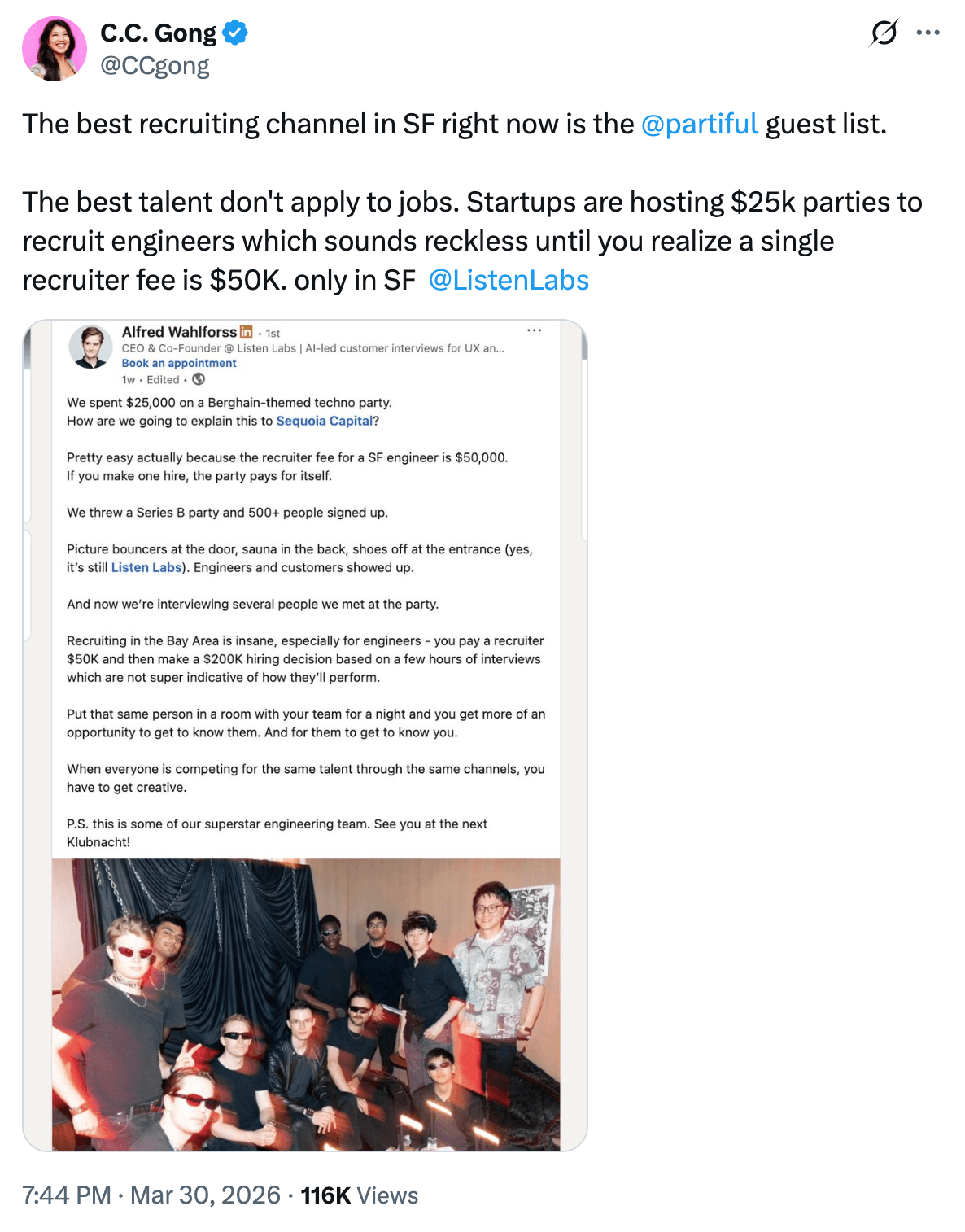
New mutuals, new group chats, new Partiful invites, new friends… and the cycle repeats.
Many terminally online SF tech folks will tell you that they have “hundreds of friends.” What they mean, mostly, is mutuals – people they’ve met once or twice IRL but have been intellectually close to for years online. Listening to each other’s pods, reading each other’s Substacks, laughing at each other’s memes on X.
An astounding number of people have met their romantic partner on X, despite the “single until series B” trend. Not through flirting over DMs or using X as a dating app, but through months of hearing someone think out loud through their online content, discovering shared interests, and eventually ending up in the same room.
One terminally online friend of mine moved to SF more than a year ago and says that he still knows zero (yes, zero) people in SF that he didn’t meet through X, or through events populated by people on X.
Sometimes all it takes is a photo of your mattress on the floor of an empty SF apartment, and the X algorithm does the rest.
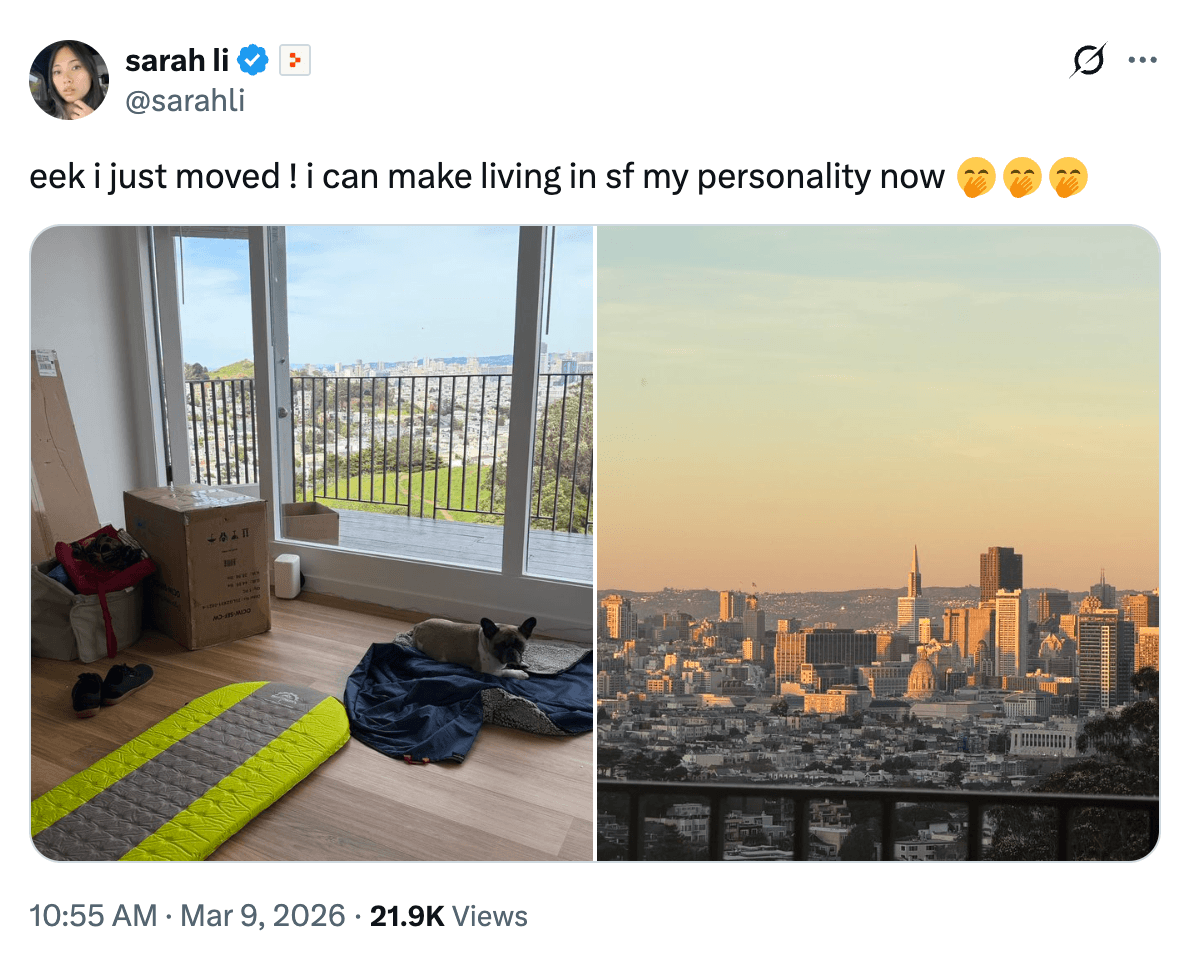
Because the social graph gets built online, SF tech events feel completely different.
In most cities, having exceptional food or ambiance is table stakes for a good party or event. Why? In part, it’s because the venue is doing “social work.” It has an important job to do, which is to create an atmosphere where strangers feel comfortable talking to each other.
In SF, having great food and ambiance feels like icing on the cake but largely irrelevant, because that “social work” has already been done on X. People aren’t there to meet strangers – they’re there to go deeper with people they’ve been thinking alongside for months online. In fact, they often arrive already knowing the last five things the other person posted about. Whoever had a banger tweet that day or ratio’d a major X-poaster walks in with the most cachet.
As a result, SF tech social events are often:
- Hosted in people’s living rooms, backyards, or rooftops – instead of at restaurants or bars
- Sans alcohol, since people already know each other and don’t need much social lubricant to get into the weeds on an interesting topic they read about on X
- Fairly age-diverse, because X and Substack aren’t about life stage – they’re about ideas. If a 22-year-old and a 47-year-old have been going back and forth in the same threads for years, they get the same Partiful invites.
When we launched the New Media Fellowship – aka the “Thiel Fellowship for the terminally online” – we didn’t do nametags, icebreakers, or rounds of intros. Instead, we rolled out an X group chat and let the fellows do what they do best.
And when we met IRL, events were organized via Partiful and hosted in the living room of my apartment in SF. The dinners were unstructured except for a few “tiny talks,” where people would volunteer to stand up and riff for two minutes on a topic they cared about. (Like how to storytell, launch viral products, and, you guessed it… how to grow on X.)
The events felt like walking into the internet.
The obvious question worth asking here is: does this export? If the terminally online are running the SF tech social scene today, is it only a matter of time until they’re running every city’s social scene?
What if the Partiful bouncer, the group chat intro, and the mutual as proof of work aren’t SF quirks… but early signals of how an entire generation is going to build trust, find love, and hire each other?
One thing’s for sure – the terminally online are growing and amassing immense cultural power, both online and offline. And if history is any guide, where San Francisco leads, the rest of the world will follow.