As a new founder with a fledgling startup, you have an obvious problem. The thing all startups need is preferential attachment – for the best customers, hires, and fans to all want to preferentially attach themselves to you. But you don’t have any signal yet. And people usually attach to high-signal stories, not the low-signal ones. So how do you bootstrap yourself some signal?

The thing about signal is, it works very differently in environments of scarcity (which is what most business advice / marketing playbooks assume), versus in environments of abundance. which today’s tech scene really is. In environments of scarcity, signal is about what you have. But in environments of abundance, the strongest signal is what you give away.
For the people you’re trying to attract — the best engineers to join your ranks, the best customers to buy your products — they live in a world of abundance. They have more choices than they know what to do with. Your reality is one of intense competition for their attention. And in that world, the strongest signal isn’t what you broadcast about yourself — it’s what others say about you in their most authentic exchanges with one another.
Once you really understand this, there is a playbook you can run, which we call the “Lighthouse Playbook”:
- Find the people who are aligned with your brand, and who could be giving something valuable away to the people you want to reach. (The cracked engineer who works for you but no one’s heard of – as soon as people hear from them they’re like, “wow, this guy is a boss, how do you find him?”) These people will be your lighthouses.
- Find some way to give those people something useful to build their own brands. Give them a platform, open doors for them, do anything to be useful for them. If you do this well, your signal will reach your intended audience, but in their voice, in a really authentic way.
Now, what you’re not doing here is “influencer marketing”. You’re not asking your lighthouses to do sponsored marketing, or endorse your product, or anything like that. That only works in a world of scarcity. In the world where we operate, it waters down your signal, and comes across as lame and inauthentic.
We’re sharing our notes on how to run the Lighthouse Playbook here, because we often see it lumped in or combined with generic “influencer marketing” playbook advice, and we think they’re actually opposites. Here’s what we’ve learned:
The Mechanics of Preferential Attachment
Some people joke on the a16z New Media team that my job is to be the “preferential attachment” guy. For example, everything we’re doing at a16z Build is to help talented people looking for the next thing preferentially attach to exactly the right people and ideas that they need to take their next step.
When you’re further along the way as a startup, that problem doesn’t change. It actually gets bigger! You still need the good people and ideas to preferentially attach to you. As Marc put it: “A startup needs to get into a loop where it’s accruing more and more resources as it goes… the question becomes how do you get that process started, to the point where the next resource you need is more likely to attach to your thing as opposed to somebody else’s.”
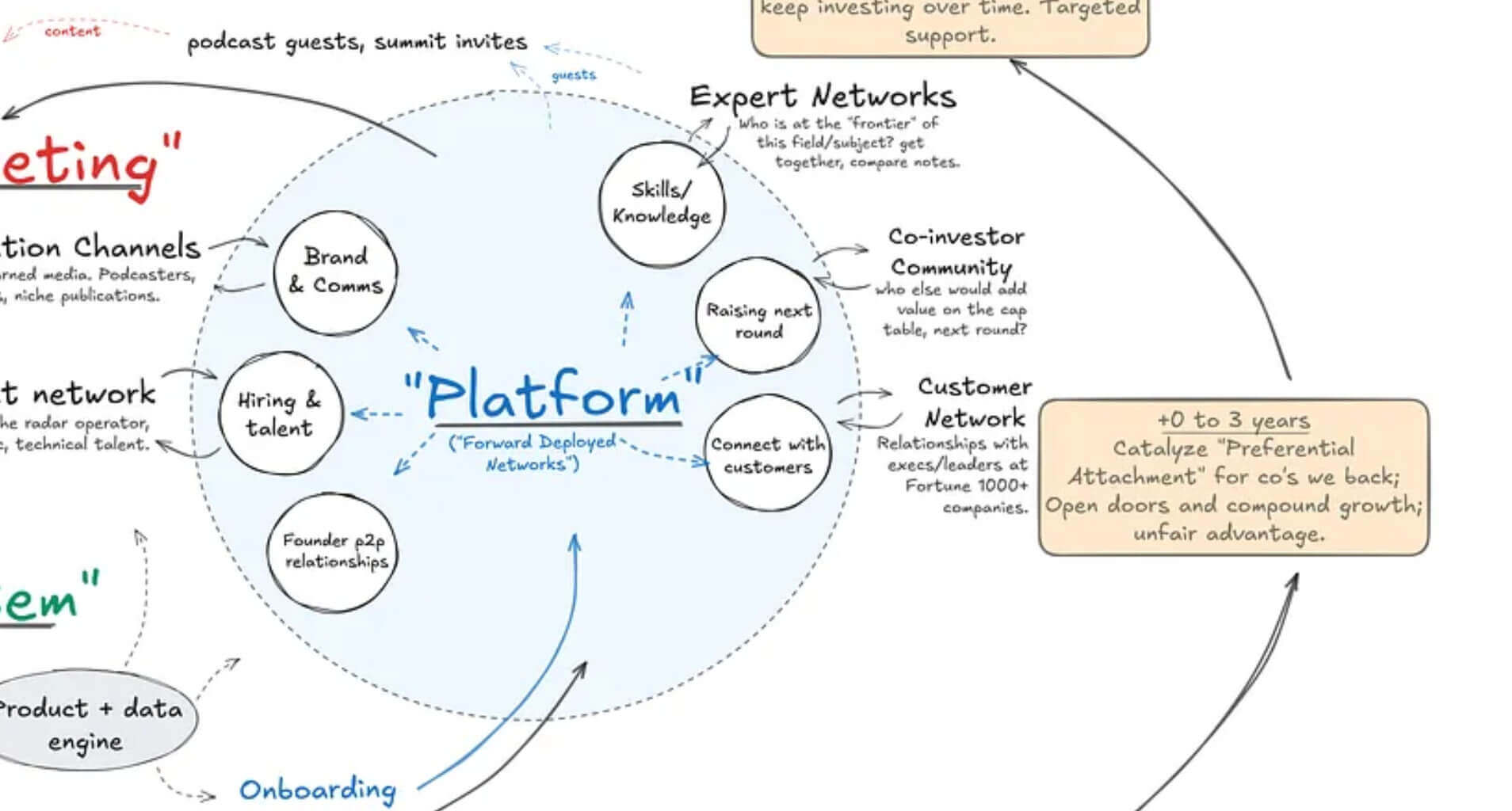
If you zoom in on that big flowchart I posted when I joined a16z, you’ll see how much of the important sauce is about preferential attachment, opening doors for hiring, customers and peers.
The thing that makes preferential attachment so interesting—and so frustrating—is that it’s fundamentally about trust transfer. When a company is early, or when a person is early in their career, there’s a credibility gap that must be bridged every single time they try to attract something they need. Talent. Customers. Capital. Partners. Every conversion requires trust that hasn’t been earned yet.
The traditional way you acquire signal is to build a brand by brute force: spend more on recruiting, buy more ads, get more PR. This works, sort of, in the way that pouring water on a fire eventually puts it out—inefficiently, expensively, and with a lot of collateral damage. In a world of scarce signal and opportunity, this may be your only choice. So I understand why your standard marketing playbooks go after every possible way to do that, including hiring other people’s brands (e.g. “brand ambassadors”, affiliates, influencers, however you want to call it) to boost your own.
But there is a better way! We are so lucky to get to work in tech where there is an abundance of choice, an abundance of signal, an abundance of opportunity. If you flip your mindset from “build my signal” into “build other people’s signal who are complimentary to me”, you both win together.
This works because, first and foremost, it answers the obvious but essential question: Who do the people you want to attract already trust, and what would make them trust you?
Emphasis on the second part of that sentence: “What would make them trust you?” Product endorsements, no matter how sincere, do not really build trust. What does build trust is showing, through your actions, that you helped someone, without asking for anything in return. (This is why angel investing is such a positive-sum activity, by the way, but that’s another topic.)
What Is a Lighthouse?
Your lighthouses are the people who:
- Are already aligned with your mission and aboard your ship.
- Are respected within the networks you care about, or have the potential to be.
- Have something authentic to say—a real story, real expertise, real credibility, relatable journey.
- Critically – can be made more influential, more respected, more visible with your help. Maybe they’re under the radar today, but are someone this network should know.
Depending on your goals, this person may be a design partner or key customer, a team member, or an advisor. Maybe it’s even you or your co-founder. What’s important is that they are someone that is high-signal in the area you care about (for example, with prospective customers or hires). Think about who a good lighthouse would be in your world. I’ll bet you that the people who come to mind first are people who are really generous with their time, with their ideas, with their knowledge; they are people who naturally practice “abundance mindset”.
Your job is to give them anything that will help them be even more effective at what they’re already doing, in a way that advances your worldview along with it. This second part is important, because you’re not doing this just to be altruistic and nice; you have goals here.
Here are the four steps you need to do to make this work, including the final step where a16z Build is explicitly helping:
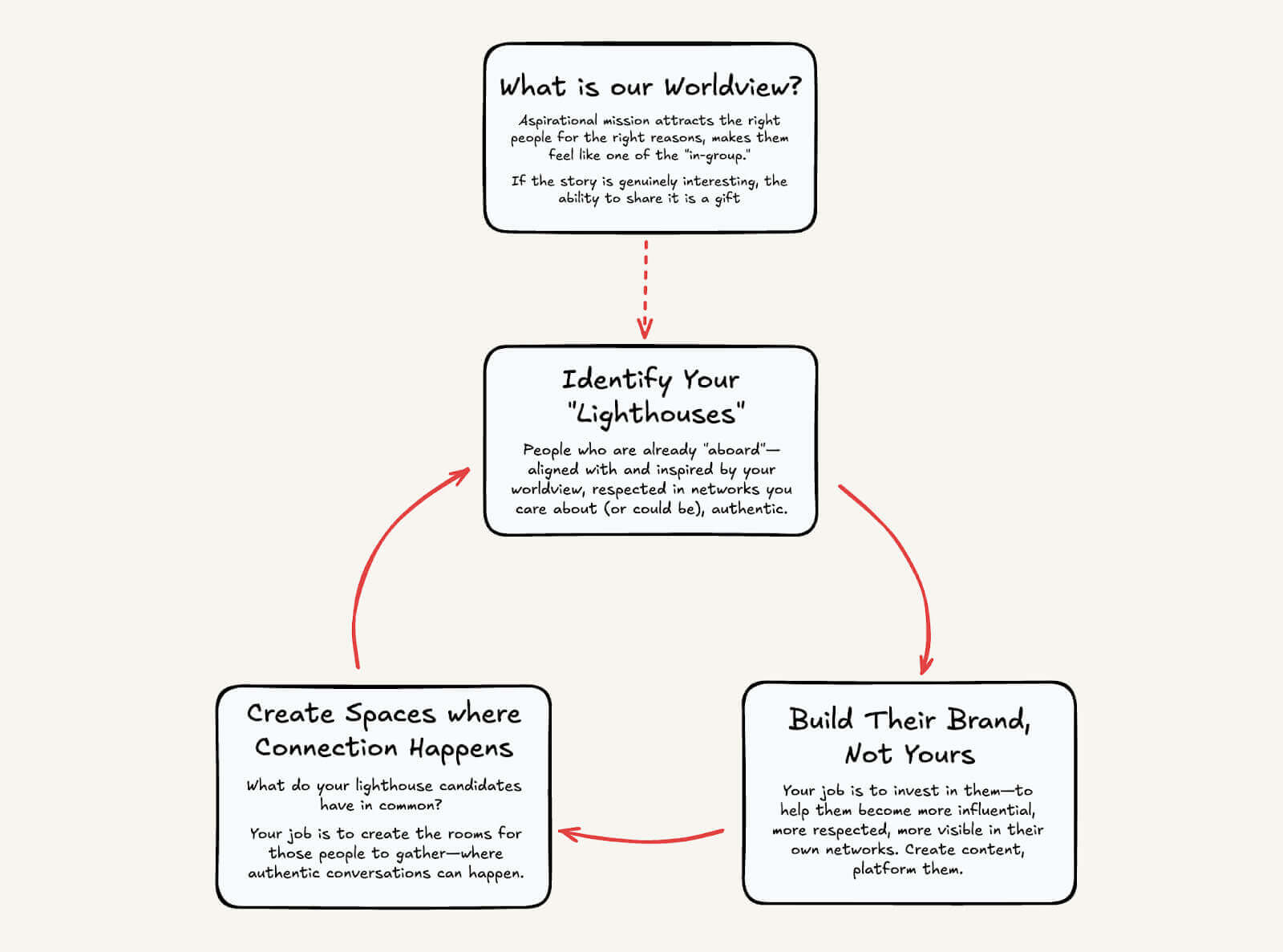
Step 1: Define Your Worldview
This could be even “step zero” – because it’s table stakes. Before you think about growth or hiring tactics, ask yourself: “What is our aspirational identity and mission that will resonate constructively and unselfishly with the people that we want to attract?”
This is not about messaging or positioning in the traditional sense. It’s about developing a worldview—a way of thinking that makes people feel part of an in-group, at the frontier of something important. Almost like building a cult, but one organized around a compelling vision of the future. This step is important, because this will be the brand of what you give away freely, and that becomes your signal.
Consider Linear. Using Linear tells the world something about you: that you care about craft, that you believe the old way of building products is broken and there’s a better way, that you’re at the frontier. It’s identity signaling as much as it is software adoption.
Or look at Stripe. Not “building payment processing infrastructure”—increasing the GDP of the internet. That’s an aspirational mission people can attach themselves to. It says: we’re not optimizing within the existing system, we’re expanding what’s possible. Stripe did this from the very beginning, and that’s a big part of why they were so high signal since day one.
This matters because the narrative is what allows your lighthouses to shine your signal without it feeling like marketing. If the story is genuinely interesting, sharing it is a gift. If it’s just product positioning, sharing it is a favor—and favors don’t compound.
Step 2: Identify Your Lighthouse Candidates
Look for people who are already “aboard”—already aligned with and inspired by your narrative—who you want more of:
- Your head of engineering, who wrote the technical architecture that your business sits atop of, and has their own network of influential peers
- A customer whose success story is genuinely remarkable—the fastest growing AI startup in their region or vertical
- An early employee whose career trajectory represents what you’re offering others
- An advisor who believed in you early and whose judgment others trust
You might be puzzled that some of these examples are “your own employees”, but think about it: your own employees should be your best lighthouses. You’re giving them a really compelling worldview; they in turn give their peers and network gifts of expertise and tacit knowledge (which they’d be doing no matter who they worked for, if they’re really special people): your job is to make sure your mission shines from their lighthouse.
Counterintuitively, the best “lighthouses” may not be well known before you start building their brands – many won’t yet have blogs, social profiles. Maybe your best lighthouse is the crazy cracked engineer who works for you but no one’s heard of — and when you pull back the curtains and build them a brand everyone’s like “this guy’s a BOSS, I want to work with THEM!”
Consider Kris Rasmussen at Figma. He was advising the company before joining full-time, came on at Series A, and saw them through to IPO. His trajectory became a signal to other technical leaders: this is the kind of opportunity where a high-potential candidate can achieve more than they would as an experienced VP elsewhere. His story recruited others like him.
Step 3: Build Their Brand, Not Yours
What does this look like in practice?
For a customer whose company is on a rocketship trajectory: don’t just write a case study about how they use your product. Help them become the person who tells the definitive story of that growth trajectory. Get them on podcasts. Connect them with conference organizers. Record their talks, clip them, amplify them. When they become the go-to voice on a topic, you benefit—but so do they.
For your head of engineering: don’t just have them write internal documentation. Help them publish the thinking that would make the engineers you want to hire say “I need to work with that person.” Push the whitepaper they wrote into the channels where people will geek out on it. Get them on podcasts that “their people” regularly consume. Partner with CS departments at top colleges to share their work as pre-reading for guest lectures. Build their reputation.
Databricks executed this playbook exceptionally well—consistently investing in making their technical leaders visible and respected voices in the data community, not just spokespeople for the company.
The difference between this and “brand ambassador” programs or “customer marketing” is authenticity at the core. You’re not asking people to say nice things about you. You’re giving them platforms to say true things about themselves—and in doing so, making them into lighthouses that attract others like them.
Step 4: Create Spaces where Magic Happens
Isolated lighthouses are useful, but networked lighthouses are transformational. This is where community comes in.
Your end goal, when you’re running the lighthouse playbook, is to reach your final destination: being the talking point in the room with both your lighthouses and their peers who are your target customers, hires or prospects. This is where all of your work will pay off. And the more interrelated your network is, the more cross-relationships that can be developed and woven into your worldview, the more you and your network can all find common cause, co-sign for each other, and preferentially attach all together. (Which is your goal!)
You can get started on this early. Think about what your lighthouse candidates have in common. Let’s say your customers are marketing leaders in Europe. Maybe it’s that they’re all struggling with similar operational challenges but have never had a room to realize that. Your job is to create the rooms for those people to gather—where authentic conversations can happen. Regular dinners, small forums, intimate gatherings organized around genuine shared interests.
What happens in these rooms? Organic, in-person testimonials—the best kind. Not “our sponsor would like us to mention that…” but “hey, have you looked at what we’re using for this? Let me tell you about it.” Trust transfers happen when trusted people talk to each other, co-sign with each other, and preferentially attach as a group.
What I’m doing on the a16z New Media team is to help accelerate a lot of this stuff for you – both for existing companies running their lighthouse playbooks, and for even earlier-stage prospective founders with a16z Build. We can’t create signal for you – that’s your job, only you can do that. But we can make a lot of the mechanics of assembling your lighthouses, creating spaces for trust and serendipity, and in-person co-signing just happen more easily. And we can help do this across our entire network of amazing founders and builders.
Step 5: Repeat.
This is where the cycle compounds.
Prospects see someone they respect thriving with your product. New hires see their future, aspirational peer – someone they trust thriving at your company
Inbound leads arrive pre-sold — they already trust you by proxy, through their relationship with your lighthouse. Top engineers seek you out — they want to work with, learn from that person
New customers, new hires become lighthouses themselves, expand and open up new networks of trust.
Homesteading your network
This whole thing can feel backwards. You’re trying to grow. You need customers, talent, attention. So naturally, you want to tell your story, amplify your brand, get your name out there. But that’s exactly the wrong instinct.
There’s an old lesson from Google’s early days: if you want people to trust your search engine, get them off of it as quickly as possible by showing them the right link. Trust comes from people clicking away from your website, not to it. Bloggers know this too—the pieces where readers click a lot of outbound links are the ones that build the most trust and loyalty.
The same principle applies here. In worlds of abundance, status is what you give away. If you can give away a really compelling and organizing narrative—if you can genuinely invest in making other people more successful and more visible—that’s the thing that compounds.
There’s a long history in tech of practicing and celebrating this notion of “Abundance culture”, going back to the Free Software movement in the early 90s, which went deep into the philosophy and mechanics of “how do things like reputation, signaling, and exchange work in environments of plenty?”, and laid the cultural groundwork for today’s tech industry, where everyone has so much choice, so many ideas and people you could preferentially attach to.
For builders today, supporting other people’s signal and reputation is the essential conduit for building your own, even if you’re starting from nothing. Anyone can write a customer testimonial. Anyone can build a careers page with talent profiles. Few will selflessly, authentically invest in another person’s brand directly. That’s what makes this work.
The Underlying Truth
AI might be lowering the cost of prototyping and building products towards zero. But it hasn’t done anything to change the cost of marketing, or attracting people to you, hiring people, or building a culture people want to work for.
Because people don’t trust companies. They trust people. And the way trust scales is not through broadcast messages from brands, but through the visible choices of people they already trust.
When someone you respect makes a move—takes a job, adopts a product, joins a community—that transmits information. It says: this thing passed the filter of someone whose judgment I value. That signal is worth more than any advertisement.
The Lighthouse Playbook is simply a systematic way to generate more of those signals by making the people who’ve already chosen you more visible, more successful, and more respected.
Build their brands. They become lighthouses. The lighthouses attract others. And eventually, you find yourself at the center of a network that wants to preferentially attach to you—not because you told them to, but because that’s what all the people they admire have done.
That’s the flywheel. That’s how you turn growth from a brute-force problem into a compounding one.
Thanks to Gonz Sanchez for inspiring and providing early feedback on this post & concept.