Three years ago, we published the first edition of this list with a simple goal: identify which generative AI products were actually getting used by mainstream consumers. At the time, the distinction between “AI-first” companies and everything else was clear. ChatGPT, Midjourney, and Character.AI were purpose-built around foundation models. The rest of the software world was still figuring out what to do with the technology.

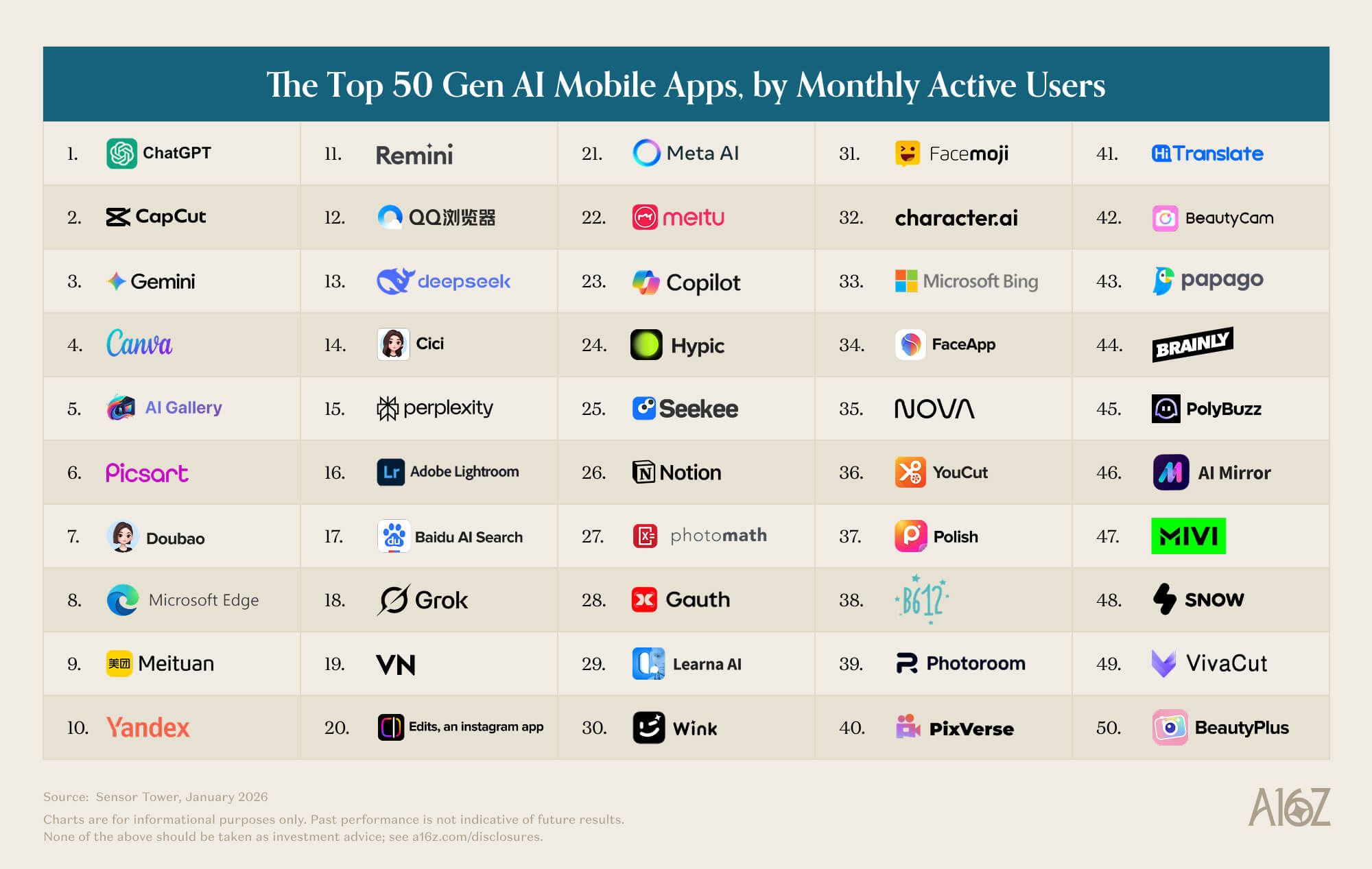
That distinction no longer holds. CapCut, a video editor with 736 million monthly active mobile users, relies on AI for its most popular features — background removal, AI effects, auto-captions, and text-to-video generation. Canva has built its entire growth engine around its Magic Suite of AI tools. Notion has seen its paid AI attach rate surge from 20% to over 50% in a single year — AI features now account for roughly half of the company’s ARR.
From this edition onward, we’re broadening the aperture to include any consumer product where generative AI has become a core part of the experience — including CapCut, Canva, Notion, Picsart, Freepik, and Grammarly. The result is what we believe is a more accurate picture of how people actually use AI, though the bulk of the top products continue to be AI-native.
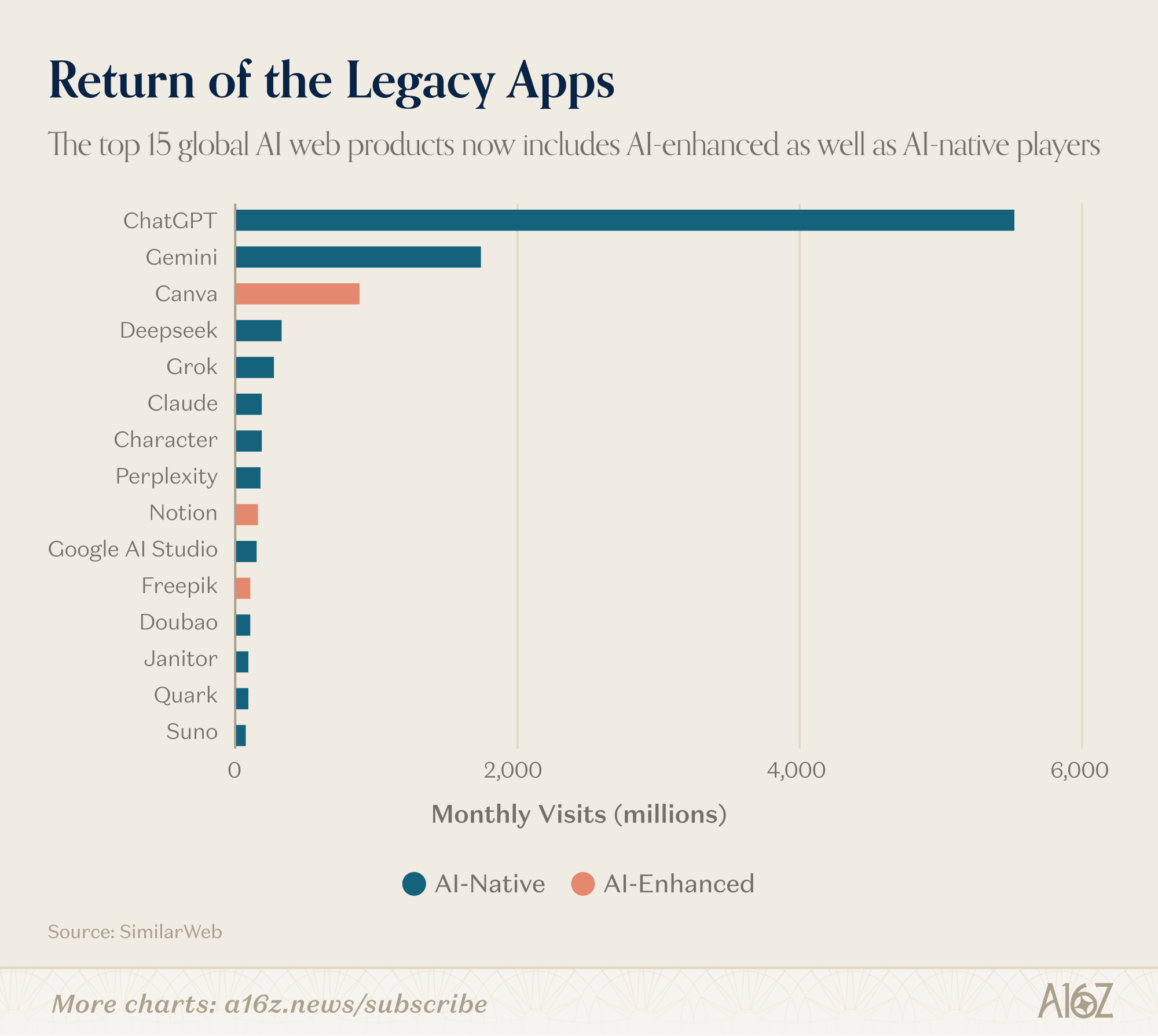 As always, our web ranking is based on unique monthly visits, per SimilarWeb as of January 2026. Mobile apps are ranked by monthly active users, per Sensor Tower as of January 2026. Here are our top takeaways:
1. ChatGPT leads but the race for the “default AI” is on
ChatGPT is still far and away the largest consumer AI product. On web, it is 2.7x larger than the #2, Gemini (measured by monthly traffic) — and on mobile, it is 2.5x larger (measured by monthly active users). ChatGPT has seen weekly active users grow by 500 million people over the past year to 900 million today. This is especially impressive given growth is difficult to maintain at scale — over 10% of the global population now utilizes ChatGPT every week.
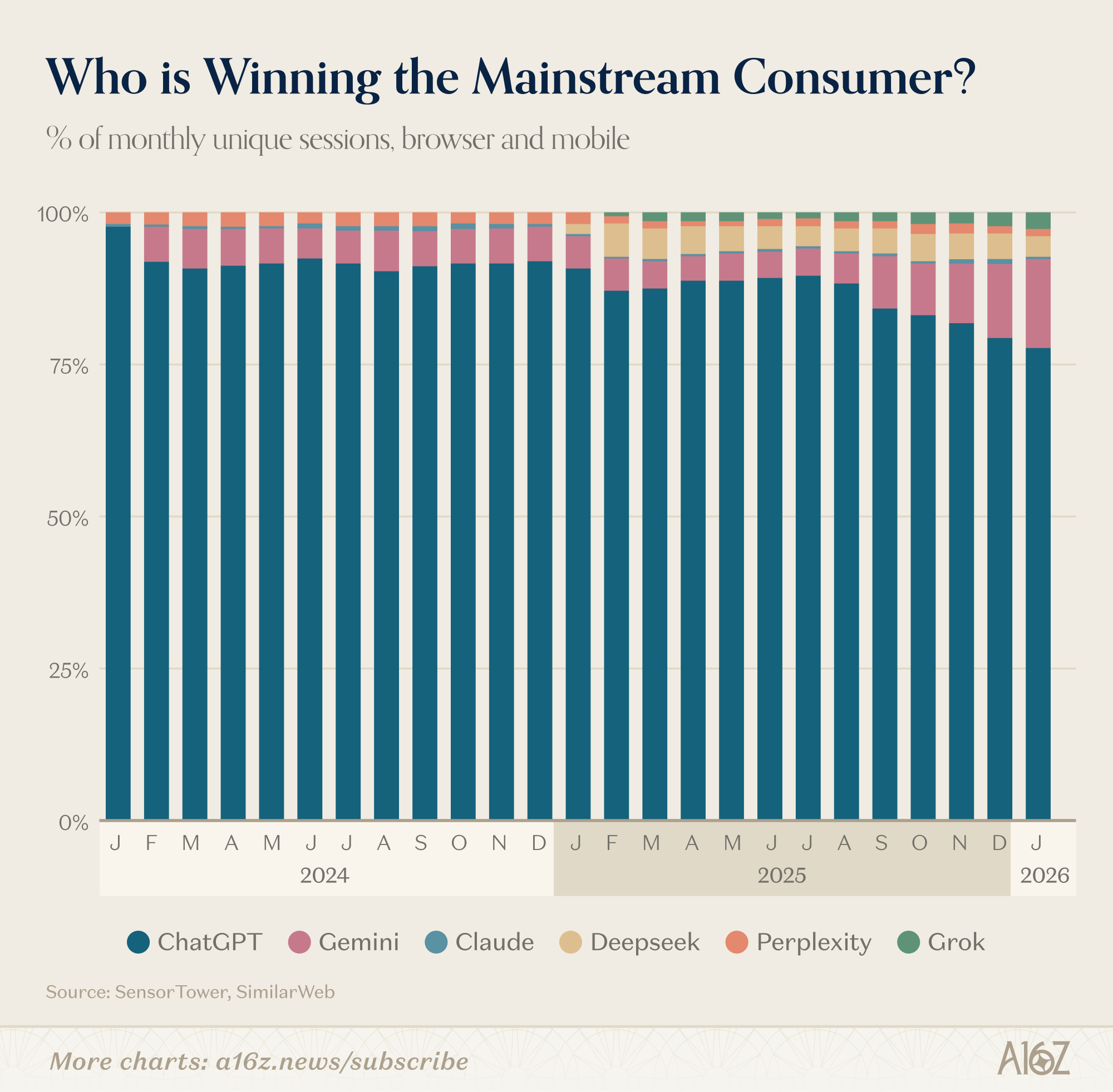
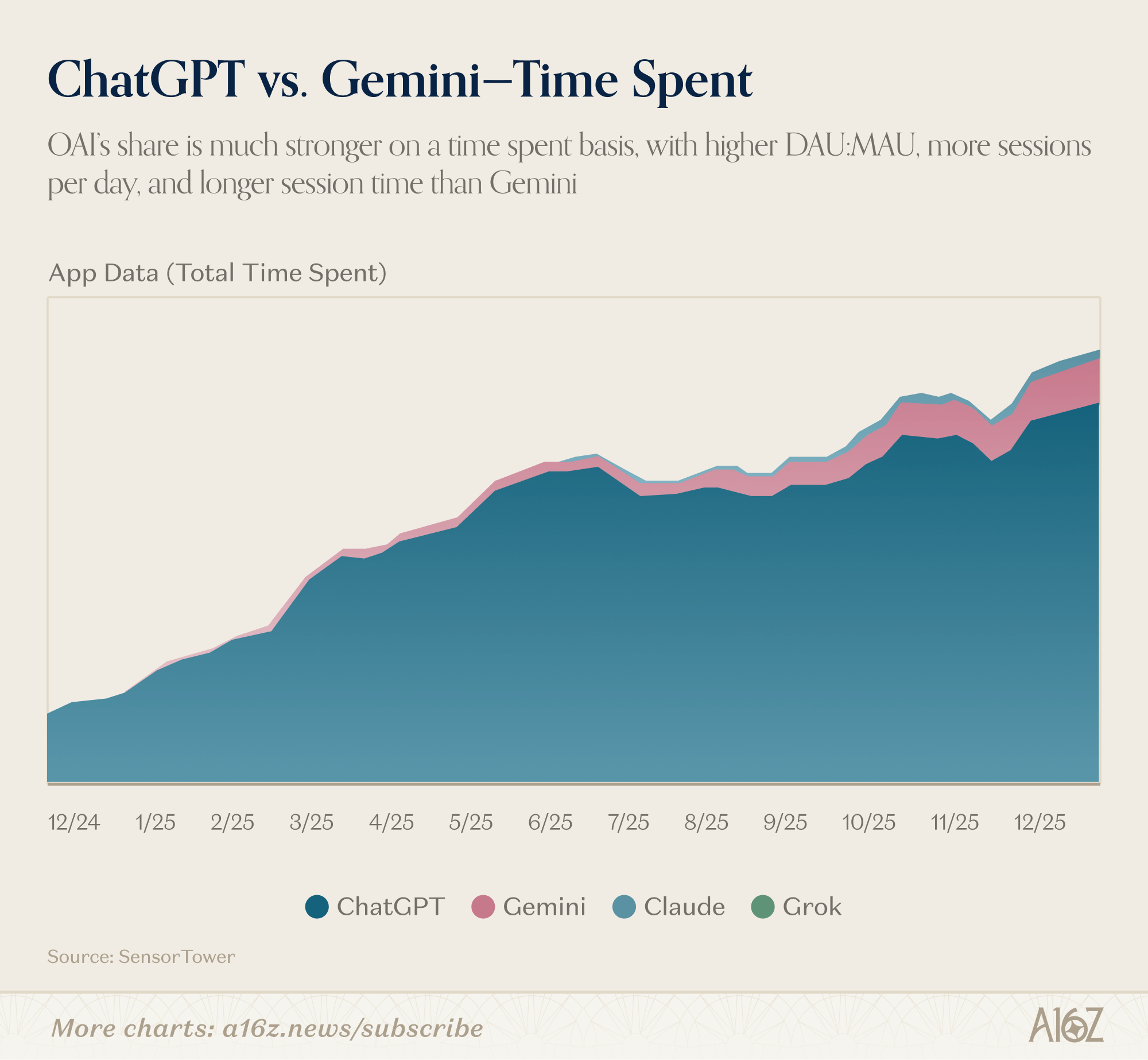 But we’re starting to see the category widening, with other horizontal platforms picking up steam for specific use cases. Both Gemini and Claude have seen an acceleration in their U.S. paid subscriber growth over the past year (though still dwarfed by ChatGPT — which is 8x larger than Claude and 4x larger than Gemini on this metric). Per Yipit Data, as of January 2026, Claude was growing paid subscribers by over 200% YoY — while Gemini was growing 258%. And, we’re seeing increasing multi-tenanting behavior — with roughly 20% of weekly ChatGPT web users also using Gemini in a given week.
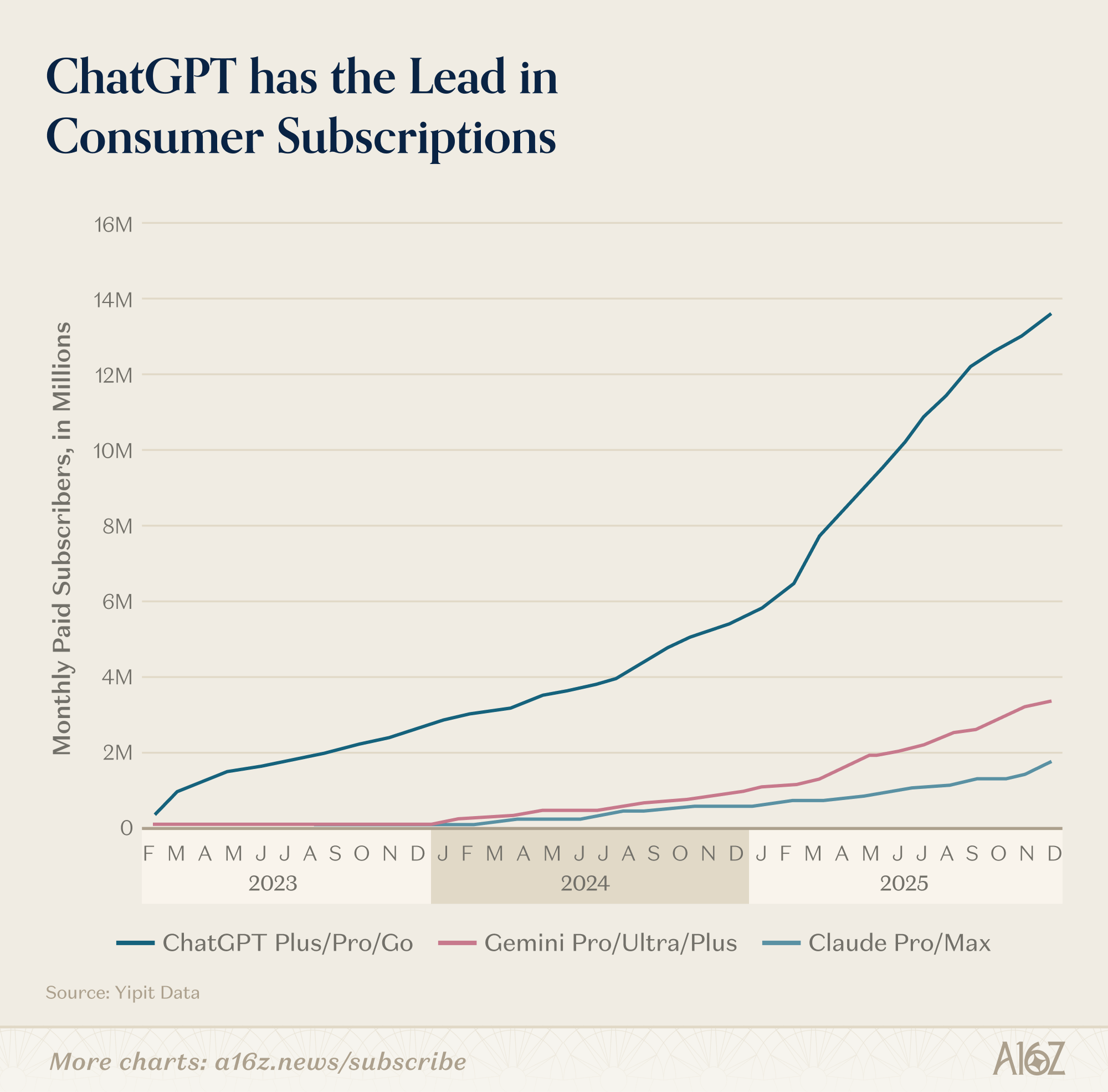 What happened? The competitors shipped. Google crushed its creative models — Nano Banana generated 200 million images and brought 10 million new users to Gemini in its first week, and Veo 3 was widely regarded as the breakthrough moment for AI video. Anthropic doubled down on the prosumer with Cowork, Claude in Chrome, plug-ins to Excel and Powerpoint, and — most notably — Claude Code.
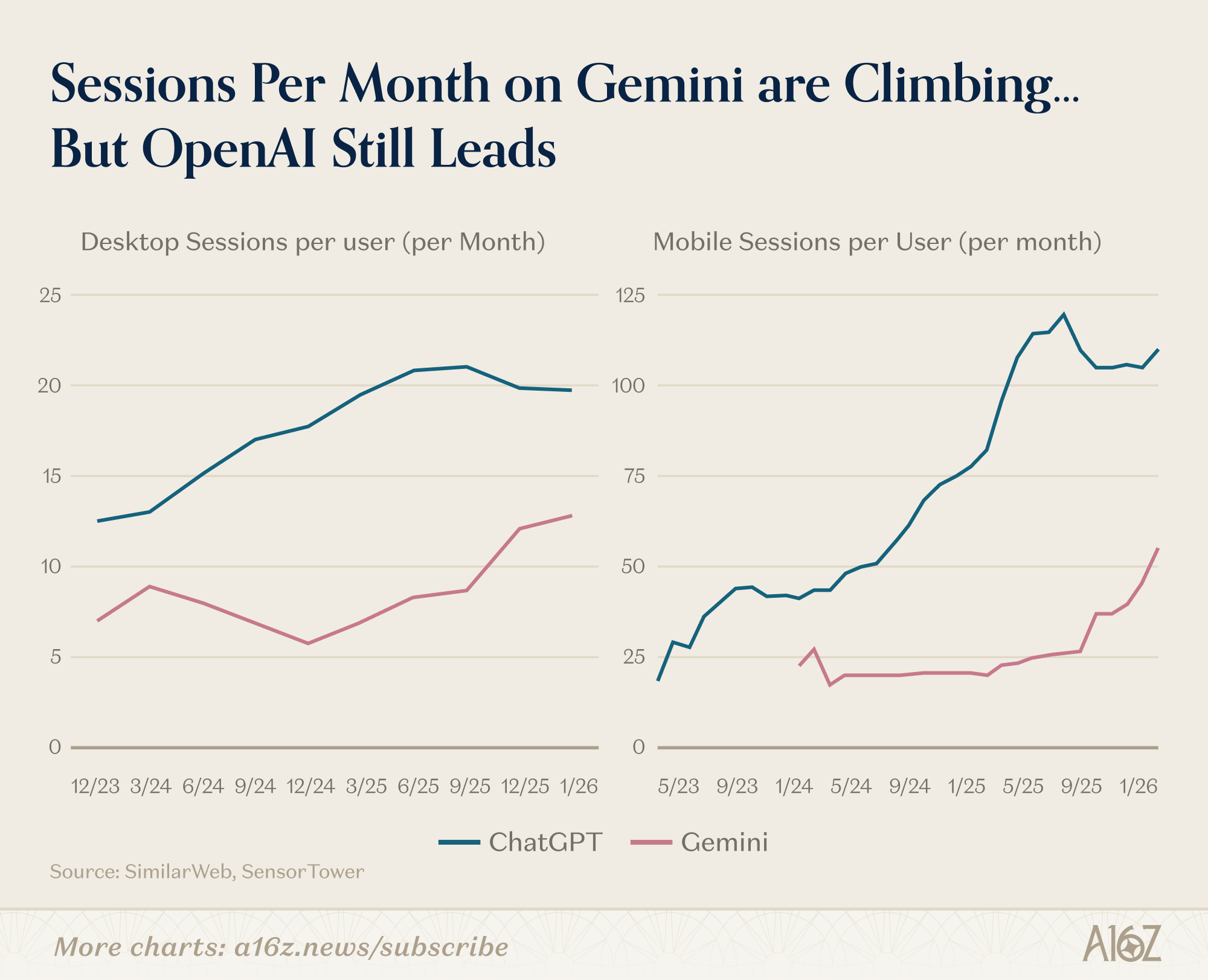
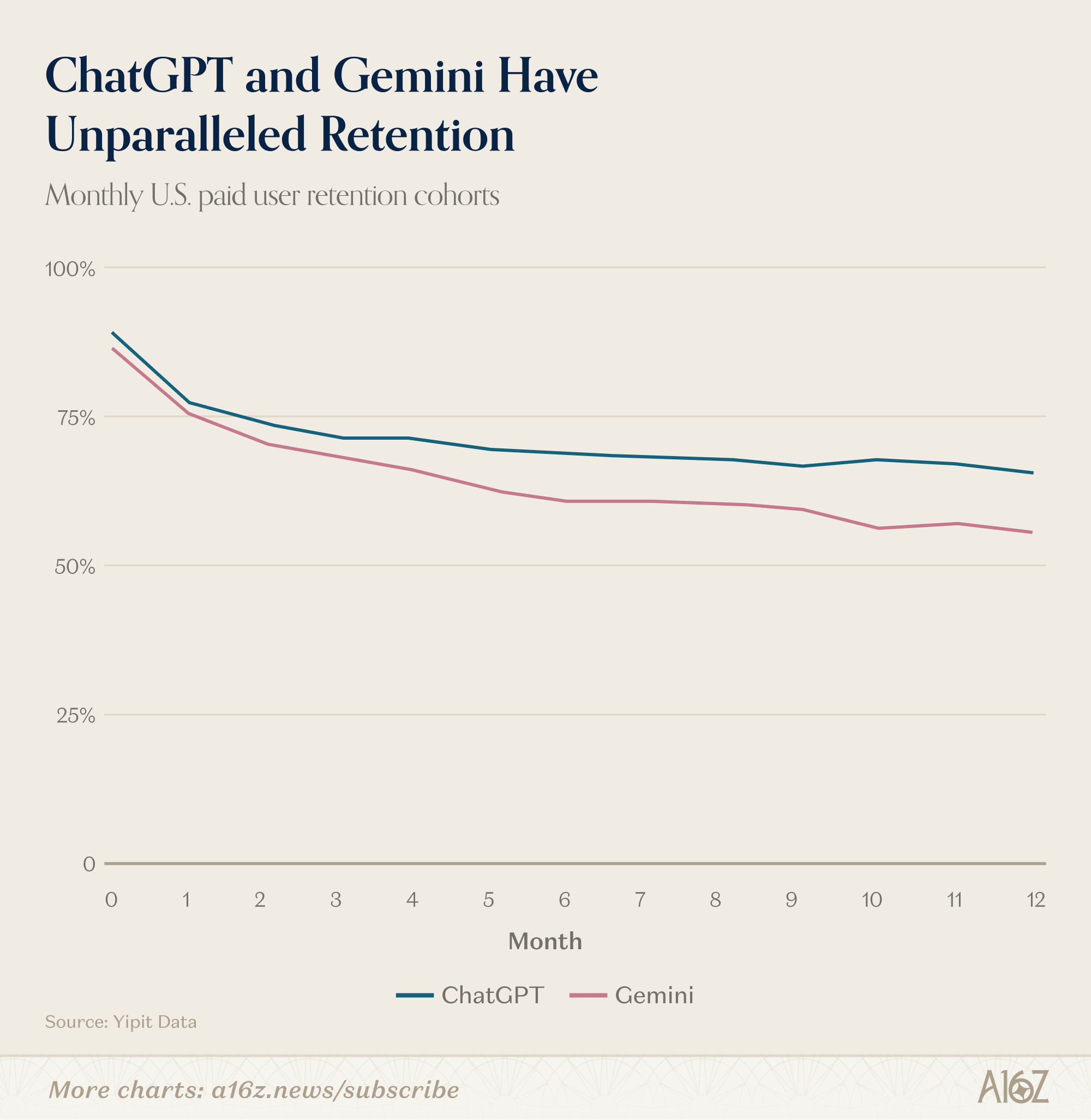
The race matters not just for who leads today but for who becomes structurally difficult to displace. Context compounds: the more an LLM knows about you, the better results it can provide and the more you use it. Early data suggests that sessions per user per month are climbing for Gemini on web, though they’re still 1.3x higher on ChatGPT — and on mobile, ChatGPT dominates with 2.2x higher sessions per user per month. Both companies show best-in-class consumer paid subscriber retention in the U.S., per Yipit Data.
 The next layer of lock-in is the app store. ChatGPT and Claude have both launched connector ecosystems — GPTs and Apps for ChatGPT, MCP integrations and Connectors for Claude — that let users build workflows on top of the assistant. Once a user has configured their AI to talk to their calendar, email, and CRM, switching costs rise dramatically. Developers may concentrate their efforts on the platforms that attract the most users, creating the same kind of flywheel that defined earlier platform wars.
We’re already starting to see where each platform is heading. Sam Altman has previously said OpenAI wants to “bring AI to billions of people who can’t pay for subscriptions,” which is why they’ve launched ads — and he’s stated that OpenAI will launch a “Sign in with ChatGPT” identity layer, positioning the assistant as the default interface between consumers and the internet. The ambition is to make ChatGPT the starting point for everything: shopping, booking, browsing, health, and daily life.
The app directories already reflect this. As of late February, ChatGPT’s includes 220 apps across 13 categories. Claude has ~160 curated connectors plus ~50 community-built MCP servers. But the two share just 41 apps in common — roughly 11% of the combined catalog — and those 41 are almost entirely the horizontal productivity stack everyone needs: Slack, Notion, Figma, Gmail, Google Calendar, HubSpot, Stripe.
Beyond that core, the platforms diverge almost completely. ChatGPT has 85+ apps across Travel, Shopping, Food, Health & Wellness, Lifestyle, and Entertainment — categories where Claude has virtually zero. These are consumer transaction categories: booking flights on Expedia, ordering groceries through Instacart, browsing listings on Zillow, tracking nutrition on MyFitnessPal. It’s the most aggressive play any AI company has made to become a consumer super-app. Claude’s exclusive integrations skew toward the professional: financial data terminals (PitchBook, FactSet, Moody’s, MSCI), developer infrastructure (Sentry, Supabase, Snowflake, Databricks), science and medical tools (PubMed, Clinical Trials, Benchling), and a growing open-source MCP community that has no ChatGPT equivalent.
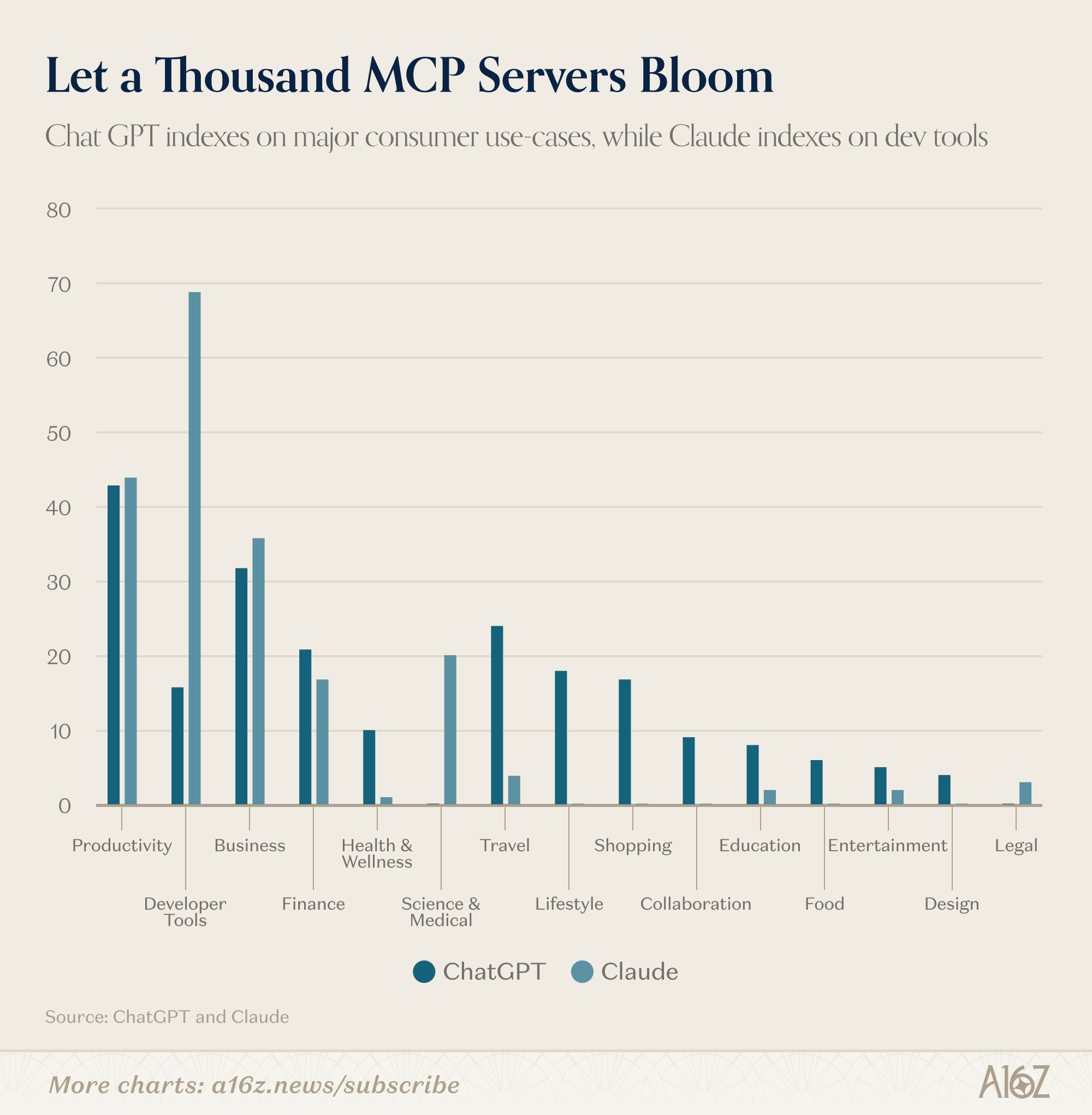 Anthropic appears to be focused on the AI power users (developers, knowledge workers, etc.) These users are more willing and able to pay for higher cost, direct subscriptions now. While ChatGPT has products catered to the same audience (ex. Codex, Frontier), they have also indicated a desire to be the platform for the true mainstream user — which may open up more avenues for monetization as the base continues to grow. They are already testing ads, and a take rate on transactions would also be a natural expansion.
If the AI assistant becomes not just a chat window but an operating environment, this race may end up looking less like the search wars — where one player took 90% of the market — and more like the mobile OS wars, where two platforms with very different philosophies both built trillion-dollar ecosystems.
2. Global usage is splintering by product
Geographically, the AI market is splintering into three distinct ecosystems, and the gaps between them are widening.
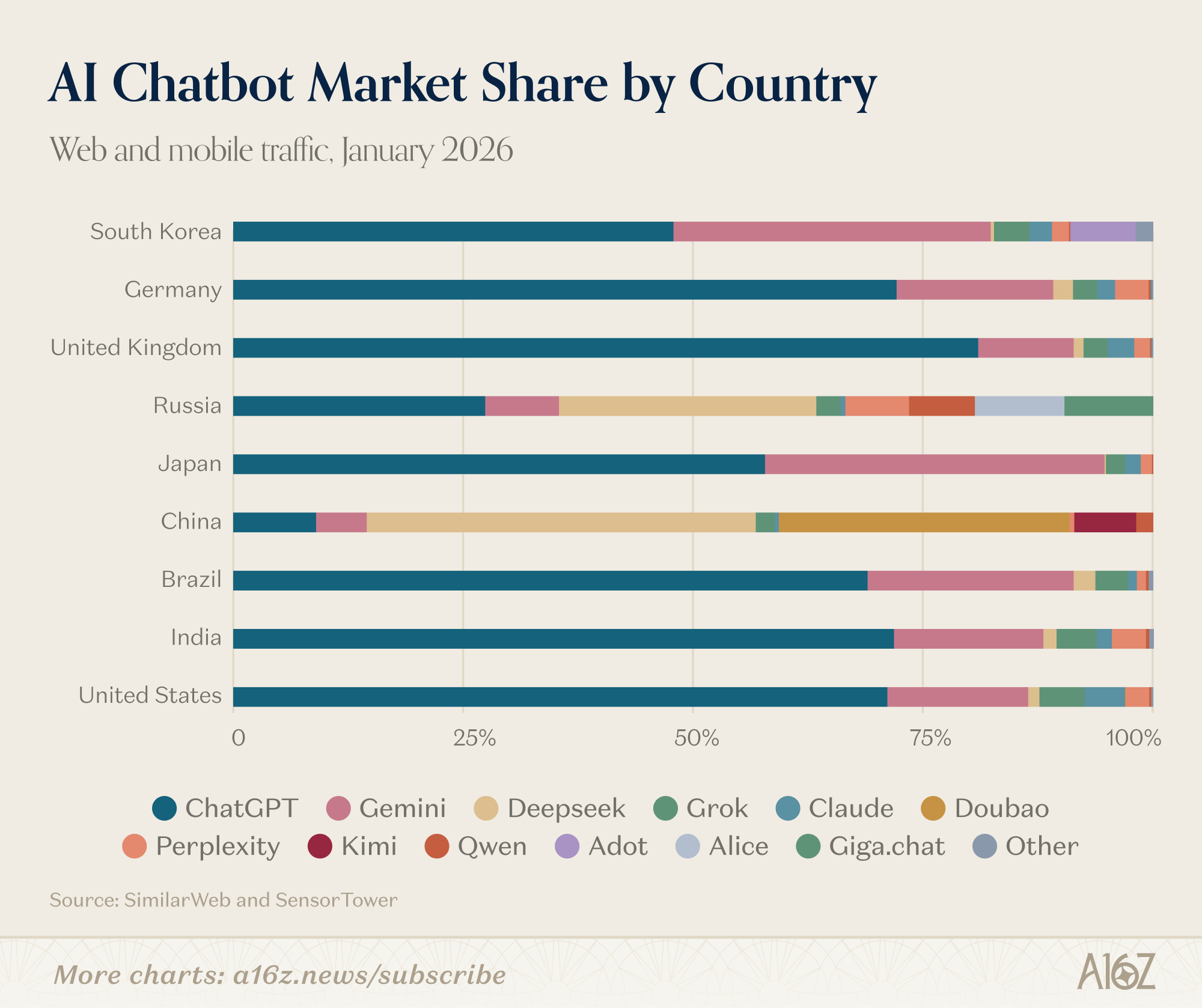 The Western AI tools continue to share a remarkably similar user base. ChatGPT, Claude, Gemini, and Perplexity all draw their top markets from the same pool: the US, India, Brazil, the UK, and Indonesia, in varying order. None has meaningful usage in China or Russia. This is a function of policy — Western tech sanctions have restricted access to US AI tools in Russia since 2022, and China requires AI providers to register, host data onshore, and comply with censorship rules.
DeepSeek is the only product that bridges the divide. Its traffic splits across China (33.5%), Russia (7.1%), and the US (6.6%) on web, with a similar pattern on mobile. China is also a heavy user of Bytedance’s Doubao and homegrown Kimi.
Russia, which barely registered as a distinct market in our earlier editions, has emerged as a third pole with the second highest rate of Deepseek saturation. Yandex Browser, which integrates the Alice AI assistant, reached 71 million MAU — making it a top ten mobile AI product globally. Sber’s GigaChat debuted on our web list. The pattern mirrors what happened in China, but compressed: sanctions created the gap, and local products filled it within two years.
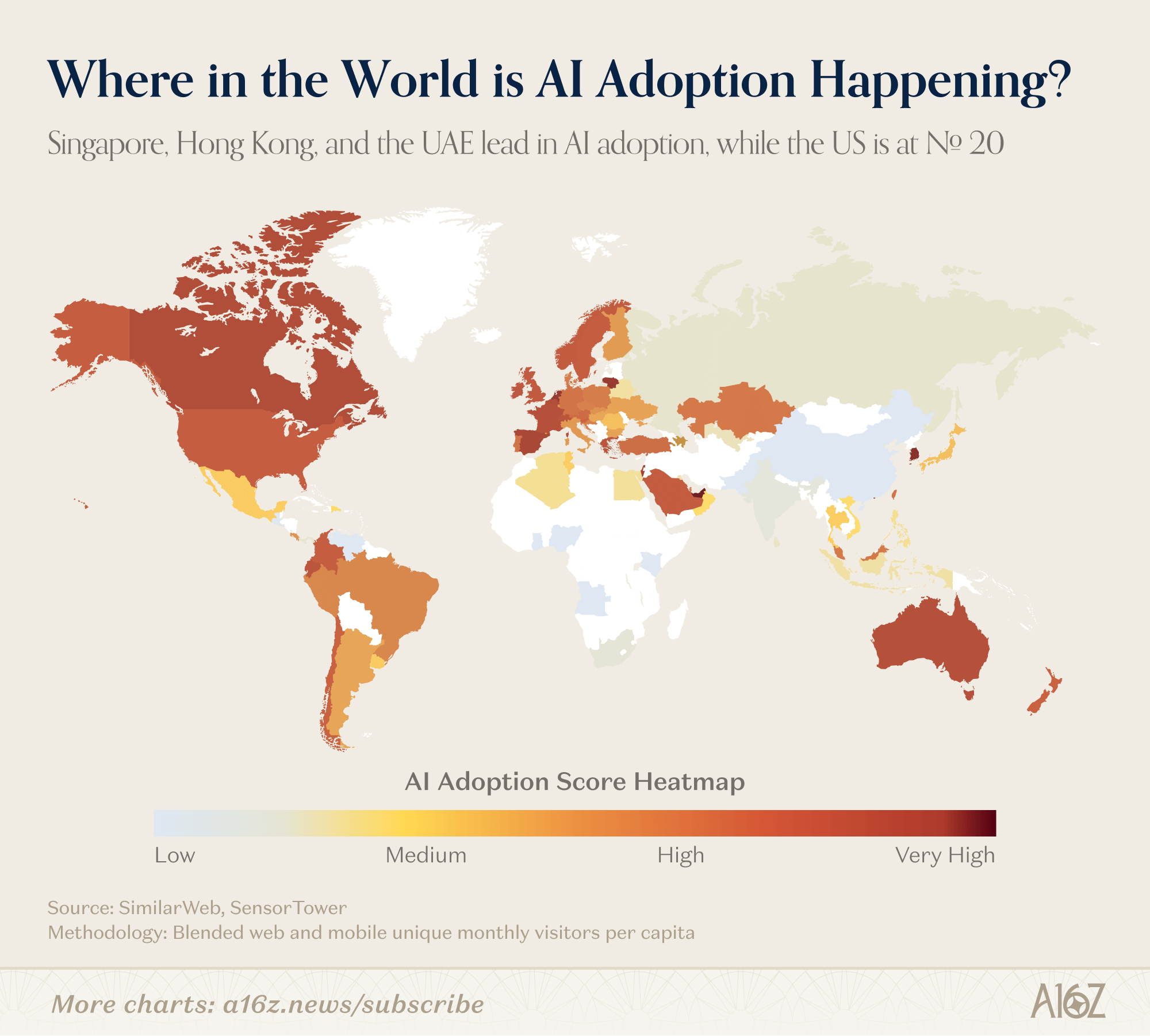
To look at AI adoption on a per capita basis, we built a simple index combining web visits per capita and mobile MAU per capita across the products on our lists, scored from 0 to 100. The results reframe the geographic picture. Singapore ranks first, followed by the UAE, Hong Kong, and South Korea. The United States — the country that produced most of these products — ranks 20th.
3. Creative tools make moves
Midjourney, DALL-E, and Stable Diffusion were the products that introduced most early adopters to generative AI — all three were released pre-ChatGPT. Image generation tools not only dominated creative tools (video and audio generation came later), but reigned supreme in our first three list versions of this list. The category has since evolved significantly.
In our first edition in September 2023, seven of the nine creative tools on the web list were image generators. Three years later, only three image generators remain — but seven creative tools still make the list. The difference is what fills the gap: video, music, and voice products have taken the slots that image generation vacated.
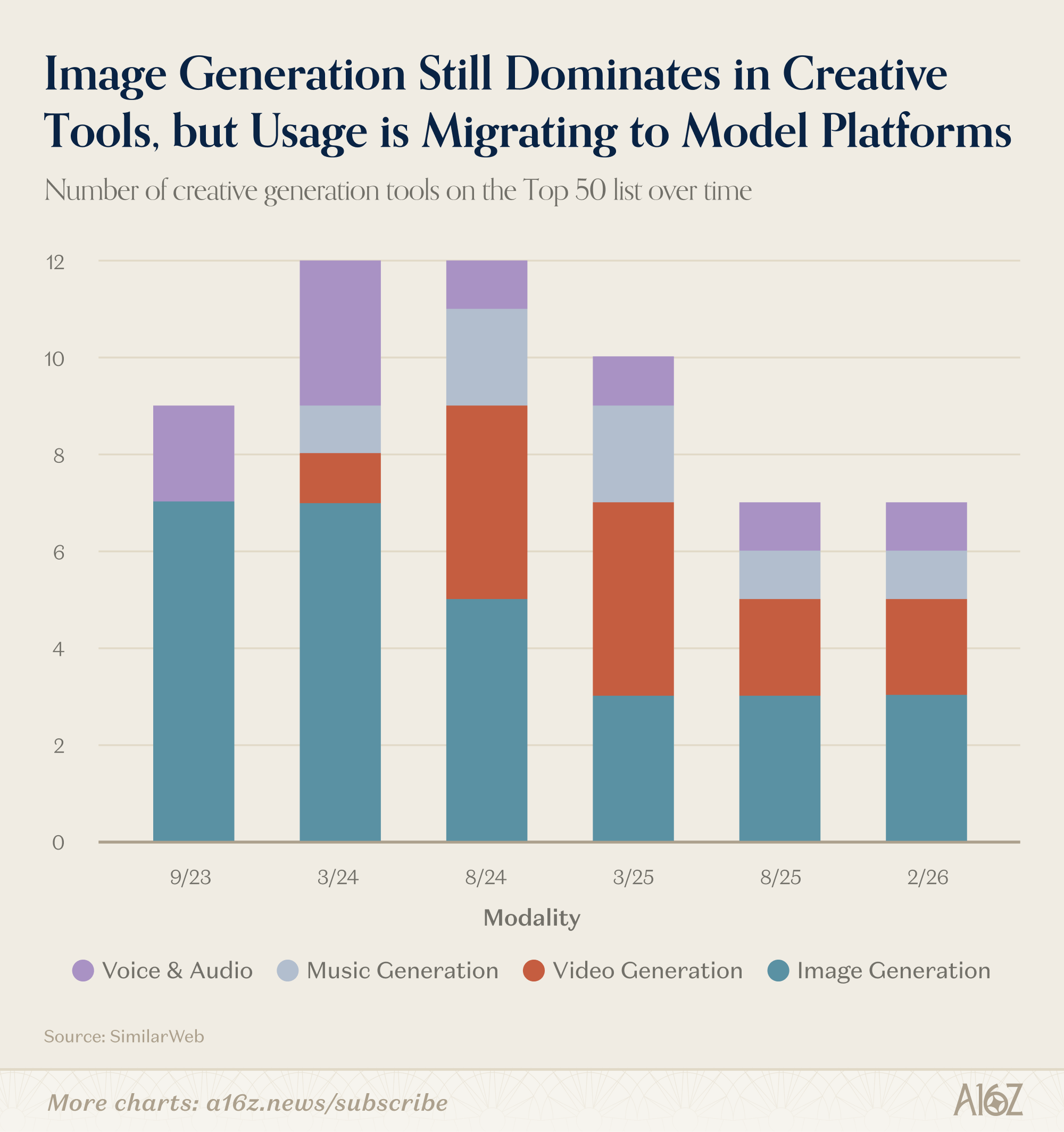 The image story is one of bundling. As the native image models within ChatGPT (GPT Image 1.5) and Gemini (nano banana) improved, the bar for standalone image products rose sharply. On our very first edition of this list, Midjourney ranked in the top 10 — it’s since fallen to #46. The products that remain — Leonardo, Ideogram, CivitAI — tend to serve specific creative communities with opinionated features rather than competing on general-purpose generation.
Video generation saw the most movement this edition. Kling AI, Hailuo, and Pixverse have all built real traction, with Chinese-developed models consistently leading in output quality — we would not be surprised to see Seedance 2.0-based applications on the next list. Veo 3 was the first US model to close that gap, and has driven traffic to Google Labs (which rose from #36 to #25 in the ranks).
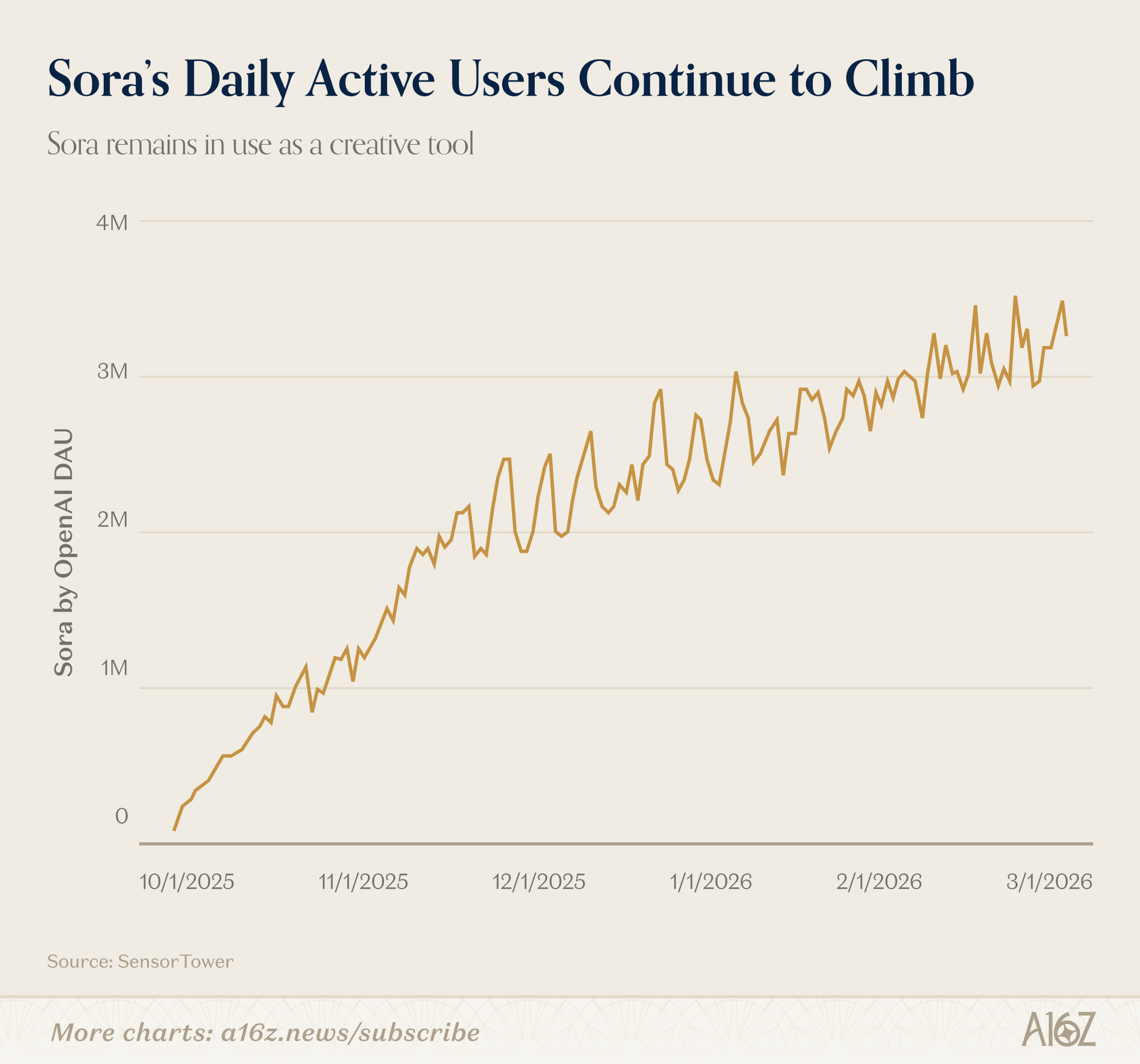
What’s missing? Sora. OpenAI launched the 2.0 version of its flagship video model as a standalone app in September 2025 — users were able to upload their digital likeness as a Cameo, and generate videos featuring real people. Sora spent 20 days at the top of the U.S. App Store and reached 1 million downloads faster than ChatGPT. Since then, downloads have decreased, as Sora stopped virally exploding as a social app (no one has yet cracked AI x social) — preventing it from making the mobile list for this edition. But, SensorTower still counts upwards of 3 million daily active Sora users on mobile, as AI video creators continue to leverage the model even if they cross-publish outputs elsewhere.
 Music and voice have been more defensible. Suno (#15) retained its rank from the last version of the list. ElevenLabs has appeared on every edition since September 2023; its capabilities — voice cloning, dubbing, audio production — remain specialized enough that they haven’t been replicated as a checkbox feature.
The pattern: where the model giants and incumbents like Google and OpenAI have focused their creative efforts (image, increasingly video), standalone traffic compresses — though there is still room for more opinionated and perhaps more highly monetized products that serve users beyond the mainstream. Where they haven’t (music, voice), there’s more room.
4. Agents are here
The shift toward agentic AI didn’t start this edition — it started last edition, with vibe coding. When Lovable, Cursor, and Bolt appeared on our March 2025 list, they represented something new: AI products that didn’t just answer questions or generate media, but built things on the user’s behalf. That was agentic behavior, scoped to a single vertical.
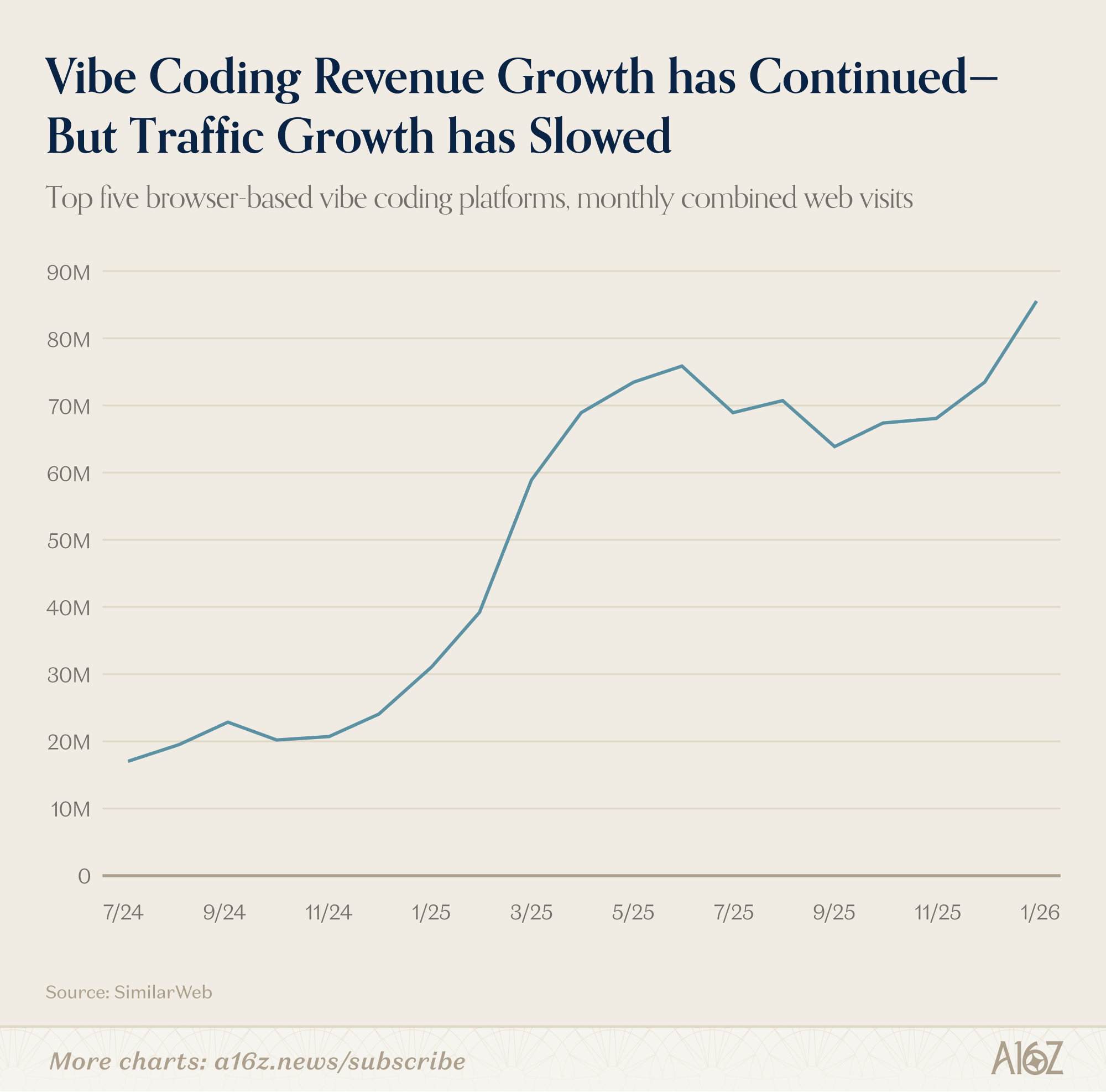
Vibe coding has proved retentive among a technical (and semi-technical) audience — with Replit and Lovable represented on this edition, as well as Claude Code (via Claude). There’s more growth to come, as the trend has not yet cracked the true mainstream. Traffic across the top five vibe coding platforms has continued, though slowed from the initial explosion — though revenue continues to rise for many of these products as developers and teams use them more intensely.
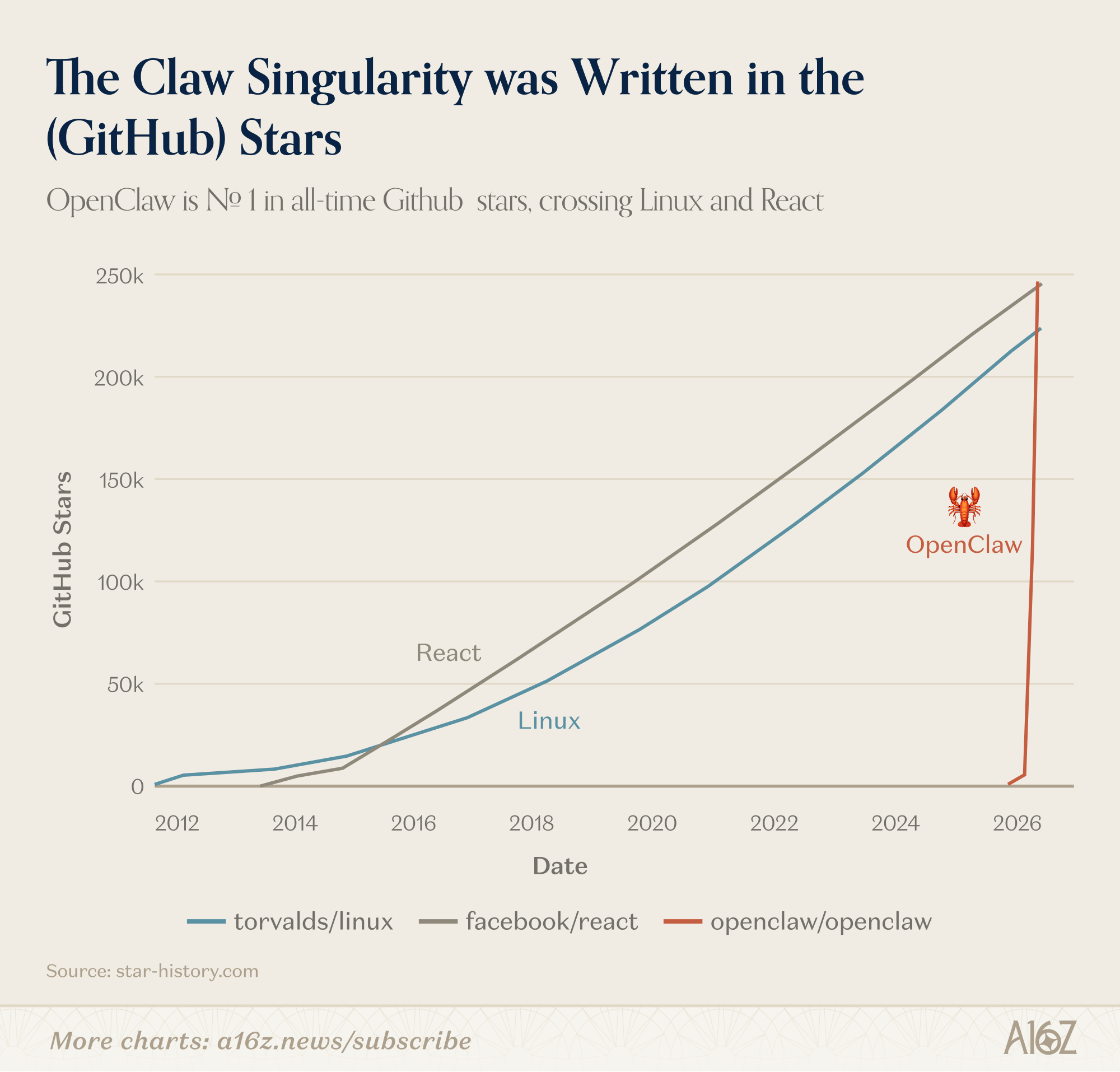
 More recently, horizontal agents have started to emerge. In January 2026, an open-source project called OpenClaw went from a solo developer’s side project to 68,000 GitHub stars and mainstream coverage in a matter of weeks. Built by Austrian developer Peter Steinberger, OpenClaw is a locally run AI agent that connects to your messaging apps and executes multi-step tasks on your behalf.
If ChatGPT was the moment consumers discovered AI could talk, OpenClaw may be the moment they discovered AI could act. The product took off in the developer community — if our analysis was pushed to February (not January), OpenClaw would have ranked in the top 30 of our web list.
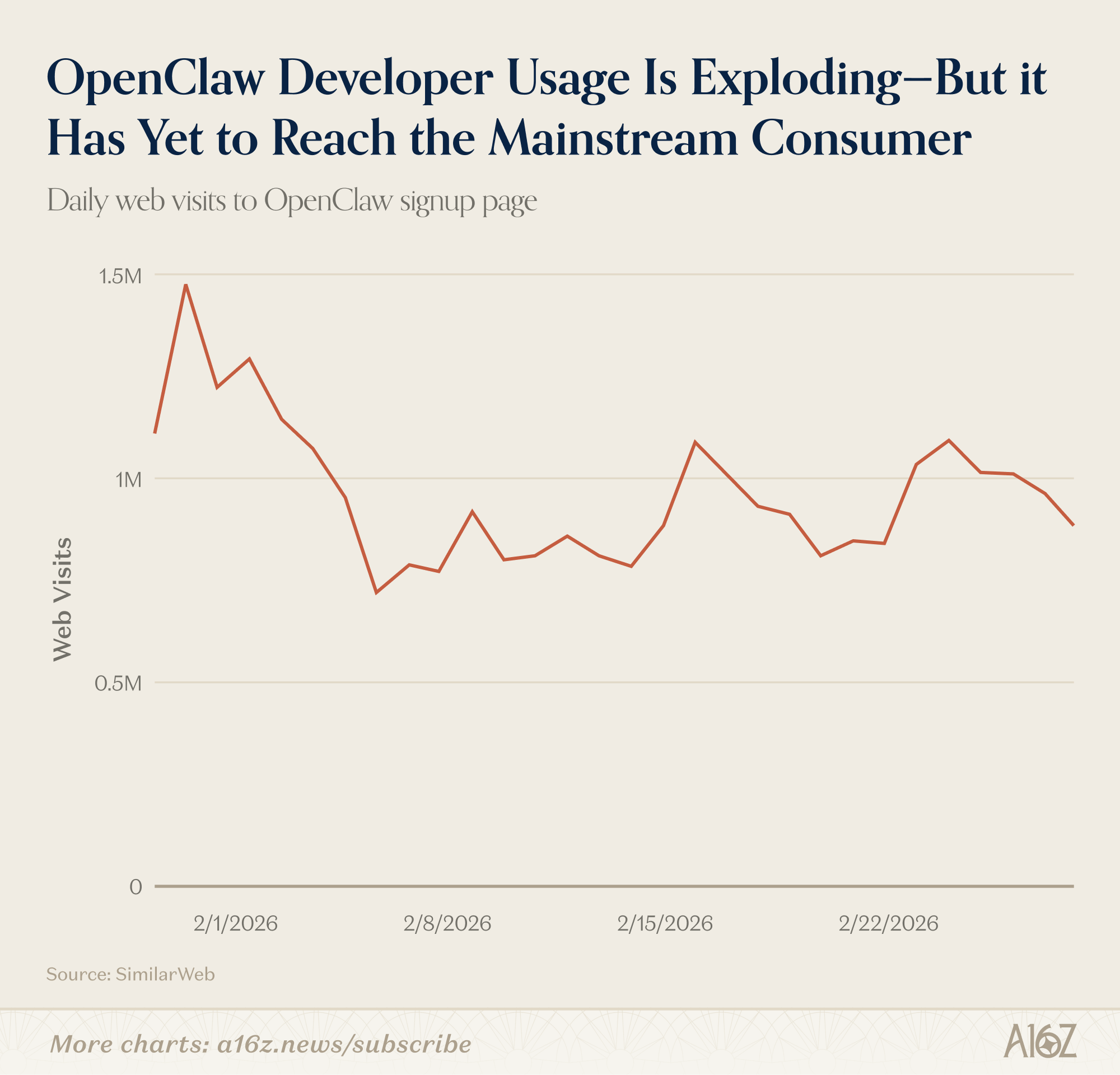
And yet, OpenClaw is not (yet!) consumer-grade — it requires knowledge of Terminal to set up and maintain. OpenClaw has continued to pick up traction among technical users, and in early March became the most-starred project on Github — surpassing both React and Linux. However, the product has not yet “graduated” to the true mainstream user — at least, as measured by new visits to the OpenClaw setup web domain (which have been fairly flat). The product was acquired by OpenAI in February 2026, which perhaps indicates the possibility of an even more accessible version of OpenClaw coming soon.
 OpenClaw isn’t the only horizontal agent on the list. Both Manus and Genspark made the ranks — each platform allows consumers to hand over open-ended tasks (research, spreadsheet analysis, slide generation), and AI will handle the workflow end-to-end. This is Manus’s second time on the list, and since it debuted it was acquired by Meta in December 2025 for an estimated $2 billion. Genspark debuts on this edition — the company raised a $300M Series B earlier this year, and announced a $100M revenue run rate.
On mobile, consumers generally interact with agents via text — not via mobile apps. At setup, users connect OpenClaw to platforms like WhatsApp, Telegram, and Signal; users message it like they’d message a friend, and it executes tasks in the background. Other products like Poke similarly provide an agentic experience directly via SMS.
These products will compete with the agentic capabilities of the general LLM assistants that consumers use every day — ChatGPT, Claude, and Gemini. As they build their own connective tissues with Connectors and apps, will consumers use one of these products as their primary agent? The next six months will give us a good picture.
5. AI beyond the browser or app
Every prior edition of this list has ranked AI products by two metrics: web visits and mobile MAU. But a new class of AI products is emerging that these rankings cannot capture. Some of the most significant consumer AI growth of the past year happened in products that don’t register in either metric.
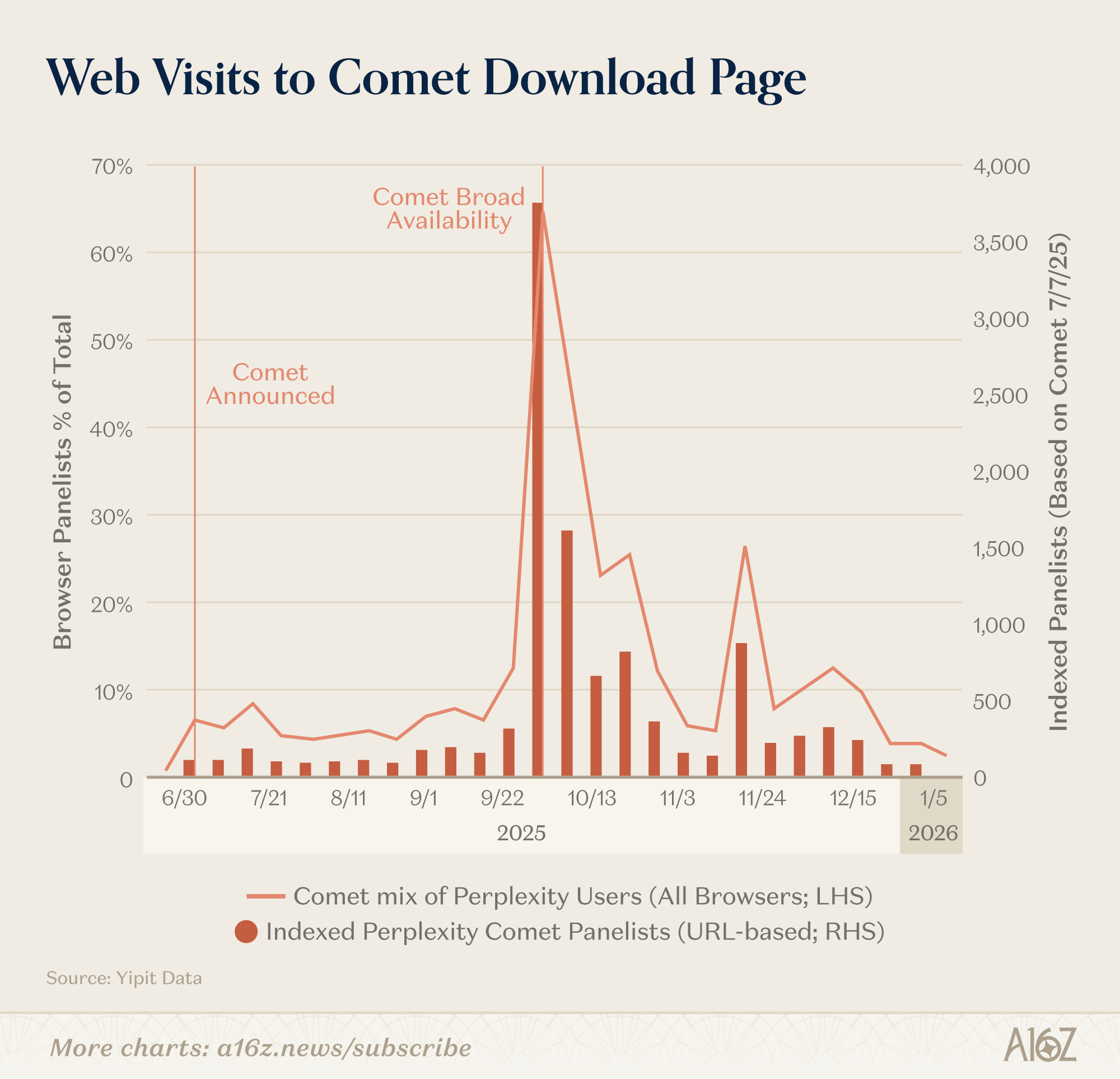
The most visible shift is the browser itself becoming an AI product. In the past nine months, OpenAI launched Atlas (a browser with ChatGPT built into every page), Perplexity shipped Comet, and the Browser Company (since acquired by Atlassian) launched Dia. Data from Yipit shows that Perplexity’s Comet has made the biggest dent in the market (in terms of visits to the download page), though no AI browser has seen accelerating growth.
Other AI giants are choosing to add AI to an existing browser, versus launching an AI browser as a standalone product. Google added Gemini to Chrome and released Disco in beta-testing, which dynamically generates web apps based on a user’s browser tab. Anthropic released Claude in Chrome, which can connect to a user’s Claude or Claude Code session to drive action on the web.
 Desktop-native AI tools have seen even more dramatic growth, especially for developers. Claude Code — a command-line agent for developers — reached a $1 billion annualized revenue run rate in just six months. OpenAI shipped a standalone Codex app for Mac, with the company reporting total Codex weekly active users of 2 million as of early March, growing 25% weekly. And, Cursor retained its spot on our top 50 web list.
For pure consumers, the most common standalone AI desktop applications are voice-related. Notetakers like Fireflies, Fathom, Otter, TL;DV, and Granola, have reached users via PLG and increasingly saturated enterprises — with a combined 20M visitors combined across the top five players. Workspace apps like Notion (debuting on this list), have also increasingly integrated AI via notetakers, research agents, and even task automation.
Finally, AI is increasingly embedded in the tools people already use. Anthropic launched Claude in Excel and Claude in PowerPoint. OpenAI launched ChatGPT for Excel. Google has deepened Gemini’s integration across Workspace — Docs, Sheets, Gmail, and Meet all now have native AI capabilities. Google also launched Personal Intelligence in January 2026, connecting Gemini to Gmail, Google Photos, YouTube, and Search — so the assistant can reference your hotel booking, your purchase history, your photo library, and your watch habits without being told.
The implication for this list: our rankings increasingly undercount the AI products people use most. A developer who spends eight hours a day in Claude Code and a knowledge worker who dictates every email through Wispr are heavy AI users who barely register in web traffic data. As AI moves from a destination to a feature, our methodology will need to shift.
Links: Top 50 Gen AI Consumer Web Products
Adot AI
Candy Network
Canva
Capcut
Character.ai
ChatGPT
Civitai
Claude
CrushOn
Cursor
Cutout
Deepseek
Doubao
ElevenLabs
Freepik
Gamma
Gemini
Google AI Studio
Google Labs
Genspark
GigaChat
Grammarly
Grok
Higgsfield
Hugging Face
Janitor AI
Kimi
Kling AI
Arena
Lovable
Manus
Meta AI
Midjourney
NotebookLM
Notion
Ourdream.ai
Perplexity
Photoroom
Pixelcut
Poe
Polybuzz
Quark
Quillbot
Qwen
Remove.bg
SeaArt
Spicychat
Suno
Turboscribe
Veed
Links: Top 50 Gen AI Consumer Mobile Apps
AI Gallery
AI Mirror
B612
Baidu AI Search
BeautyCam
BeautyPlus
Brainly
Canva
Capcut
Character.ai
ChatGPT
CiCi
Copilot
Deepseek
Doubao
Edits
FaceApp
Facemoji
Gauth
Gemini
Grok
Hi Translate
Hypic
Learna AI
Lightroom
Meitu
Meituan
Meta AI
Microsoft Edge
Microsoft Bing
Mivi
Notion
Nova
Papago
Perplexity
Photomath
Photoroom
Picsart
Pixverse
Polish
Polybuzz
QQ Browser
Remini
Seekee
Snow
VivaCut
VN
Wink
Yandex
YouCut