By the time you reach the growth stages, you almost certainly have a sales leader, or perhaps even multiple sales leaders if you’ve expanded internationally. Typically, these leaders operate as player-coaches with an instinct for motivating a small team to do whatever it takes to close deals. But gut-feel sales won’t scale your company.
As a go-to-market (GTM) organization becomes more complex—adding different sales motions, serving multiple customer segments, and selling into new regions and countries—many companies hire a chief revenue officer (CRO) to own and execute the GTM strategy. Unlike a VP of sales who oversees sales teams with a focus on hitting sales numbers, your CRO is responsible for your entire topline revenue and manages most or all core revenue-generating functions, including:
- Field and inside sales
- Revenue operations and enablement
- Business and sales development
- Sales engineering
- Customer success and services
- Channel, partnerships, and alliances
The CRO is the GTM architect and field general. They’ve got to ensure that they effectively recruit, train, equip, and deploy the troops and that their supply lines are kept fed.
—Joe Morrissey, general partner at a16z
When you get the right CRO in at the right time, they’ll develop accurate growth plans and revenue forecasts based on data and help achieve a scalable, well-oiled GTM machine that unlocks ARR growth for your company. Since you can’t expect what you can’t inspect, they also have a process to regularly inspect all aspects of the GTM motion, from recruiting and enablement to pipeline generation, the sales process, and the forecast. If a number isn’t on target, they know which levers to pull and tweaks to make to get the business back on track.
TABLE OF CONTENTS
When to hire
TABLE OF CONTENTS
One of the biggest failure modes for hiring a CRO in the growth stage is waiting too long. It can be easy to spot the need for a new sales leader when revenue has plateaued. But it’s more likely that you’re still growing, and in some cases, even doubling or tripling sales numbers year over year when the initial signs appear that your sales leader isn’t going to be able to scale to the next level of ARR. How do you recognize that a current sales leader is struggling to scale without waiting for revenue to slow? Early-stage leaders tend to operate more from feel than numbers, and 3 leading indicators that they’re not scaling are:
- Lack of data-driven operational rigor. When they come up with forecasts and quotas, or when they set hiring plans and redraw territories, they can’t tie their plans to business numbers.
- Poor-performing hires. They struggle to hire good salespeople across different territories or they hire reps who consistently don’t make their numbers.
- Failure to see past this quarter. They operate tactically on a deal level or on a horizon that doesn’t extend beyond this quarter.
While CROs are most common in enterprise software companies (which this guide tends to focus on), consumer companies that monetize through self-service subscriptions, selling to small companies, or advertising may hire a CRO when customer acquisition and retention increase in volume or become so complex that the CEO needs a new strategic leader to scale the GTM org.
For PLG companies
Many product-led growth (PLG) companies will hire a CRO to help layer a top-down motion onto their existing PLG motion and then coordinate these 2 distinct motions. We talk extensively about this scenario in The “$20M to $500M” Question: Adding Top Down Sales, including the 2 conditions that signal it’s time to add top-down sales onto a working bottom-up motion:
- The bottom-up flywheel is working: The clearest evidence that the product-driven flywheel works is the company’s overall topline traction: a best-in-class product drives viral adoption and early monetization, which in turn continue to expand the user base, often with limited dollars spent on marketing and sales. While the exact threshold will vary by company, there is a surprising amount of convergence that achieving between $20M and $30M ARR in bottom up–driven sales is a strong leading signal.
- The business is demanding a top-down solution: While individual users may not appreciate or value features such as improved security, nuanced access control, and enhanced transactional support, these features become naturally requested at the enterprise level and as centralized procurement gets involved.
Writing the MOC
We discuss writing a mission–outcomes–competencies document (MOC) in greater detail in The Hiring Process.
The last 10 years have seen seismic changes in the GTM for enterprise companies, and there’s a shortage of CROs, especially CROs with experience in product-led growth, consumption-based pricing, and selling through cloud partners. Instead of hiring someone who has already been a CRO, many growth-stage companies look for a sales leader with experience in the specifics of their go-to-market org and who is ready to level up.
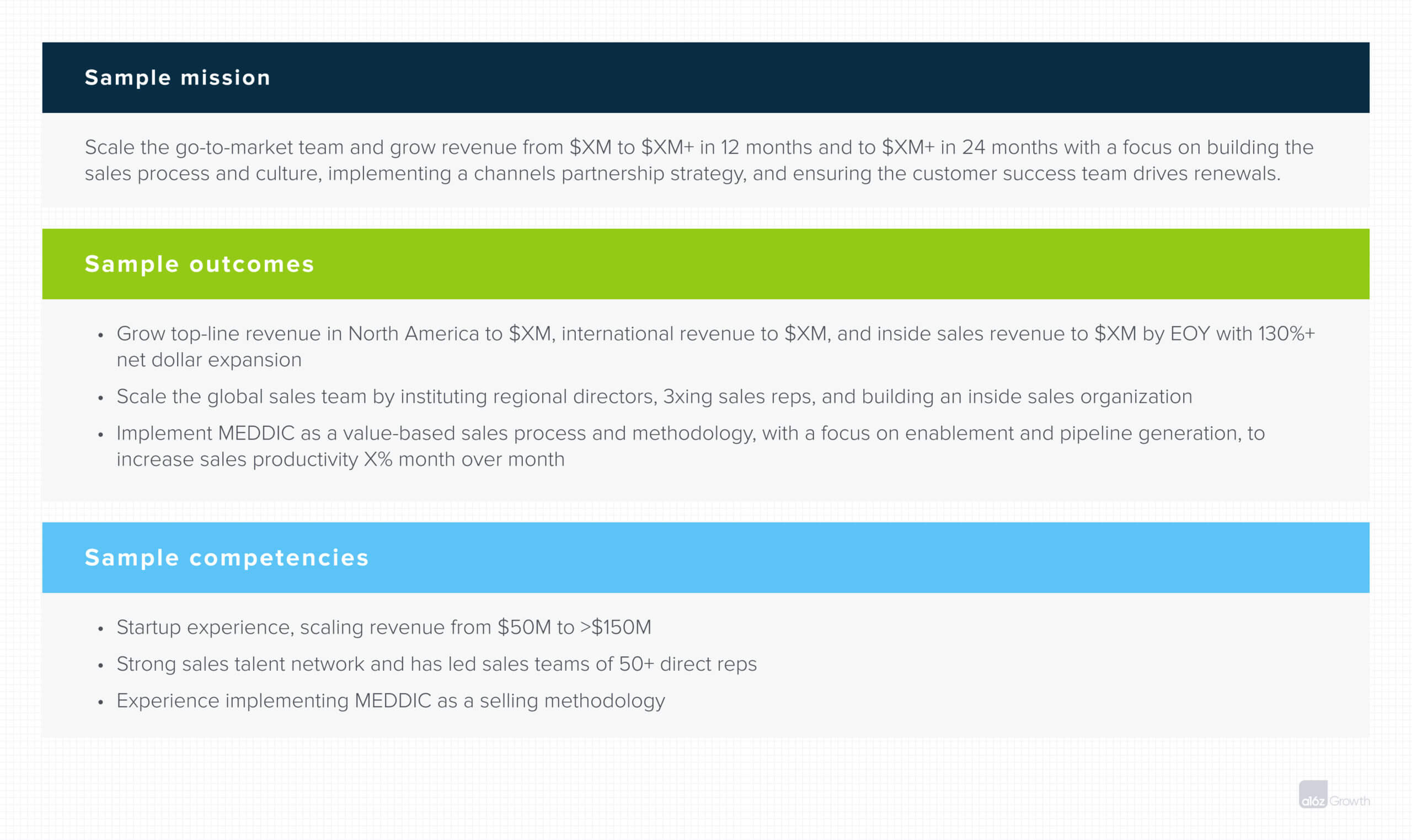
It’s critical to find a leader who has experience scaling from your current ARR to the ARR you want to hit in 12–18 months. Someone who has managed companies with bigger ARRs may seem more experienced and thus more qualified. That said, if you’re considering a sales leader from a large, well-established company to scale your company from $50M ARR to $150M ARR, dig deep to understand how much they actively developed the processes that scaled their company’s revenue (instead of benefiting from already established processes) and gauge their willingness to roll up their sleeves to build what your company needs to scale.
Additionally, your company’s survival depends on your CRO delivering the revenue that they forecast. While you don’t need to hire someone who has done the job before, you should hire someone whose trajectory indicates that they are ready to do this job now. Have they been at companies where they’ve seen great sales execution scaled effectively? Can they articulate what world class sales execution looks like? Any potential all-star CRO will have a strong track record of being internally promoted and regularly meeting or beating forecasts as they take on greater levels of responsibility. A sales leader who hops around too much without getting promoted is likely not ready to be a CRO.
What core competencies should you look for in a CRO?
- Hiring and retaining talent at scale. The best CROs know that sales capacity and sales productivity are probably the 2 biggest levers they can pull to increase revenue, and they also know it can take 6–9 months to recruit and ramp sales reps. They anticipate and effectively plan for the sales capacity they will need 12 or even 18 months down the line to hit their revenue targets. They then attract good salespeople and put in place the enablement materials and programs, training, and technology to ramp them quickly.
- Developing salespeople. Your sales team will stay if they’re earning, learning, and having fun—and it’s the CRO’s job to articulate what good performance looks like, equip them to sell your product, become better salespeople, and build an energetic culture that entices them to stay. The best CROs are passionate about developing their team.
- Accurately forecasting revenue and set territories and targets. Pipeline and outbound sales often play a bigger role as enterprise startups scale into new territories and sell to bigger customers with higher ACVs. Territories often become smaller at the same time sales quotas increase. A good CRO redraws territories as your company changes while accurately forecast revenue.
- Establishing sales processes and systems. A good CRO thrives on developing processes and systems to fine tune execution through the entire sales funnel to increase efficiency and conversion rates.
- Identifying your ideal customer profile (ICP). Many companies fall into the trap of chasing individual customer opportunities, which isn’t cost-effective and can inundate your engineering team with one-off product requests. Your CRO should be able to define the best customers for your product (your ICP) and the best pain points, value propositions, and use cases to sell around. They should then be able to map a customer engagement process to the sales funnel.
Specific questions to consider about your GTM org
Are you layering on top-down sales to a working bottom-up/or PLG motion? PLG-assisted sales tend to hinge on velocity and transactional-based selling. Because customers adopt the product through a self-service motion before interacting with a salesperson, the vast majority of these deals are opened and closed in a quarter.
Many enterprise sales people just aren’t as excited about the velocity of PLG sales or able to keep organic adoption rolling. While SMB leaders may be better at high-velocity sales, they may leave money on the table during enterprise transactions.
If you’re a PLG company considering layering on a top-down enterprise sales motion, you’ll want to prioritize hiring a CRO who can architect and operate in multiple customer segments at once. They’ll need to manage high-velocity transactional SMB and mid-market sales where PLG often originates, as well as more strategic enterprise sales. They not only need to understand how the motions to these customer segments differ, but also they need to recognize how and when to move upmarket into different customer segments over time. For this, you want a CRO who has experience with enterprise selling and excels at finding signals in massive amounts of data coming in from product usage and adoption. From this data they should be able to distill what leads to focus on, how to manage pipeline, and how to assign reps to those deals to close them ASAP.
Specifically, they should be able to:
- use data to build a model for your sales process
- discover penetration thresholds that signal an account is ready for an enterprise sale
- build a high-quality pipeline
- identify the right stakeholders for enterprise selling
Do you run a consumption-based pricing model? In consumption-based pricing, the challenge for a CRO is to effectively bridge the connection between presales and post-sales to drive revenue through retention and expansion. In some cases, we see companies recruit CRO candidates who have worked in infrastructure, often at one of the cloud platforms, and have a good understanding of consumption-based models, especially how to structure sales compensation and incentives around a consumption-based model.
Do sales through a third-party cloud provider make up a substantial part of your revenue? If so, you’ll want to look for a leader with experience managing a cloud partnership. Such a leader should be able to structure sales compensation to align the incentives of your reps with the incentives of your cloud partners.
Who is your ICP? You want a candidate who has sold to a similar target customer and price point. While sales expertise is more important than technical expertise, the more technical your product is, the more you may want to find someone who has also sold a similar solution or technology (i.e., marketplace, business intelligence solution).
What is your sales methodology? Value-based selling has become increasingly popular, but actually implementing a value-based selling process looks very different depending on the company’s sales motion and methodology (for instance, MEDDIC is currently popular). You’ll want a CRO who has experience implementing the sales framework of choice. Or, if you’re hiring for someone to choose and implement a methodology, you’ll want to make sure the methodology works with your culture and customers.
Sample MOC
Setting up your CRO for success
We cover best practices in The Hiring Process, but we’ve included some role-specific considerations below for you to keep in mind when making this hire and integrating them into your org.
Keep the interview loop tight
While it’s helpful for the CRO to interview with their key partners on the executive team, CRO candidates for growth-stage companies generally want to move quickly. We recommend keeping the interview loop limited to a few key partners, like the senior technical org leader (usually a CTO or CPO), finance, marketing, and the CEO.
Communicating to your existing sales leaders
While it’s almost always a good idea to talk to an existing leader as soon as you know you plan to bring in someone over them, it’s especially important when looking for a CRO. Enterprise technology sales is a small and relationship-driven world, which means word travels fast. You don’t want your sales leader feeling surprised by the news or to hear it from anyone other than you. Be transparent about your intentions and your plan early on. You’ll be more likely to retain your existing leader, if that’s your goal. And if it isn’t, or if your existing leader chooses to leave, they will also be more likely to work with you on the transition and less likely to recruit away some of your top reps.
Test the fit between your candidate, marketing, and product
In the interview process, have your marketing and product leaders test if a CRO candidate is a good counterbalance to them. For instance, your marketing leader may evaluate how well the CRO candidate understands your demand-generation pipeline and how leads move from MQL to SQL. On the product side, you may test if your CRO can collect and prioritize feedback from the field based on where the market opportunity is. A good CRO candidate will explain how they have given product requests to product teams in the past and how that led to product features that helped sales to close bigger and better deals. A bad one will see the product team as primarily a ticket-taking organization.
Negotiate comp for better alignment
Finally, a good CRO is almost always a good salesperson—expect them to negotiate hard on their compensation package. Even in the growth stages, it’s not uncommon to find CROs with 30–50% of salary structured as bonus. The negotiations can be a great opportunity to align their compensation structure to what you want them to accomplish on a specific time horizon. Find out what motivates your potential CRO to push their team to reach revenue targets, and walk through different bonus structures with a focus on what bonus structure will best set up your CRO to deliver.
Further reading
We’ve drawn insights from some of our previously published content and other sources, listed below. In some instances, we’ve repurposed the most compelling or useful advice from a16z posts directly into this guide.
The ”$20M to $500M” Question: Adding Top Down Sales, Sarah Wang and David George
A bottom-up go-to-market strategy isn’t enough to scale your organization—you’ll almost certainly need to layer in top-down sales. This article addresses timing, what indicators to look for, and how to compensate your enterprise salespeople.
Initial growth at successful early stage bottom up companies is often the result of a product-driven flywheel: The product’s value and appeal drive individual user adoption, which in turn drive viral momentum through word of mouth, while product upgrades and individual usage often lead to team adoption. However, as products proliferate through an enterprise customer, there’s a limit to the users who want to or are able to discover, use, and pay for it on their own. As the company starts to scale, relying purely on self-serve often results in an asymptotic flattening of the growth curve, resulting in linear or worse, declining growth.
Boss Talk with Ben and Ali: Enterprise Selling for Technical Founders, a16z editorial
Building out your enterprise sales motion isn’t easy, in part because hiring salespeople and leaders is so different from the engineering and product hires you’ve made in the past. Here, Horowitz and Ghodsi discuss sales culture, hiring, and what CEOs can expect during the interview process.
Hire a Head of Sales, Peter Levine
The best companies build both a great product and sales team, and a great sales team requires a great sales leader. By hiring a proper head of sales to build out your team and your process, you can save yourself a lot of time and headaches.
Through the Looking Glass: Hiring Sales People, Ben Horowitz
If you think you can hire a sales team the way you hired your engineering team, you’re wrong. According to Horowitz, you’re looking for people who are courageous, competitive, and hungry, which means you have to change your interview and screening process.
Why Must You Pay Sales People Commissions?, Ben Horowitz
Sales is competitive, which means great sales people thrive in a performance-based environment. Before you consider something other than the traditional sales compensation model, it’s important to understand why commissions are a critical incentive and why offering them can weed out the poor performers.
Prizes and competition are critical to building a healthy sales culture. So what’s an unhealthy sales culture? One that’s governed by politics. Salespeople must sell into highly political environments to succeed and that’s why they don’t want to live in one. If you do not evaluate and pay on what sales people sell, then what do you evaluate and pay on?
5 “Hard Things” Sales Leaders Can Learn from Ben Horowitz, Mark Treacy
In this article, Treacy applies learnings from Ben Horowitz’s book The Hard Thing About Hard Things to sales leaders. These insights can help you identify the traits of a great sales leader and understand their priorities so you can make better hiring decisions.
The Importance of Partnerships in the Great Unbundling, Sarah Wang and Bob Moore
Partnerships have changed the go-to-market strategy, often accelerating the sales process and creating a better, more robust pipeline. Learn why you might need a sales leader who knows how to build a strong partnership program.
Getting Ready to Move Upmarket, Joe Morrissey
The benefits of moving upmarket are immense, but only if you do it right. To find success in the enterprise, you need a leader who understands your product value framework, can define your ICP, and then map your roadmap and sales process to that ICP.
In fact, the single biggest mistake I’ve seen companies make when moving upmarket is mistaking initial enterprise interest for product-market fit when, in actuality, your product usually needs to be much more robust to address the complexities of a large enterprise company.
Pipeline Cures All, Joe Morrissey
You may be in an economic downturn or it may be that your inbound pipeline has dried up. Either way, your only answer is to go outbound and build more pipeline. Often, this involves a culture shift and a new playbook, and these have to come from your sales leader.
Growth+Sales: The New Era of Enterprise Go-to-Market, Peter Lauten and Martin Casado
Companies often start with a product-led, bottom-up sales motion before layering in top-down sales. By understanding the changing sales landscape and common failure modes, you can hire the right sales leader to take advantage of a “growth+sales” motion.
Fintech Scales Vertical SaaS, Kristina Shen, Kimberly Tan, Seema Amble, and Angela Strange
Fintech infrastructure companies have enabled SaaS companies to add financial services to their core offerings, which can open up new market opportunities and increase revenue per customer. Learn how fintech is driving vertical SaaS and how that can change your revenue model.
The Hard Thing About Hard Things, Ben Horowitz
Any entrepreneur will tell you that running a company is hard. A key part of running a successful company is making successful hires. In his book, Horowitz offers interview questions you can ask your potential sales leader to identify if they’re a match.


