Looking for a job in the 2020s will be very different from looking for a job in the 2000s, or even the 2010s. In this new era of reduced budgets, open-ended hiring freezes, and a shape-shifting workforce of career changers, relocators, and solopreneurs, the concept of a resume and a job board seems comically antiquated. This antiquated system plays no small part in the current crisis, as millions of talented, hardworking people are in jobs (or, worse, without jobs) that leave them underutilized, under-engaged and undercompensated. We need to do better.
While COVID-19 has thrown the labor market in a state of chaos and uncertainty, it has also accelerated an evolution that has been years in the making: the rise of the “deep” job platform.
We previously espoused the need to transition from traditional job platforms like Indeed and LinkedIn to “vertical” job platforms that address the specific need of a particular industry or candidate. This vital focus is complemented by an expansion in services provided: from mere job matching to deeper platforms. These platforms not only connect candidates with employers, they also offer additional features designed to create long term success for the candidates, companies, and the platforms themselves. These features range from training to community to—in some cases—financial services.
In the wake of COVID-19 and the Great Rehiring, these deep job platforms will play a critical role in getting people back to work as soon as possible, in the best jobs possible.
Here, we expand on our vertical jobs thesis by revealing what this deep platform revolution looks like in labor and talent marketplaces, from the founder’s perspective. Below, we identify four tactics for entrepreneurs to pinpoint their offerings, develop their product, and successfully build the career platforms of the future.
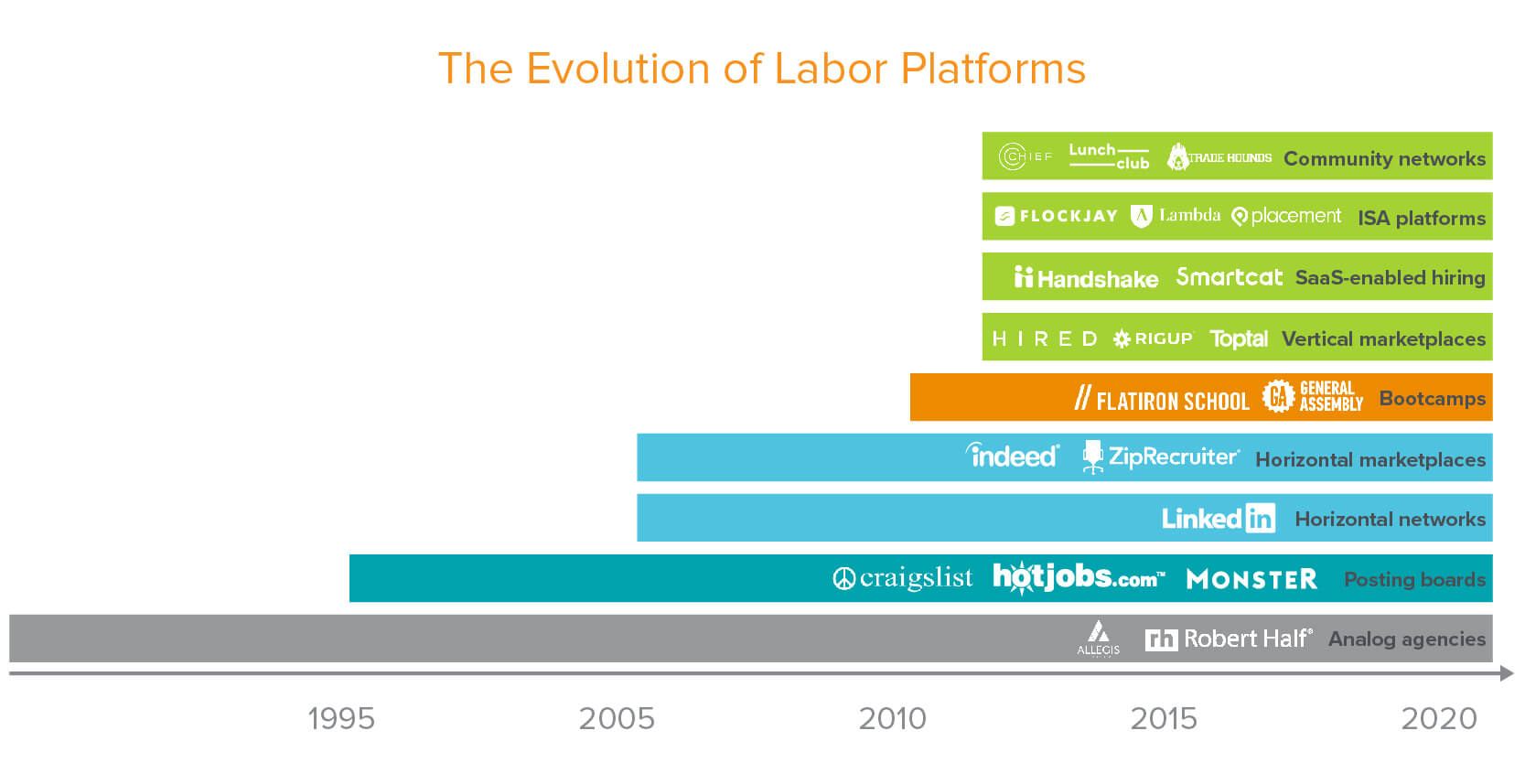
What Is a Deep Job Platform?
Job platforms have gone from light to layered; from simply matching potential candidates with open roles to adding additional value to the employers, the job seekers, or in some cases, both. Just as the gig economy and product marketplaces evolved from listings to managed marketplaces, jobs marketplaces are entering a new phase: the deep platform era.
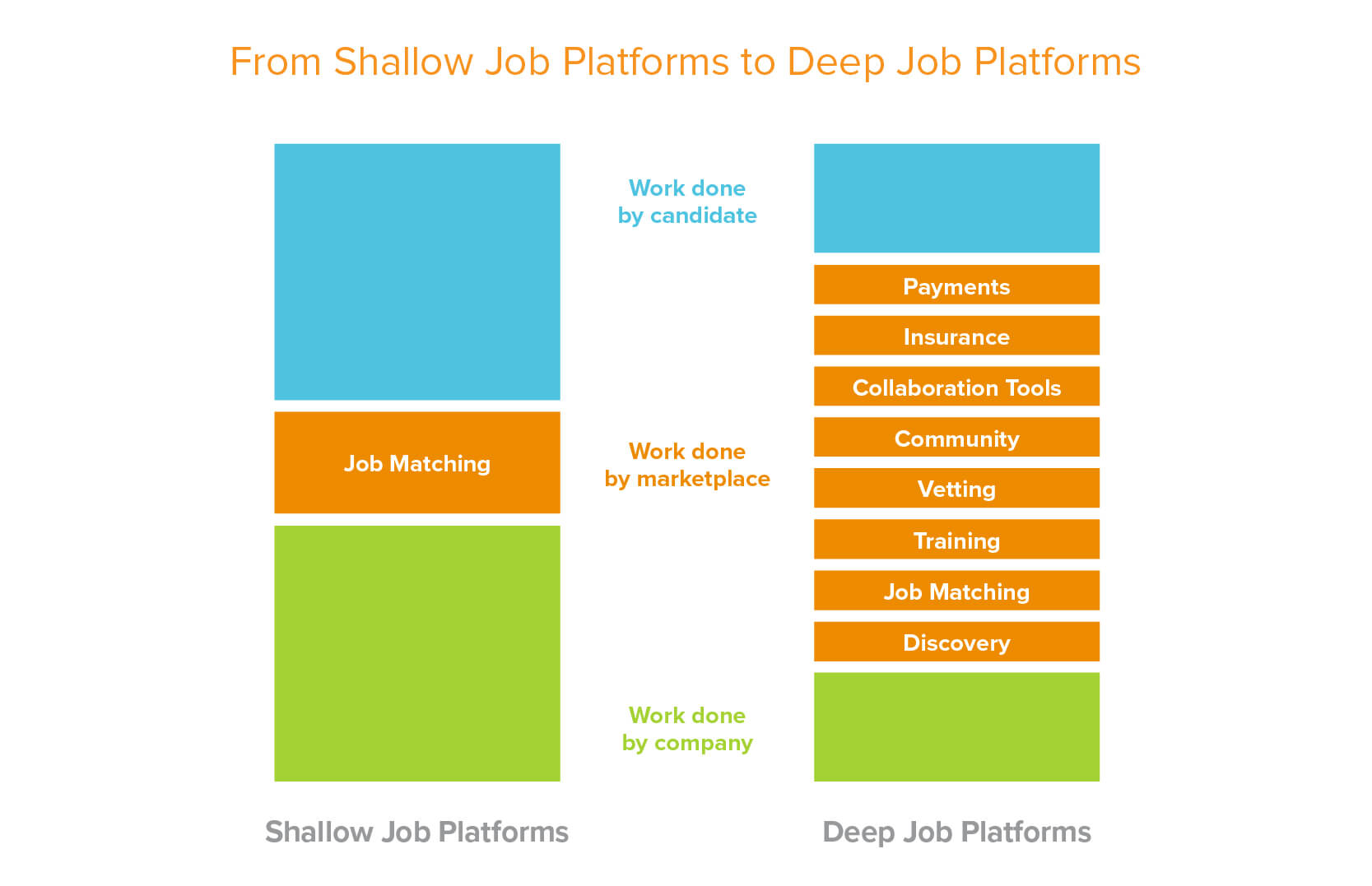
The deep job platform includes products and features specifically designed for the candidates and companies they work with. The specific features of each platform are highly dependent on the type of candidate or employer it serves. Founders building today’s job platforms are finding the bottlenecks and constraints that throttle their unique, vertical networks and producing features to eliminate them. Not every full stack marketplace has all these features, but the core menu of services is:
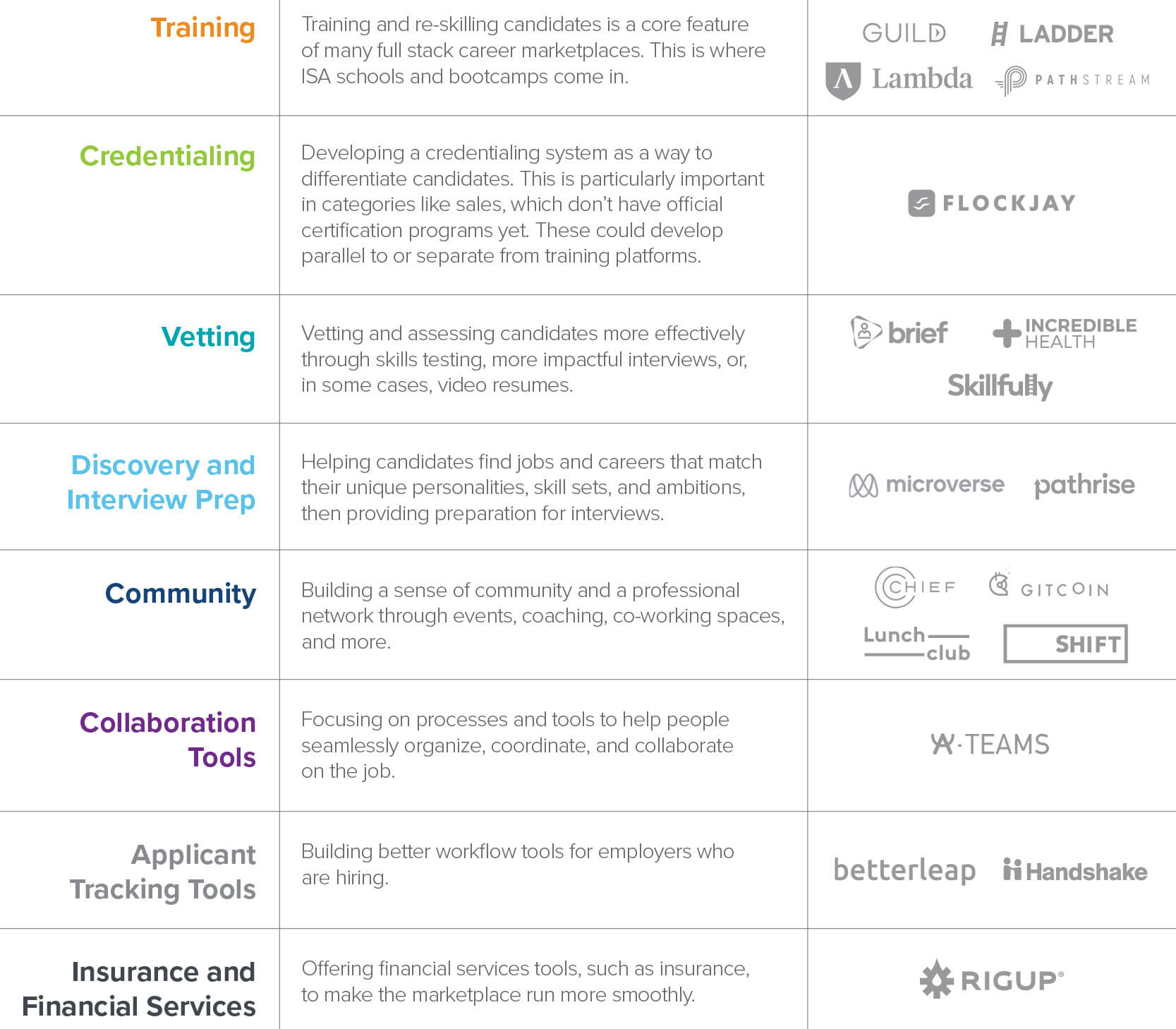
Four Tactics for Building a Deep Job Platform
While it’s relatively easy to identify where the opportunity is—and the bloated incumbents to attack—the discussion often ends there. We don’t want to just identify the opportunity. We want to advance the conversation from strategy to tactics and establish a playbook for building a deep job platform. Investors often speak in generalities, rather than offering practical advice for founders. But when you’re building a deep job platform, specificity is critical. No company—even one focused on a specific vertical—can build all the potential features. The margins inherent in a jobs or talent marketplace make it too hard. Founders need to focus on identifying and building the unique features that unlock their specific vertical category.
Tactic 1: Find your unique friction. Remove it.
One strategy is to find the most frustrating friction points for that specific vertical and eliminate them. In the generalized sense, StubHub used this strategy to compete with eBay by adding maps. The same lesson applies to vertical job platforms.
Where it works: While it’s a broadly applicable strategy, the specific friction points and features vary based on the vertical category you’re going after and which side of the marketplace is most challenging. These can include specialized workflow, data networks, or solving adjacent points like insurance and liability issues.
Examples:
- Incredible Health: Nurses are a supply-constrained market, but hospitals have notoriously slow hiring processes. Incredible built unique features like credentialing to speed up the process and, ultimately, hiring decisions.
- RigUp: This vertical marketplace for construction workers offers liability insurance and faster payments.
- Hired: Operating a supply-constrained marketplace for engineers, Hired built better assessment and interviewing tools to make it easier to quickly identify supply that may not be obvious.
Tactic 2: Come for the tool, stay for the (jobs) network
Come for the tool, stay for the network is a classic marketplace strategy. In the context of vertical job platforms, it usually means a SaaS-enabled marketplace for the demand side. Building something that captures the hiring patterns or workflow of an industry better than the horizontal incumbents can unlock growth. The tool usually serves two functions: (1) makes the process more seamless (hopefully for the more constrained side of the marketplace) and (2) helps the product become sticky with users that might otherwise multi-tenant or use multiple products.
Where it works: It works best when it caters to the demand side in a demand-constrained market, like entry-level college grads looking for jobs. But the SaaS can be focused on either side of the marketplace (or even to an intermediary), depending on the market dynamics for that vertical.
Examples:
- Handshake: SaaS sold to schools, which enables students and employers to find each other.
- Smartcat: Translation SaaS—e.g., machine learning to provide a first draft for translators—but with a marketplace built in, so companies and individuals can hire translators through it.
Tactic 3: Bring your own supply
Bring your own supply (BYOS) is when you augment the supply side with your own “exclusive” supply. There’s a range of strategies here, from better marketing to differentiated testing that better identifies potential candidates to better training in order to create new supply. ISAs have become a unique tool to compliment this BYOS strategy.
Where it works: This works in supply-constrained markets where the opportunities outweigh the talent available.
Examples:
- Lambda and Flockjay: Creating a new supply of developers and sales reps, respectively, through specific training programs.
- Placement and Ladder: Creating a new supply of white collar workers and nurses, respectively, through features like relocation and ISA financing.
Tactic 4: Come for the network, stay for the jobs
This is akin to the original LinkedIn strategy, but now with a narrower focus. How it works: First build a community or a network of individuals in a certain demographic or vertical, then layer in job opportunities and employers in a nuanced and organic way.
Where it works: The secret here is to build around a category or group of individuals that is highly appealing, either because it is a supply-constrained market or because it’s a community that’s not easily accessible elsewhere.
Examples:
- Lunchclub: Brings together professionals, primarily in technology
- Chief: Connects female professionals and executives
- Shift: Works with high-potential military veterans
Founders today recognize inadequacy of the traditional low-touch job platforms, which has only been exacerbated by the current economic crisis. By identifying and removing hiring friction, harnessing SaaS tools, fostering authentic networks, and training a uniquely skilled workforce, builders of deep job platforms are fundamentally reinventing not just how we hire, but the opportunity available to millions of people in the US and around the world. These founders combine a deep knowledge of their particular segment—an essential feature of the Great Rehiring—with an optimistic, future-focused view of how to best harness the talent available. Not only do deep job platforms better serve job seekers and hiring managers—they’re also far superior businesses than the traditional job marketplaces, which can become spammy and low fidelity as they grow.
More importantly though, in a time when millions of Americans are looking for jobs and trying to survive the latest economic crises, this new wave of companies is serving a crucial role in quickly getting people back to work in long-term, high-quality jobs. These platforms are improving on the inefficient processes of the past to build a workforce—and economy—that is more resilient, more nimble and, ultimately, far better prepared for the future.
