Infra

Most People Can’t Vibe Code. Here’s How We Fix That.

Justine Moore Posted February 3, 2026

Vibe coding promised to democratize software engineering. Instead, it’s created a new class of power users without touching everyday consumers.

We are living through a golden age of software. People are shipping insanely cool apps in an afternoon, automating their entire lives with agents, and prompting tools that would’ve taken a dev team months.

But the people drawn to vibe coding are largely developers, founders, designers, and PMs. They’re daily active users of X, fans of Karpathy’s YouTube videos, or regular listeners to Dwarkesh. They know what a terminal is.

That’s maybe 1% of the population.

Most people still think AI = ChatGPT. If they do see one of these vibe coding demos, it’s like a video of someone doing a backflip — cool to see, but not something they’re going to try at home.

The Gap Is Enormous

Try to put yourself in the mindset of someone who has never coded before. This is going to be difficult if you’re technical or even tech-adjacent – you’ve internalized so many things that the average person has never encountered.
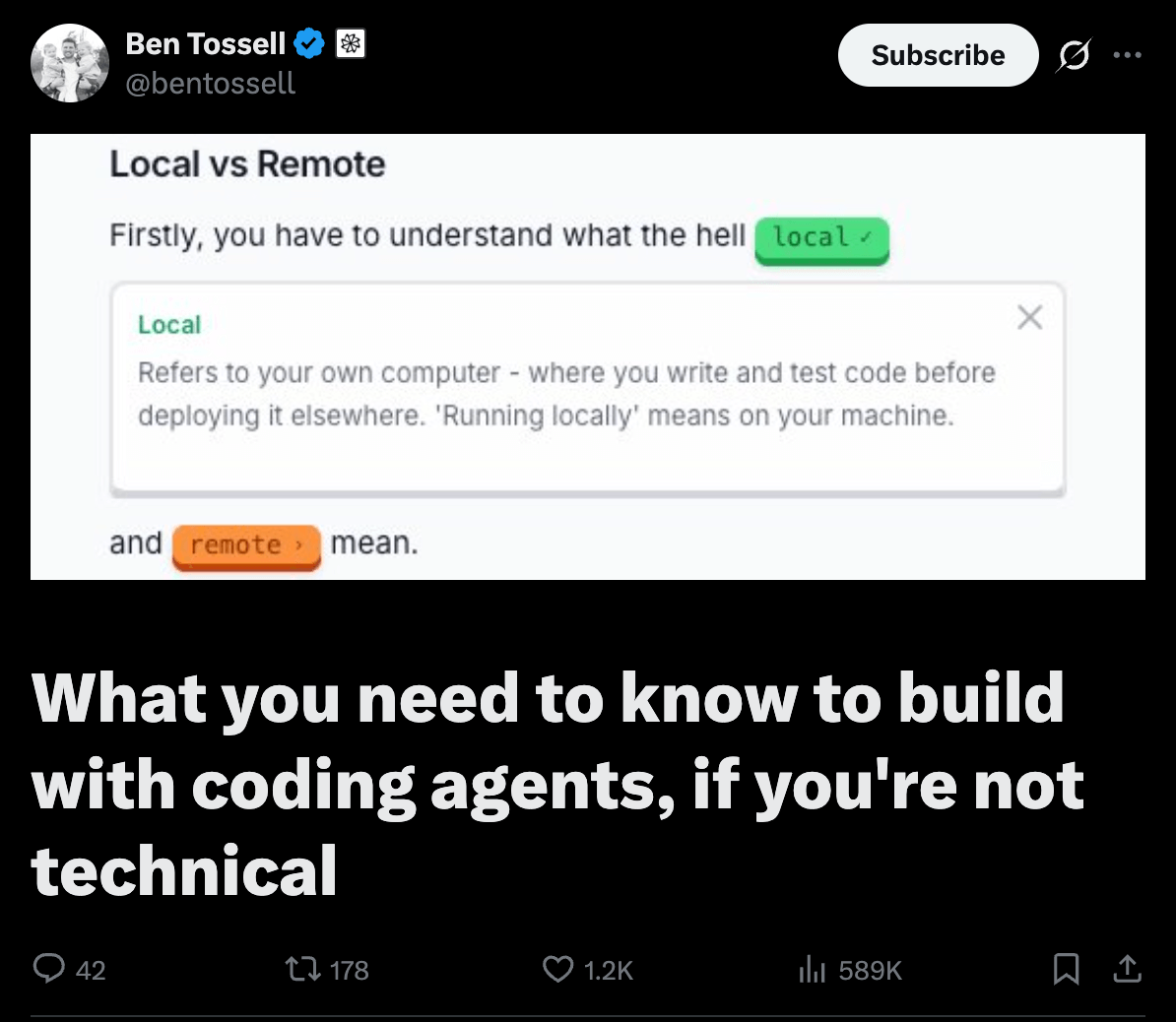
Ben Tossell wrote a great post that may help you understand the mindset of a non-technical user.

I have zero engineering background, so I’m a good test case. I’d never interacted with either a CLI or an IDE before I started vibe coding. Now, my success rate is probably 50/50 on the projects I start. I spend a lot of time dragging screenshots and copying error messages into Cursor and asking for help.

Take OpenClaw (formerly ClawdBot). To run it, you need a separate machine (Mac Mini or VPS), terminal access, and the ability to configure your own security protocols. Did I get it up and running? Yes. Am I using it to its full potential? Absolutely not.

I’m not the only one who has struggled with vibe coding – in fact, we may be the silent majority. I came across a blog post from a writer that captures this perfectly. He was trying to vibecode an app to pull quotes from his newsletter (h/t @broderick). After getting off to a solid start, he quickly ran into problems.
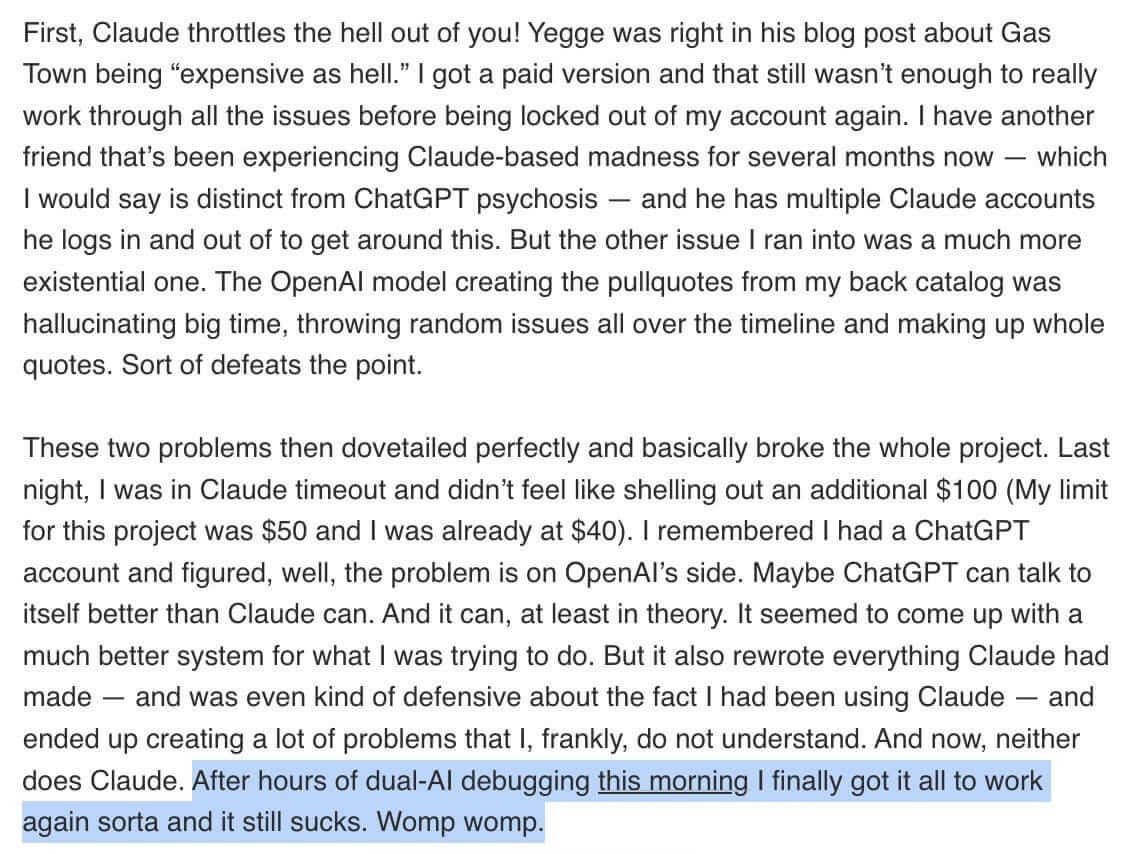
He got further than most non-technical people ever would – but still ended up frustrated, and feeling unsuccessful. This is not the kind of experience that takes a product mainstream.

The Product Layer

Matt Rickard wrote years ago that every Unix command eventually becomes a startup. Technical people build powerful but arcane tools, then someone packages them for everyone else.

We’re in the Unix era of AI agents. The raw capabilities are incredible – but they’re buried under terminal commands, API keys, and YAML configs. Enter the product layer.

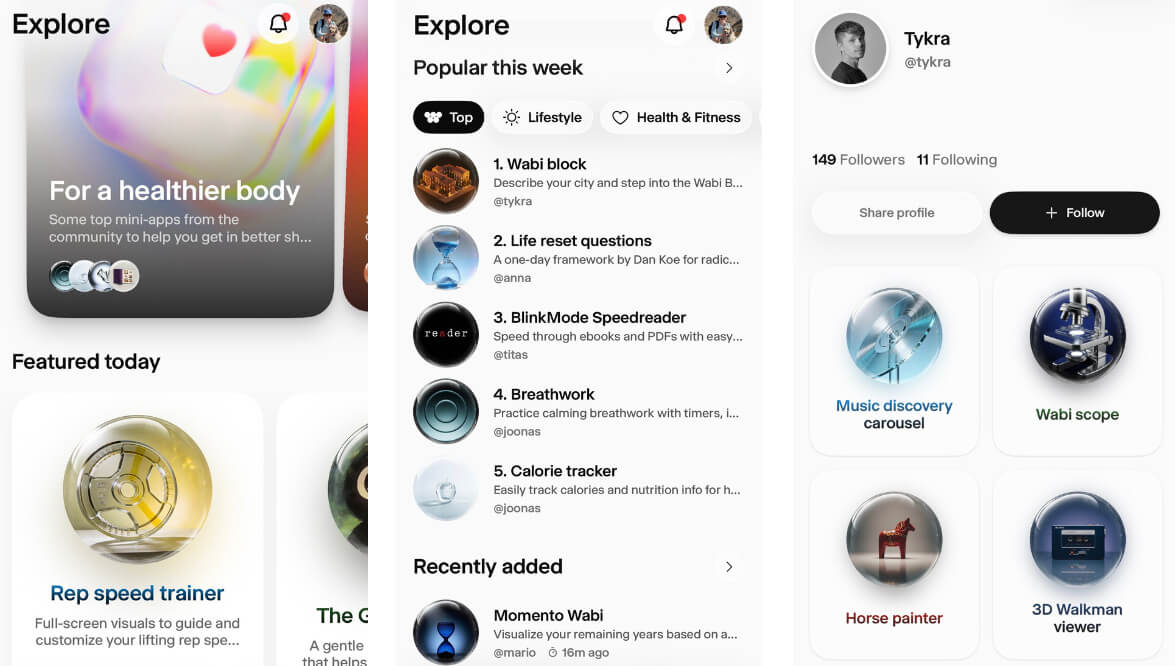
Companies like Poke (by Interaction Company) and Wabi get this. Poke built an AI assistant that lives in iMessage – no setup, and no terminal. You just text it. Wabi is building what CEO Eugenia Kuyda calls “YouTube for apps” – a platform where you can prompt an app into existence and share it with friends. No integrations, authentication, or API keys required.

These aren’t tools for developers. They’re products for people. Tools give you capabilities to build something yourself. Products give you the outcome you’re looking for.

Why This Is Hard

Building for consumers is harder than building for developers. Developers will work through complex problems and tolerate rough interfaces, while consumers will abandon a product if a page takes too long to load. You can ship tools to developers – but you need to ship products to consumers.

The setup problem. Developers will SSH into a server, configure environment variables, manage dependencies. Consumers need zero-setup: open browser, start building. Everything runs in the cloud, sandboxed and secure by default.

The security problem. Veracode’s 2025 report found that nearly half of all AI-generated code contains security vulnerabilities. Developers might catch these. Consumers won’t. As one researcher put it: applications built through vibe coding are “often built by inexperienced users, who either don’t configure the runtime environment at all, or configure it according to advice from the same AI.” Consumer products need guardrails baked in—not opt-in security that requires expertise.

The imagination problem. This one’s underrated. Developers often know what they want to do with a coding agent and have mental models for what software can do. Non-technical people can’t even imagine what they can create. The best consumer products will help people discover what’s possible—templates, use cases, or a feed of “what people like you built this week.”
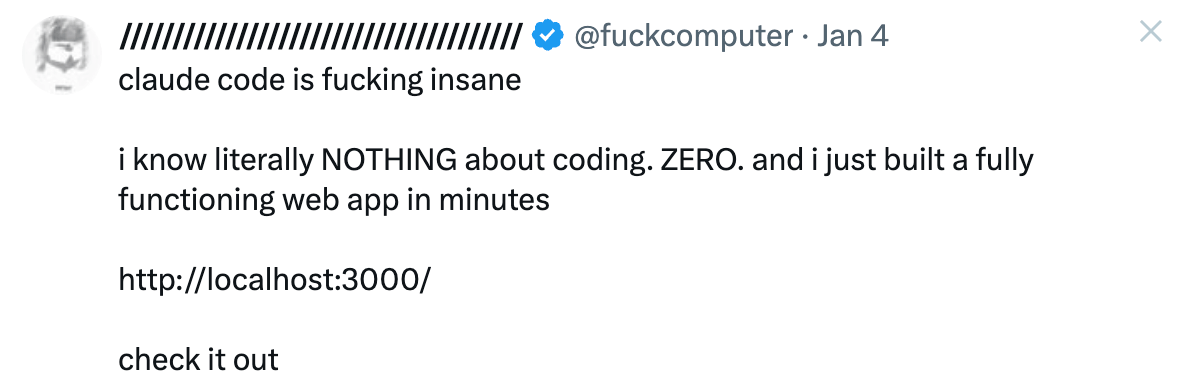
The deployment problem. Many consumers struggle to understand how to deploy a product they’ve built (hence the “localhost” meme). Consumer tools need to collapse this complexity entirely—you hit “done” and your thing exists in the world.
The Opportunity

Almost everyone uses software. Very few people have ever built it. That’s starting to change with vibe coding—but so far, it’s only come for people who are already somewhat technical.

The startups that figure out vibe coding for consumers will do what Squarespace did for websites and Canva did for design: take something that requires expertise and make it accessible.

Right now, vibe coding is a spectator sport for most of America. Someone’s going to build the on-ramp. When they do, we won’t just have more developers—we’ll have millions of people building software who never thought they could.

If you’re building in this space, reach out. I’m at @venturetwins or jmoore@a16z.com.

Want More a16z Infra?

Analysis and news covering the latest trends reshaping AI and infrastructure.

Learn More
Recommended For You
Infra

new Your Data Agents Need Context

Jason Cui and Jennifer Li
Infra

The State of Generative Media 2026

Jennifer Li and Justine Moore
Infra

Matt Bornstein

Martin Casado

Want More Infra?

Analysis and news covering the latest trends reshaping AI and infrastructure.

Sign Up On Substack

Views expressed in “posts” (including podcasts, videos, and social media) are those of the individual a16z personnel quoted therein and are not the views of a16z Capital Management, L.L.C. (“a16z”) or its respective affiliates. a16z Capital Management is an investment adviser registered with the Securities and Exchange Commission. Registration as an investment adviser does not imply any special skill or training. The posts are not directed to any investors or potential investors, and do not constitute an offer to sell — or a solicitation of an offer to buy — any securities, and may not be used or relied upon in evaluating the merits of any investment.

The contents in here — and available on any associated distribution platforms and any public a16z online social media accounts, platforms, and sites (collectively, “content distribution outlets”) — should not be construed as or relied upon in any manner as investment, legal, tax, or other advice. You should consult your own advisers as to legal, business, tax, and other related matters concerning any investment. Any projections, estimates, forecasts, targets, prospects and/or opinions expressed in these materials are subject to change without notice and may differ or be contrary to opinions expressed by others. Any charts provided here or on a16z content distribution outlets are for informational purposes only, and should not be relied upon when making any investment decision. Certain information contained in here has been obtained from third-party sources, including from portfolio companies of funds managed by a16z. While taken from sources believed to be reliable, a16z has not independently verified such information and makes no representations about the enduring accuracy of the information or its appropriateness for a given situation. In addition, posts may include third-party advertisements; a16z has not reviewed such advertisements and does not endorse any advertising content contained therein. All content speaks only as of the date indicated.

Under no circumstances should any posts or other information provided on this website — or on associated content distribution outlets — be construed as an offer soliciting the purchase or sale of any security or interest in any pooled investment vehicle sponsored, discussed, or mentioned by a16z personnel. Nor should it be construed as an offer to provide investment advisory services; an offer to invest in an a16z-managed pooled investment vehicle will be made separately and only by means of the confidential offering documents of the specific pooled investment vehicles — which should be read in their entirety, and only to those who, among other requirements, meet certain qualifications under federal securities laws. Such investors, defined as accredited investors and qualified purchasers, are generally deemed capable of evaluating the merits and risks of prospective investments and financial matters.

There can be no assurances that a16z’s investment objectives will be achieved or investment strategies will be successful. Any investment in a vehicle managed by a16z involves a high degree of risk including the risk that the entire amount invested is lost. Any investments or portfolio companies mentioned, referred to, or described are not representative of all investments in vehicles managed by a16z and there can be no assurance that the investments will be profitable or that other investments made in the future will have similar characteristics or results. A list of investments made by funds managed by a16z is available here: https://a16z.com/investments/. Past results of a16z’s investments, pooled investment vehicles, or investment strategies are not necessarily indicative of future results. Excluded from this list are investments (and certain publicly traded cryptocurrencies/ digital assets) for which the issuer has not provided permission for a16z to disclose publicly. As for its investments in any cryptocurrency or token project, a16z is acting in its own financial interest, not necessarily in the interests of other token holders. a16z has no special role in any of these projects or power over their management. a16z does not undertake to continue to have any involvement in these projects other than as an investor and token holder, and other token holders should not expect that it will or rely on it to have any particular involvement.

With respect to funds managed by a16z that are registered in Japan, a16z will provide to any member of the Japanese public a copy of such documents as are required to be made publicly available pursuant to Article 63 of the Financial Instruments and Exchange Act of Japan. Please contact compliance@a16z.com to request such documents.

For other site terms of use, please go here. Additional important information about a16z, including our Form ADV Part 2A Brochure, is available at the SEC’s website: http://www.adviserinfo.sec.gov.