If you had just five minutes to tell a Founding Father about the last 250 years in America, what would you say?
It’s 2026, the 250th anniversary of the signing of the Declaration of Independence, so it’s a natural time to reflect. What is the state of our union? Are we living up to the expectations our founders set out for us?
If you only listened to the loudest voices in the legacy media, you’d think America was on the verge of collapse. Rolling Stone asked if we are “witnessing the fall of the American Empire.” Francis Ford Coppola, one of the great directors of the twentieth century, was quoted in The Guardian as saying we are at the point where “we might lose our republic.” In the wake of Charlie Kirk’s assassination, Vox asked if America is “on the brink of civil war.”
And the tone of the national conversation on social media is even worse. The subject of the chatter changes daily, but the gloomy tone persists: the terminally online, wildly overresponsible for what information Americans ingest, are not quite sure what will ultimately doom America, but the leading contenders include political violence, tribalism, insurrection, cancel culture, systemic inequality, climate change, drug overdoses, border control, gun violence, crashing fertility rates, the “loneliness epidemic,” Chinese competition, restrictions on speech, wokeism, community collapse, rising housing costs, authoritarianism, socialism, and the national debt.
But if I had that conversation with a Founding Father, I’d start with this:
The Union survived, and there’s an American flag on the moon.
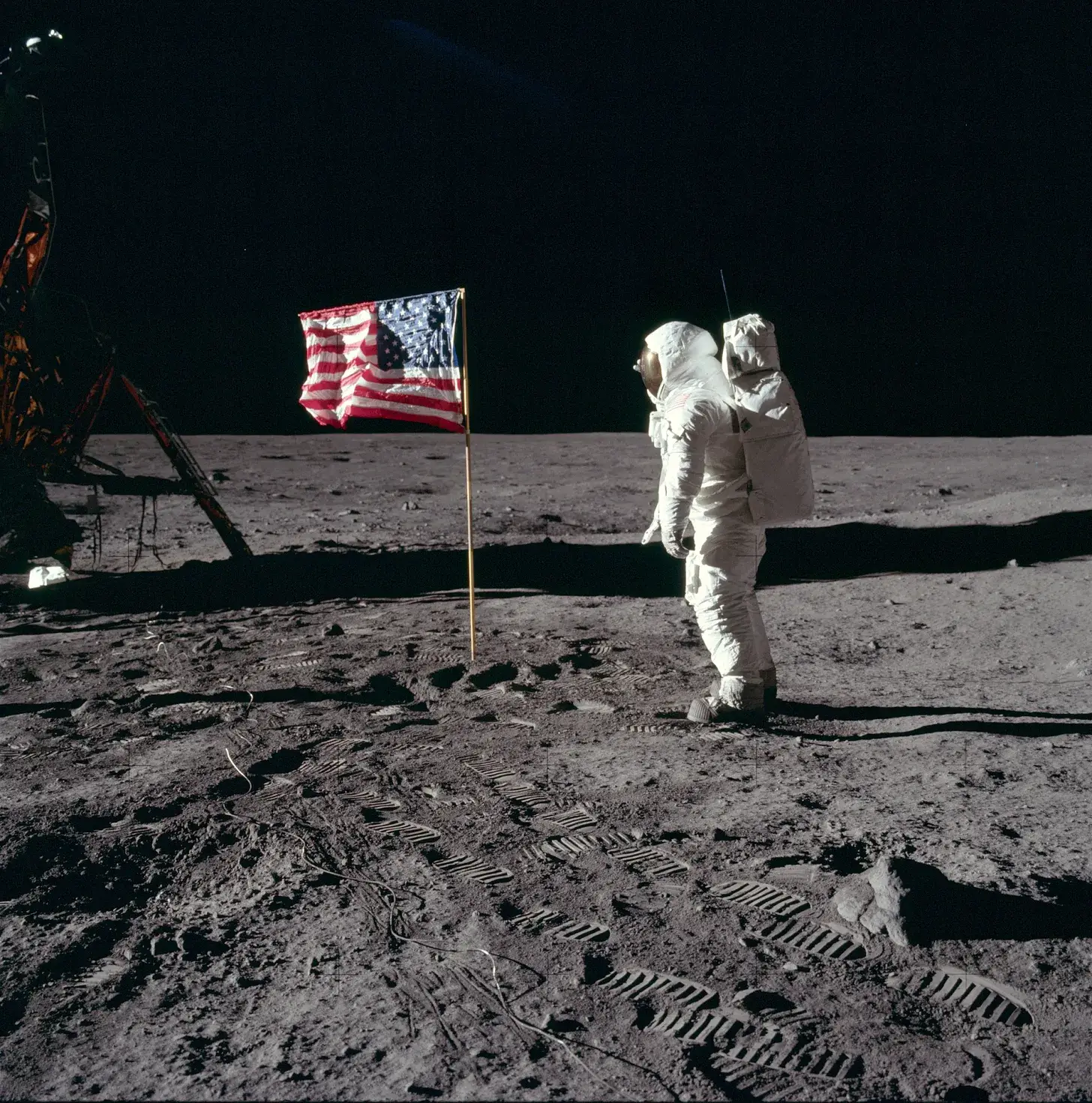
NASA / Neil A. Armstrong – Apollo 11 Image Library
The nation fought a brutal civil war over the issue of slavery. Eleven of the 34 states seceded; 2% of all Americans died; the union’s national debt rose 3300% in just five years; the President suspended habeas corpus. Slavery was abolished. And the Union survived.
The world fought a series of brutal, global wars. In both, Americans were drafted to fight across oceans. In the worst, a German dictatorship conquered continental Europe and left Britain alone, besieged, the last thing standing between the world and totalitarian dictatorship. America, by then the world’s foremost industrial superpower, intervened and defeated the Germans. And the Union survived.
A massive social revolution extended America’s ideals to every American, whether white or black, male or female; America led the world through wave after wave of technological revolution that dramatically changed the way people live, work, and find meaning. And the Union survived.
There are 340 million Americans that live in 50 states coast-to-coast. Only 0.5% of infants die before age one, and the average American lives to be 78 years old. Less than 2% of Americans work in agriculture, compared to 90% in 1776, and the average American consumes 15 times more energy daily. Americans can now talk to almost any human on Earth, instantly, using a device that fits in their pocket. Flying machines — planes — can carry you anywhere on Earth in less than 24 hours. And even more powerful flying machines — rockets — can escape the surface of Earth and have brought Americans to the lunar surface.
I do not think it would be difficult to explain to a Founding Father how incredible it is that the American union survived for 250 years, and that life in 2026 is awesome.
But, judging from the discourse, the inverse — convincing you that things are great, today, actually — might be a more challenging sell. We are David Foster Wallace’s fish in water: “There are these two young fish swimming along and they happen to meet an older fish swimming the other way, who nods at them and says ‘Morning, boys. How’s the water?’ And the two young fish swim on for a bit, and then eventually one of them looks over at the other and goes ‘What the hell is water?’”
In the remainder of these pages, it is my goal to remind you that Americans today are floating in absolutely pristine, carefully-engineered, painstakingly-filtered, brilliantly blue water. The last 250 years of technological progress are often invisible, yet make us safer, healthier, more comfortable, more connected, and more productive — and a quick look back at what life looked like in 1776 will help bring that truth into focus.
Water
In 1776, water was scarce. There was no household running water; every drop had to be physically hauled from the nearest freshwater source. The average household consumed just a few gallons of cold, unpressurized water each day, and adults and children alike would at times drink home-brewed beer, hard cider, or whiskey instead, out of fear of disease.
Those fears were warranted. Water sources were often brackish, muddy, or polluted, and in a pre-filtration, pre-germ-theory world, water was often a vector for diseases like dysentery or typhoid.
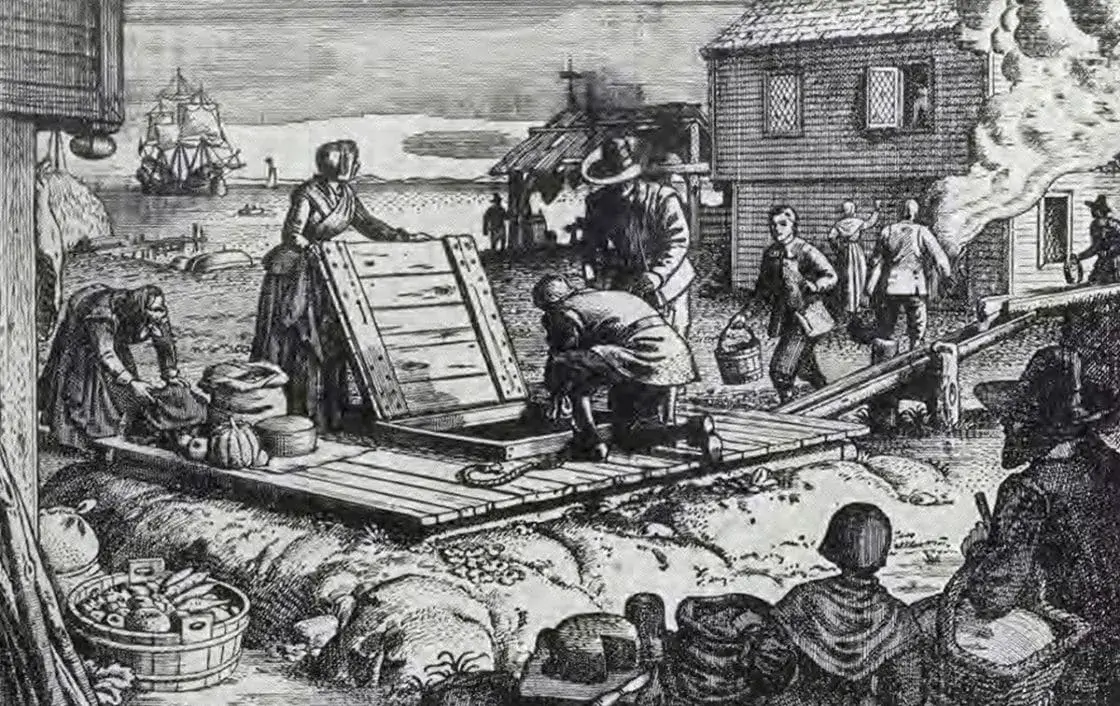
The “Conduit”, Boston’s 1652 supply, the first Water Works in the U.S.
Food
The food supply in Revolutionary America was more reliable by comparison. Producing food required a massive human burden, of course — nine out of every ten colonial Americans worked in agriculture.
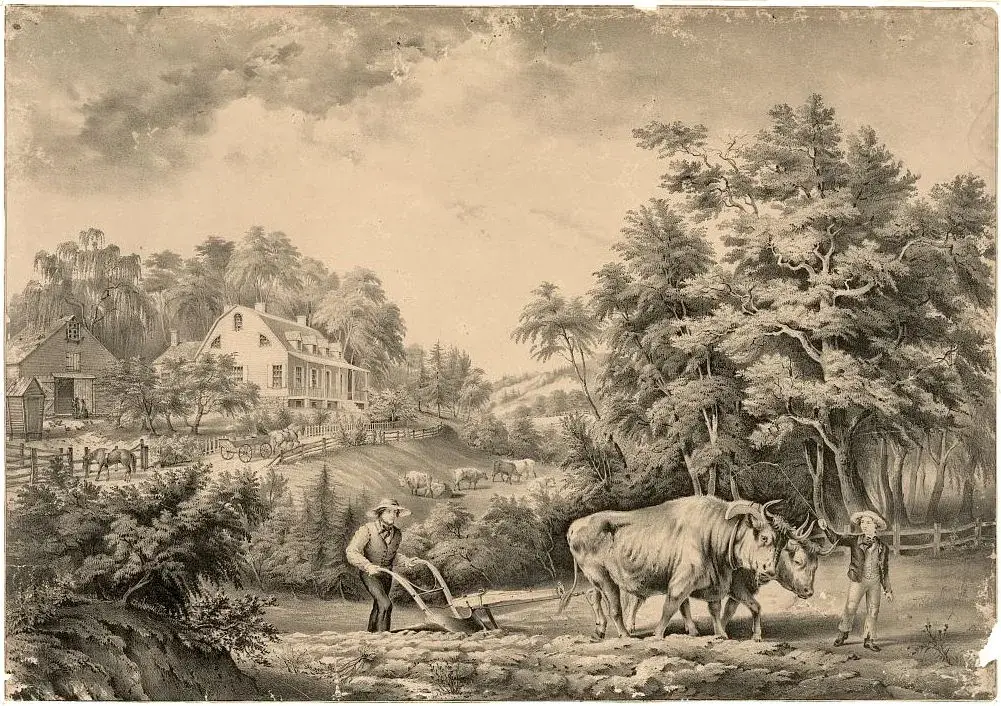
1853 Currier & Ives print of an American farmer plowing his field.
With no refrigeration, de-brining salted meats required hours of soaking in water. But most Americans were well-fed, at least during the summer. In the winter, fresh produce was scarce given the impossibility of long-distance food transportation, making scurvy a legitimate threat.
Shelter
Winter created far greater problems than scurvy in 1776, however, as insulation was effectively unknown. Houses were small, drafty, and entirely reliant on inefficient, ashy, smoky, smelly hearths for heating. You could only really get warm around the fire, or in bed with a bladder of hot water or a bed of coals; Thomas Jefferson famously couldn’t write to complain about the cold in his estate, Monticello, because his inkwell had frozen solid.
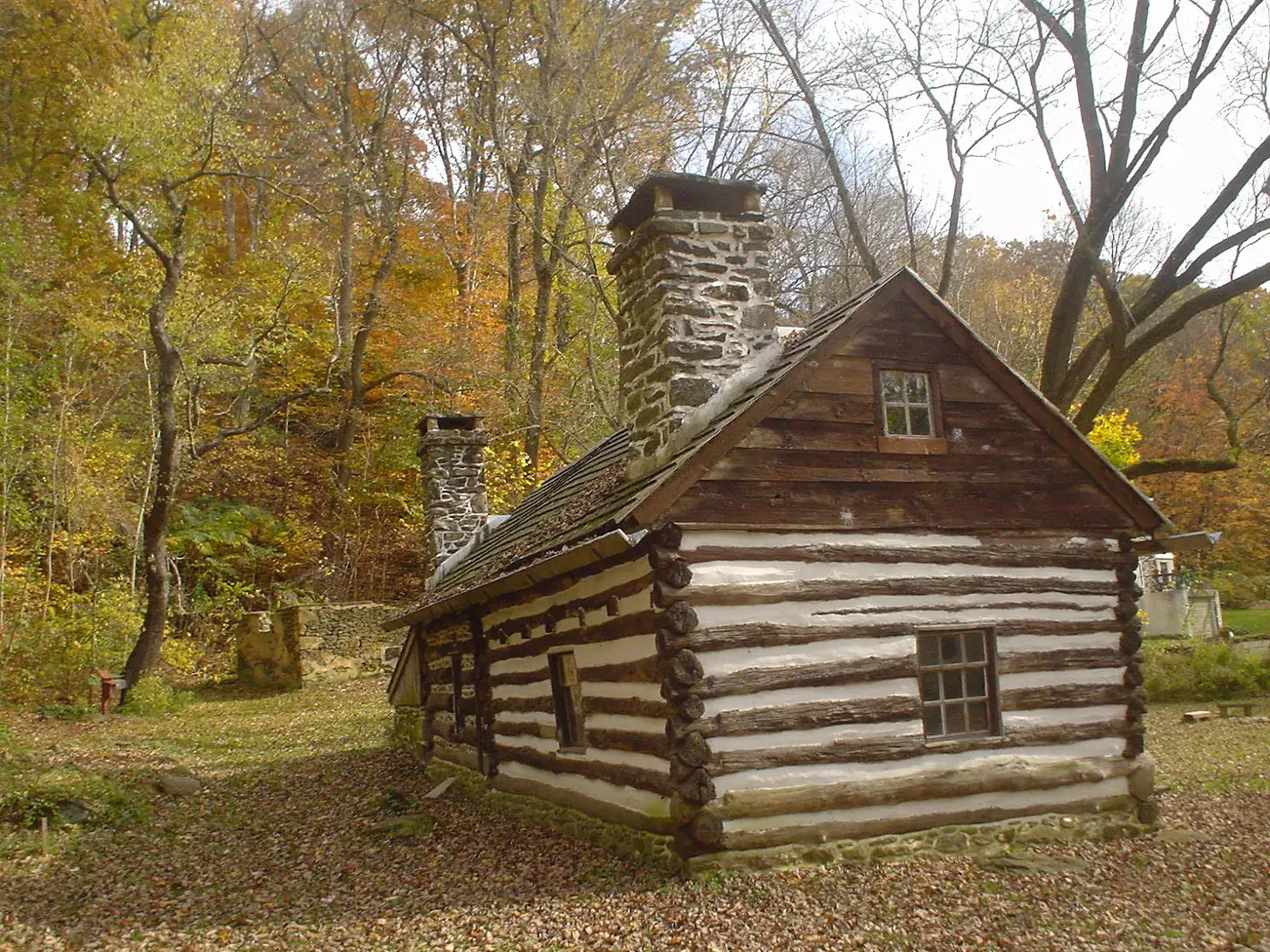
Lower Swedish Cabin, Drexel Hill, Upper Darby Township, Pennsylvania, built ca. 1640–1650, may be one of the oldest log cabins in the United States.
The winter’s cold and the daily necessities of cooking and water purification made firewood a truly massive industry. Cutting, hauling, storing, and constantly managing firewood meant that it may have been more than one quarter of the 1776 economy. (For comparison, 28% of America’s GDP in 2026 is roughly $8.7 trillion.) Nearly every colonial household consumed about forty cords of wood — 5,120 cubic feet, or around 70 tons, of stacked fire wood — annually.
(Firewood in the American Economy: 1700 to 2010. | NBER)
Sights and Smells
With no incandescent lighting, nighttime was oppressively dark. You could read fireside or by candlelight, but both were expensive. George Washington famously spent $15,000 on candles each year (in today’s dollars).
Washington’s preferred candles — made from spermaceti (a waxy oil from the heads of sperm whales) or beeswax — were mostly odorless, but expensive. A single beeswax candle cost roughly a laborer’s daily wage. As a result, most people could only afford to use tallow candles made from animal fat, which were smoky and putrid. Or they simply embraced the darkness, and looked up at a sky completely alive with stars. (This is one part of life in 1776 that I envy.)
Even during the day, many people couldn’t see clearly. Eyeglasses were expensive, yet primitive: Benjamin Franklin wouldn’t invent bifocals until 1784. Not that you’d always want to see the sights of 1776 America. Colonial cities were, in a word, disgusting.
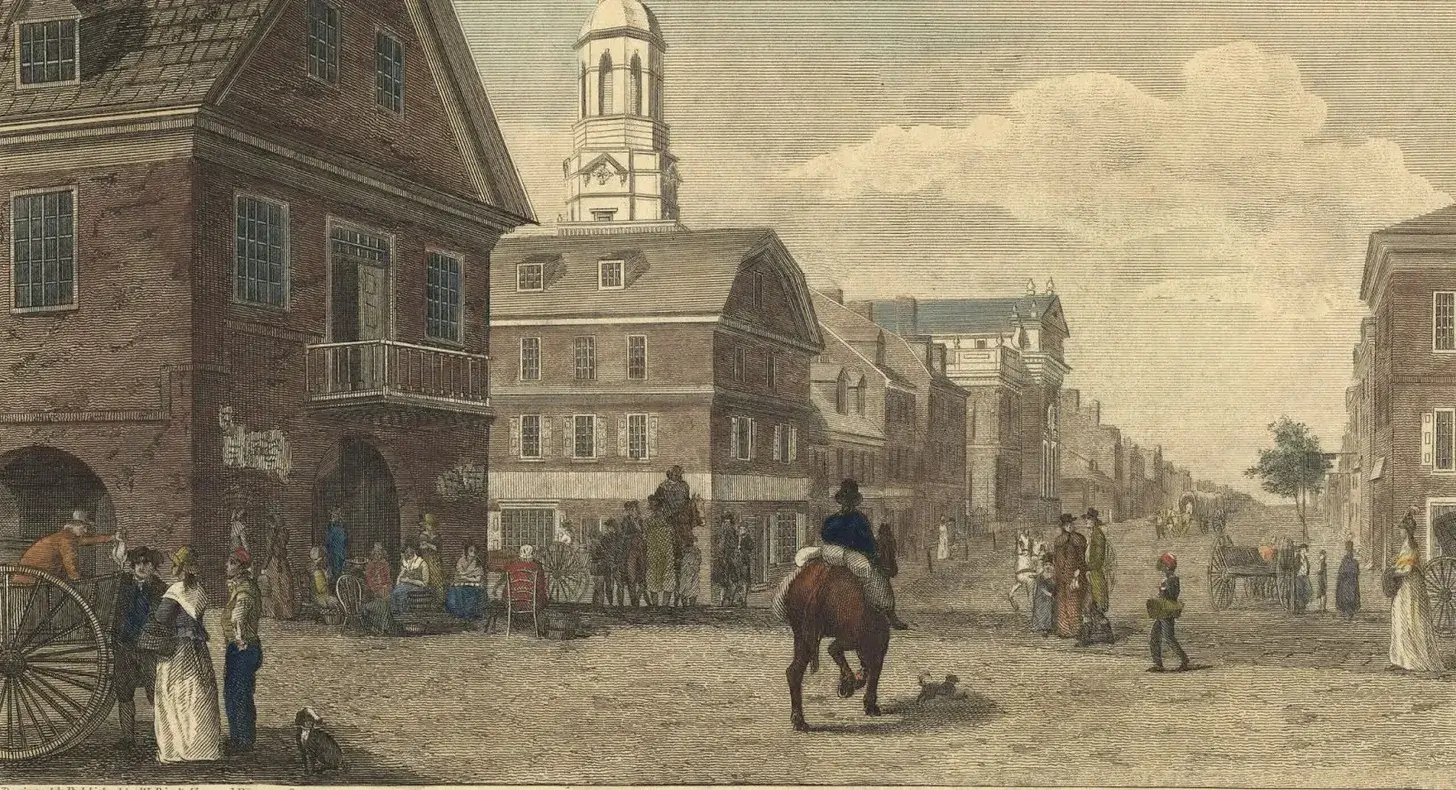
Engraving of Philadelphia from 1799. Second Street North from Market St. and Christ Church, created by William Birch
Indoor plumbing was nonexistent, so if the urge arose in the middle of the night, a colonist might simply defecate in a chamber pot and toss it out the window to be retrieved by a “night soil man.” Streets that didn’t smell of human excrement certainly smelled of horse manure (“emissions” meant something different for 18th century transportation) or rotting trash on the streets. Colonists at the time rarely took a full bath, and to survive in such an olfactory environment many colonists adopted the “nosegay,” a small, fragrant bouquet worn to ward off offensive smells.
Medicine
In such a sanitation-free environment, diseases rampaged through the colonies with little resistance. Doctors were still in the “balancing humors” stage of medicine, hadn’t yet discovered anesthesia, and did little to keep people alive: 40% of all children died before age five, and those who made it to age five could only expect to live to 60 years old.
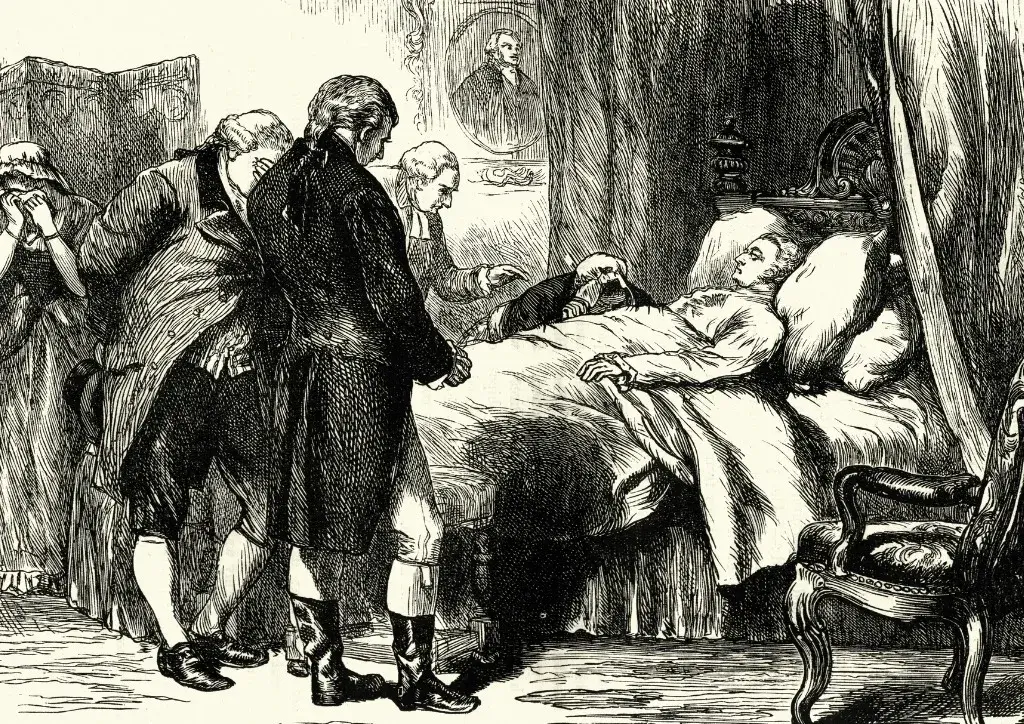
George Washington died at age 67, likely of epiglottis, a bacterial infection of the throat, which is survivable today.
In 1776, many now-treatable ailments were fatal. You could die of pneumonia, a burst appendix, sepsis from a minor cut, tetanus, the flu, or a simple fever. You could die of dysentery or scurvy. You could die of any number of now-vaccinated or eradicated diseases: smallpox, typhoid, malaria, cholera, tuberculosis, diphtheria, whooping cough, or yellow fever. The world was casually, routinely lethal.
Comfort
Making a new shirt in 1776 took hundreds of hours of manual labor. Flax seeds needed to be grown, harvested, retted, broken, scutched, heckled, spun, and woven — so most people only owned one good set of clothes. Clothing was so valuable that some colonists listed it in their wills.
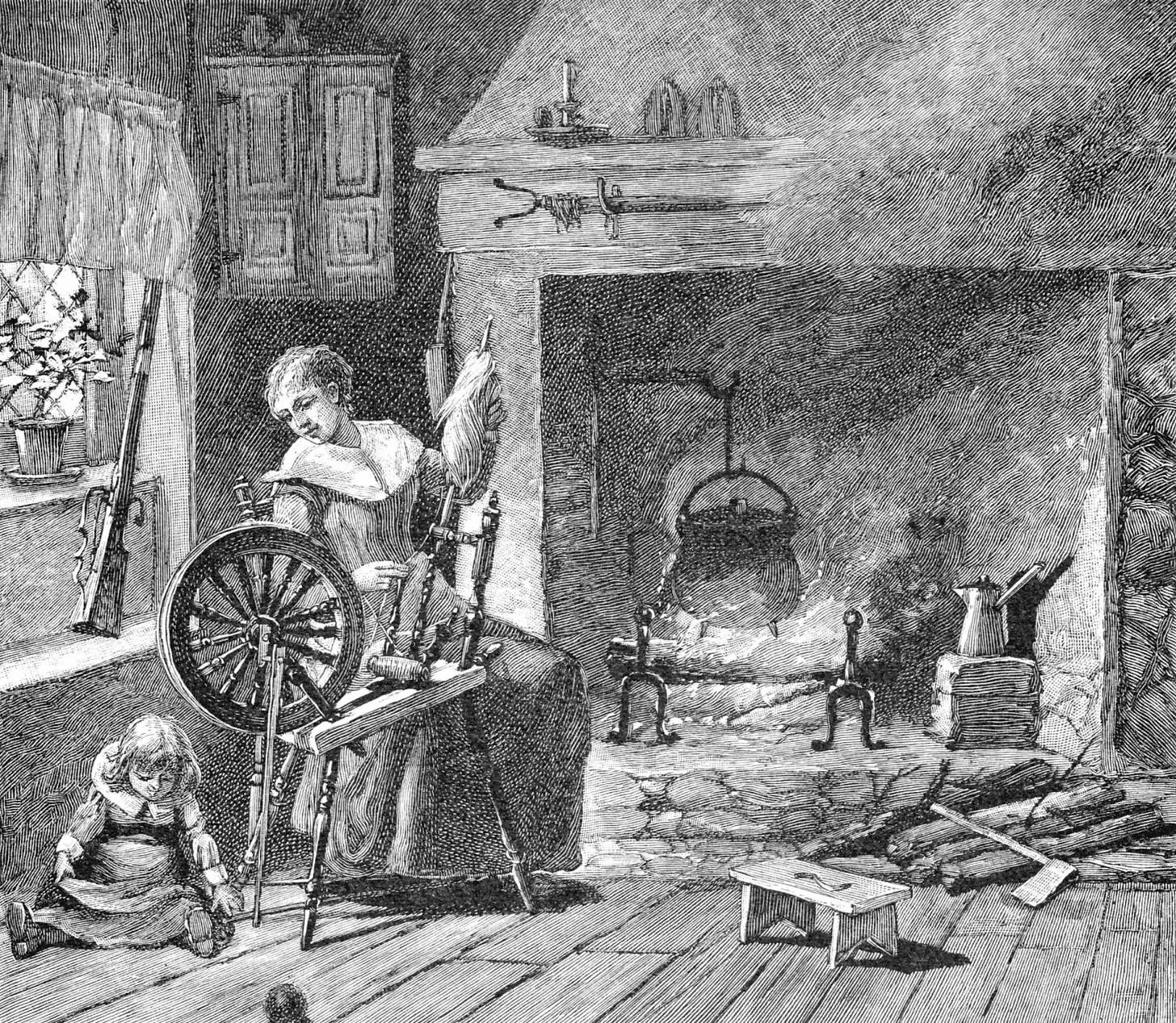
A New England kitchen, engraving in A Brief History of the United States (1885)
The world was not comfortable, and cosmetic improvements were unnecessary and therefore neglected. Dental hygiene, for instance, was uncommon. Most adults were missing teeth, and only the rich — including, famously, George Washington — could afford to replace them.
Energy and Work
The vast majority of “schooling” was just one-on-one apprenticeship to learn a trade, often starting as early as age 13.
As noted, 90% of the population worked in agriculture, and farming was manual labor powered by humans and horses. A human can generate about 75 watts of work; a horse can generate 750. For comparison, a single gallon of gasoline can generate 33,000 watt-hours of energy.
Knowledge work like governance and trading were similarly inefficient, with low literacy rates, no standard timekeeping method, and exceptionally slow communications channels. News traveled at the speed of a horse — whether “the British are coming” or the news of the signing of the Declaration of Independence itself, which took 29 days to travel the 550 miles from Philadelphia to Charleston, South Carolina.
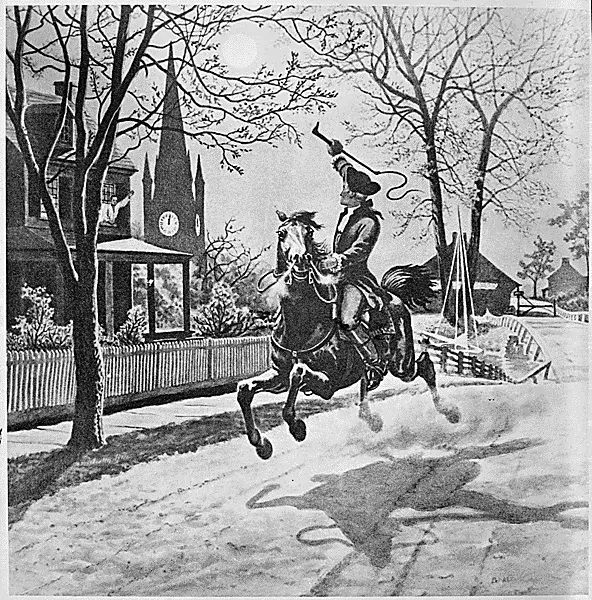
7. Paul Revere’s ride, Illustration. Local Identifier: 208-FS-3200-5. National Archives Identifier: 535721.
Travel
It was rare for a colonist ever to travel more than a few dozen miles from home. A longer trip, say from Boston to New York, might take a week on horseback or a “miraculous” five days on “The Flying Machine“ stagecoach.
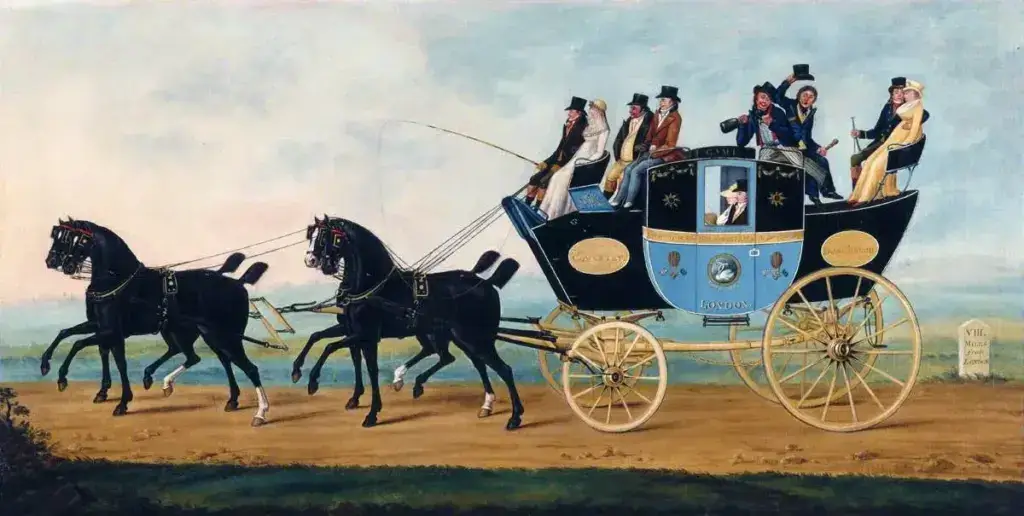
Cordrey, John; The London to Birmingham Stage Coach; Science Museum, London
Crossing the ocean was nearly unthinkable. Of course, colonists had made the treacherous, ten-week voyage to reach the American colonies — but most would make such a risky trip once in their lifetimes.
Flash forward to the modern day, and we are surrounded by invisible miracles.
I am writing this piece in the middle of winter, in a fully lit, 72-degree room at 8:38pm. Earlier today, I drove my electric car on a paved road to pick up a week’s worth of groceries. We ate fresh vegetables for dinner (in winter!), cooked indoors using filtered, on-demand water on a natural gas flame, prepared by my mother-in-law who is visiting from her home 2,000 miles away in Georgia. My two children, born safely at clean hospitals, are sleeping comfortably in soft beds and warm clothing. My wife is talking to her friend who lives in Tennessee. I am watching a basketball game happening in Seattle on the right half of my screen, while typing this on the left. I’m wearing a shirt gifted to me by my employer, one of perhaps a dozen t-shirts I own. The room smells like vanilla thanks to a $5.43 candle. The candle is made of scented wax, not spermaceti.
America in 2026 is not perfect, but we have achieved an incredibly high standard of living. Of course, we still face profound challenges, but we have shown that material progress is eminently possible. That’s why I work to build and fund technology companies that promote the national interest: I am a proactive optimist who believes in the American Dream. I do not believe things automatically will get better, but I know that things can get better if we make them so.
If you brought a Founding Father to modern-day America, it would take a while to explain to them how far technology has come over the past 250 years. (Or slightly less time, if you show them my report, More Perfect.) But once he understood the everyday miracles of our technologically-infused lives, it may be even harder for him to understand the pessimism of the national conversation. If we’ve come this far, he might ask, why would we think that any problem can stand in America’s way for long?
