Fintech

The Fresno Free-for-All Behind the Original Credit Card

Alex Rampell Posted September 18, 2019

Credit cards and payment cards are arguably the most valuable network in the world, with at least $1 trillion of publicly traded market cap. On September 18, 1958—61 years ago today—it all began in the little town of Fresno, California. 

At the time, there were “charge cards,” like Diner’s Club, but there was no “credit” being extended. For consumers, lines of credit were either specific to a merchant (like Sears), or a burdensome process. If you wanted to get a loan, you had to go to the bank in person.
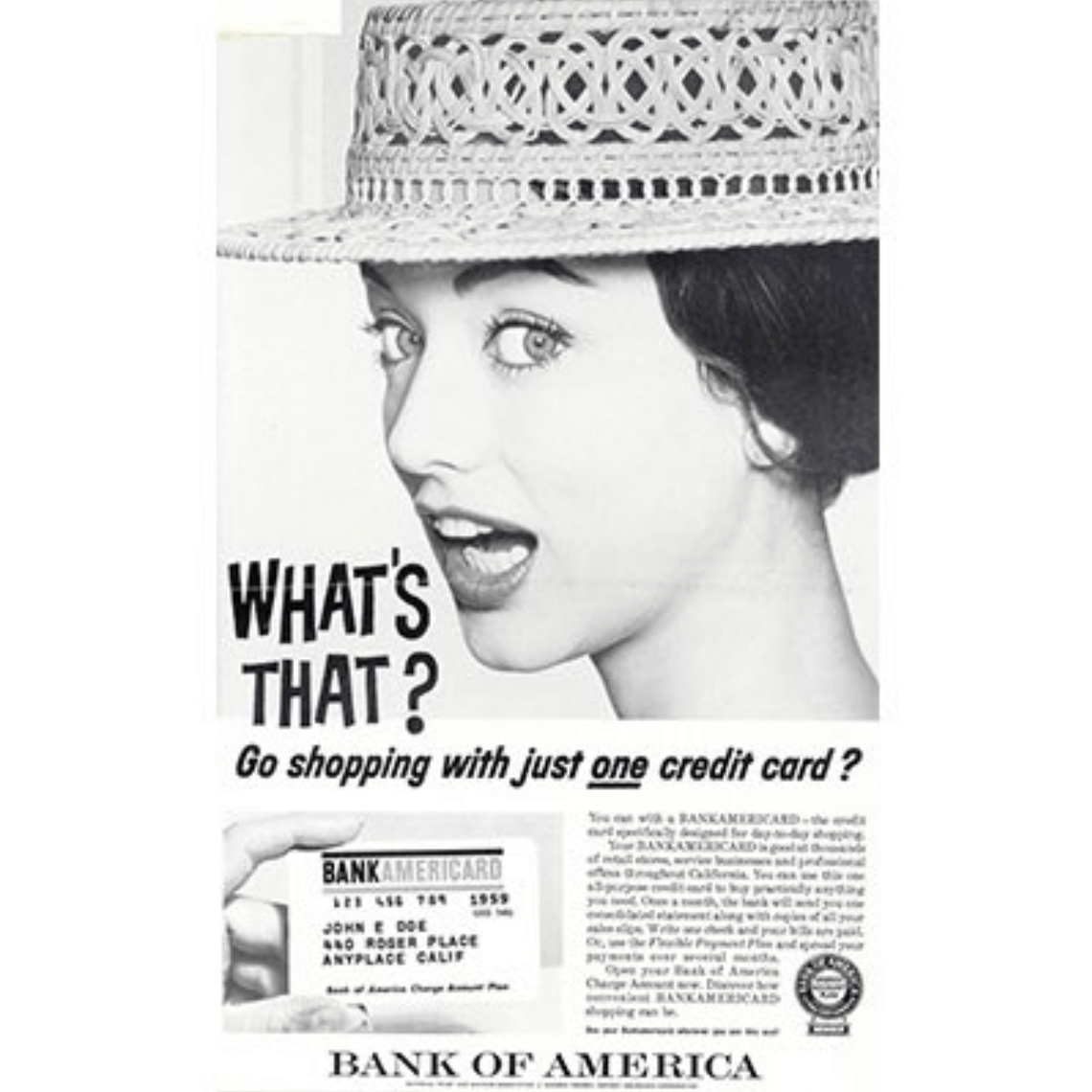
Back then, Bank of America was still a California-only operation. Fresno’s population was about 250,000 people and 45 percent of all Fresno families were Bank of America customers. The concept for the credit card emerged out of the bank’s corporate think tank, called the “Customer Services Research Department,” run by a 41-year-old named Joe Williams. Williams thought a multi-merchant credit card could provide two benefits: convenience (don’t carry cash!) and lending (don’t apply for more and more loans, let your whole balance “revolve” if you want).

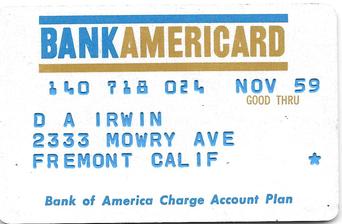
On September 18, the bank mailed 60,000 Fresno residents a BankAmericard. There was no application process. The card simply arrived in the mailbox, ready to use. Credit card fees for merchants were set at 6 percent and consumers received between $300 and $500 in instant credit. There was a certain brilliance behind the 60,000-person drop: On day 1, cardholders simply existed. This permitted Bank of America to sign up all merchants who didn’t already have proprietary credit card programs. BofA focused on fast-moving, small merchants like Florsheim Shoes, not giants like Sears. More than 300 Fresno merchants signed up.

Within three months, Bank of America had expanded its customer base to Modesto in the north and Bakersfield to the south. Within a year, it added San Francisco, Sacramento, and Los Angeles. Thirteen months after the initial Fresno drop, the bank had issued 2 million cards and onboarded 20,000 merchants. 
Joe Williams, the card’s original mastermind, had assumed that collections would be a breeze, late payments would never cross 4 percent, and existing bank credit systems would work. Instead, his optimistic projections did not hold. Simply giving people credit cards created far more bad debt than Bank of America had ever seen (on a customer % basis). Delinquencies were over 20 percent. Merchants hated paying 6 percent fees. Criminals quickly figured out how to replicate the cards, and fraud grew out of control. Less than two years after the Fresno drop, Williams quit. The credit card almost died then and there. 

But against all odds, Bank of America persevered with the BankAmericard. Within a few years, BankAmericard turned a profit. Eventually, BankAmericard became a non-profit consortium called Visa, uniting many banks with competing credit cards. Another consortium called MasterCharge (later MasterCard) did the same with a different set of banks. The credit card grew like a rocketship, transforming how people pay and borrow. The rest is history.

Read Joe Nocera’s Piece of the Action for more.

Want More a16z Fintech?

Commentary and analysis on recent news, and compelling trends in the fintech space.

Learn More

Want More Fintech?

Commentary and analysis on recent news, and compelling trends in the fintech space.

Sign Up On Substack

Views expressed in “posts” (including podcasts, videos, and social media) are those of the individual a16z personnel quoted therein and are not the views of a16z Capital Management, L.L.C. (“a16z”) or its respective affiliates. a16z Capital Management is an investment adviser registered with the Securities and Exchange Commission. Registration as an investment adviser does not imply any special skill or training. The posts are not directed to any investors or potential investors, and do not constitute an offer to sell — or a solicitation of an offer to buy — any securities, and may not be used or relied upon in evaluating the merits of any investment.

The contents in here — and available on any associated distribution platforms and any public a16z online social media accounts, platforms, and sites (collectively, “content distribution outlets”) — should not be construed as or relied upon in any manner as investment, legal, tax, or other advice. You should consult your own advisers as to legal, business, tax, and other related matters concerning any investment. Any projections, estimates, forecasts, targets, prospects and/or opinions expressed in these materials are subject to change without notice and may differ or be contrary to opinions expressed by others. Any charts provided here or on a16z content distribution outlets are for informational purposes only, and should not be relied upon when making any investment decision. Certain information contained in here has been obtained from third-party sources, including from portfolio companies of funds managed by a16z. While taken from sources believed to be reliable, a16z has not independently verified such information and makes no representations about the enduring accuracy of the information or its appropriateness for a given situation. In addition, posts may include third-party advertisements; a16z has not reviewed such advertisements and does not endorse any advertising content contained therein. All content speaks only as of the date indicated.

Under no circumstances should any posts or other information provided on this website — or on associated content distribution outlets — be construed as an offer soliciting the purchase or sale of any security or interest in any pooled investment vehicle sponsored, discussed, or mentioned by a16z personnel. Nor should it be construed as an offer to provide investment advisory services; an offer to invest in an a16z-managed pooled investment vehicle will be made separately and only by means of the confidential offering documents of the specific pooled investment vehicles — which should be read in their entirety, and only to those who, among other requirements, meet certain qualifications under federal securities laws. Such investors, defined as accredited investors and qualified purchasers, are generally deemed capable of evaluating the merits and risks of prospective investments and financial matters.

There can be no assurances that a16z’s investment objectives will be achieved or investment strategies will be successful. Any investment in a vehicle managed by a16z involves a high degree of risk including the risk that the entire amount invested is lost. Any investments or portfolio companies mentioned, referred to, or described are not representative of all investments in vehicles managed by a16z and there can be no assurance that the investments will be profitable or that other investments made in the future will have similar characteristics or results. A list of investments made by funds managed by a16z is available here: https://a16z.com/investments/. Past results of a16z’s investments, pooled investment vehicles, or investment strategies are not necessarily indicative of future results. Excluded from this list are investments (and certain publicly traded cryptocurrencies/ digital assets) for which the issuer has not provided permission for a16z to disclose publicly. As for its investments in any cryptocurrency or token project, a16z is acting in its own financial interest, not necessarily in the interests of other token holders. a16z has no special role in any of these projects or power over their management. a16z does not undertake to continue to have any involvement in these projects other than as an investor and token holder, and other token holders should not expect that it will or rely on it to have any particular involvement.

With respect to funds managed by a16z that are registered in Japan, a16z will provide to any member of the Japanese public a copy of such documents as are required to be made publicly available pursuant to Article 63 of the Financial Instruments and Exchange Act of Japan. Please contact compliance@a16z.com to request such documents.

For other site terms of use, please go here. Additional important information about a16z, including our Form ADV Part 2A Brochure, is available at the SEC’s website: http://www.adviserinfo.sec.gov.