There has been a ton of speculation about the extent to which AI has made real inroads into large enterprises, but most existing information consists solely of self-reported AI usage or surveys that capture qualitative buyer sentiment rather than hard data. In addition, the handful of studies that do exist assert that AI is falling short in the enterprise, most notably from a study by MIT that claimed that 95 percent of generative AI pilots fail to convert.
Based on our internal data and conversations with corporate executives, we find that statistic hard to believe. We have been closely tracking where AI is seeing the most adoption and where ROI has been clear, and have compiled hard data on what’s actually working in enterprise AI.
AI Penetration in the Enterprise
Based on our analysis, 29% of the Fortune 500 and ~19% of the Global 2000 are live, paying customers of a leading AI startup.
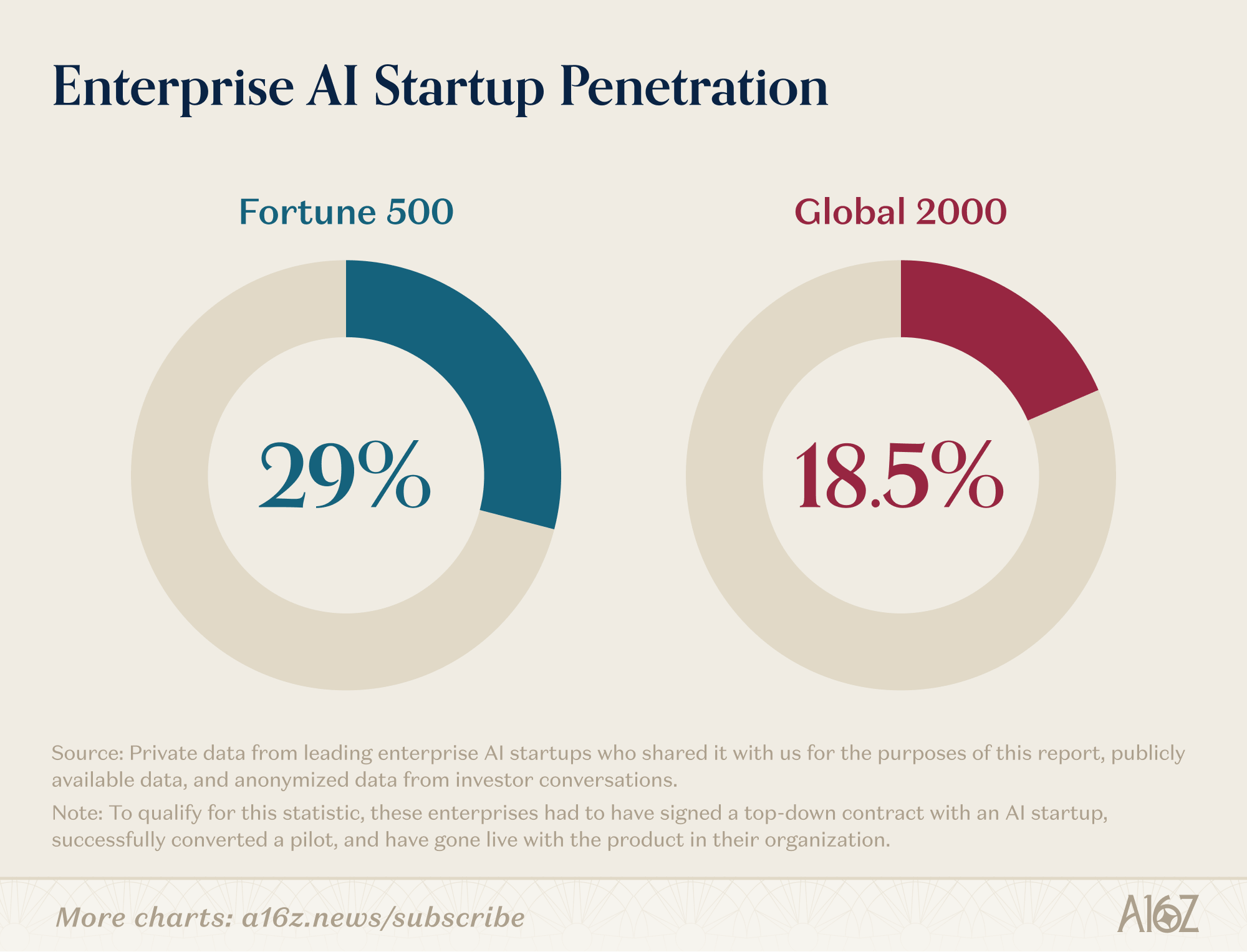
To qualify for this statistic, these enterprises had to have signed a top-down contract with an AI startup, successfully converted a pilot, and have gone live with the product in their organization.
This level of penetration in such a short period of time is remarkable since Fortune 500 enterprises are not known to be early adopters of technology. Historically, many startups had to initially sell to other startups to get early momentum, and it was only after a few years that a startup would be able to land its first enterprise contract, and significantly more revenue and time before they could eventually land a Fortune 500-sized customer.
AI has upended that norm. OpenAI launched ChatGPT in November 2022 and immediately spotlighted the potential of AI to consumers and enterprises alike. In doing so, they unleashed a storm of interest in AI that previous generations of technology never elicited, and large enterprises have been willing to take a bet on newer products earlier than they ever have before. The result: just over 3 years later, almost one-third of the Fortune 500 and one-fifth of the Global 2000 have real enterprise AI deployments in their organizations. (Data Methodology: This data is aggregated from the leading enterprise AI startups and encompasses private data from companies who shared it with us for the purposes of this report, as well as from publicly available data and anonymized data analyzed from the thousands of conversations we have at a16z with both startups and large enterprises.)
What’s Working in Enterprise AI
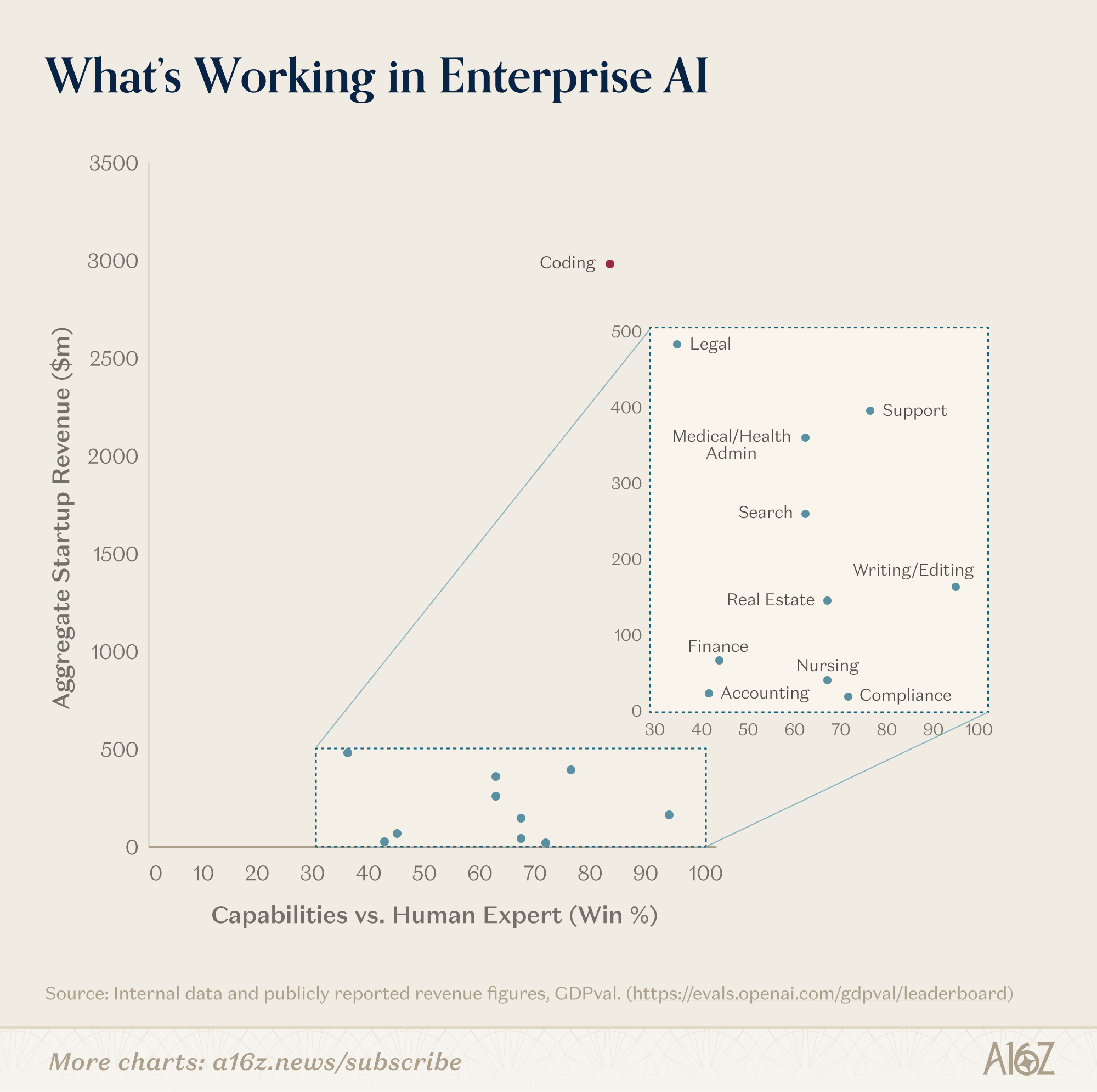
Where is this adoption happening fastest, and how does it map to the work the models are inherently better at doing?
We find that the most indicative way to assess this is to overlay revenue momentum across use cases against the theoretical capabilities of the models as defined by GDPval, a well-known benchmark from OpenAI which assesses model capabilities on real-world economically valuable tasks. To us, these two factors encapsulate both how good models could be, as well as how much value they’re proving to deliver today. This makes them highly illustrative of where AI adoption is today, where it may be headed, and where there’s still AI overhang in adoption despite the maturity of the model capabilities.
Where is enterprise AI delivering the most value today?
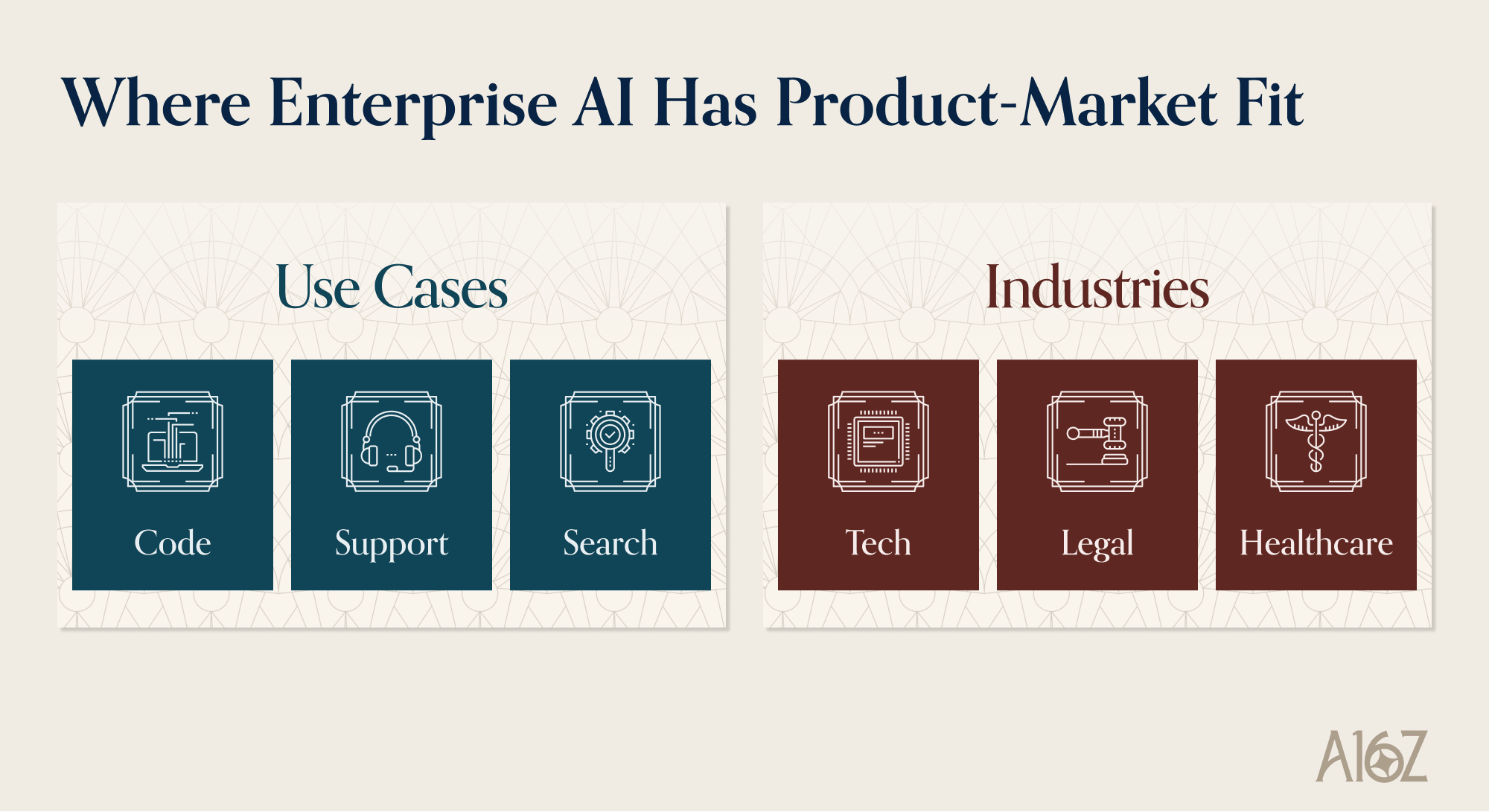
On the revenue momentum, enterprise adoption of AI is dominated by a clear set of use cases and industries. Coding, support, and search represent the lion’s share of use cases by far (with coding being an order-of-magnitude outlier even among this set), while the tech, legal, and healthcare sectors have been the industries most eager to adopt AI.
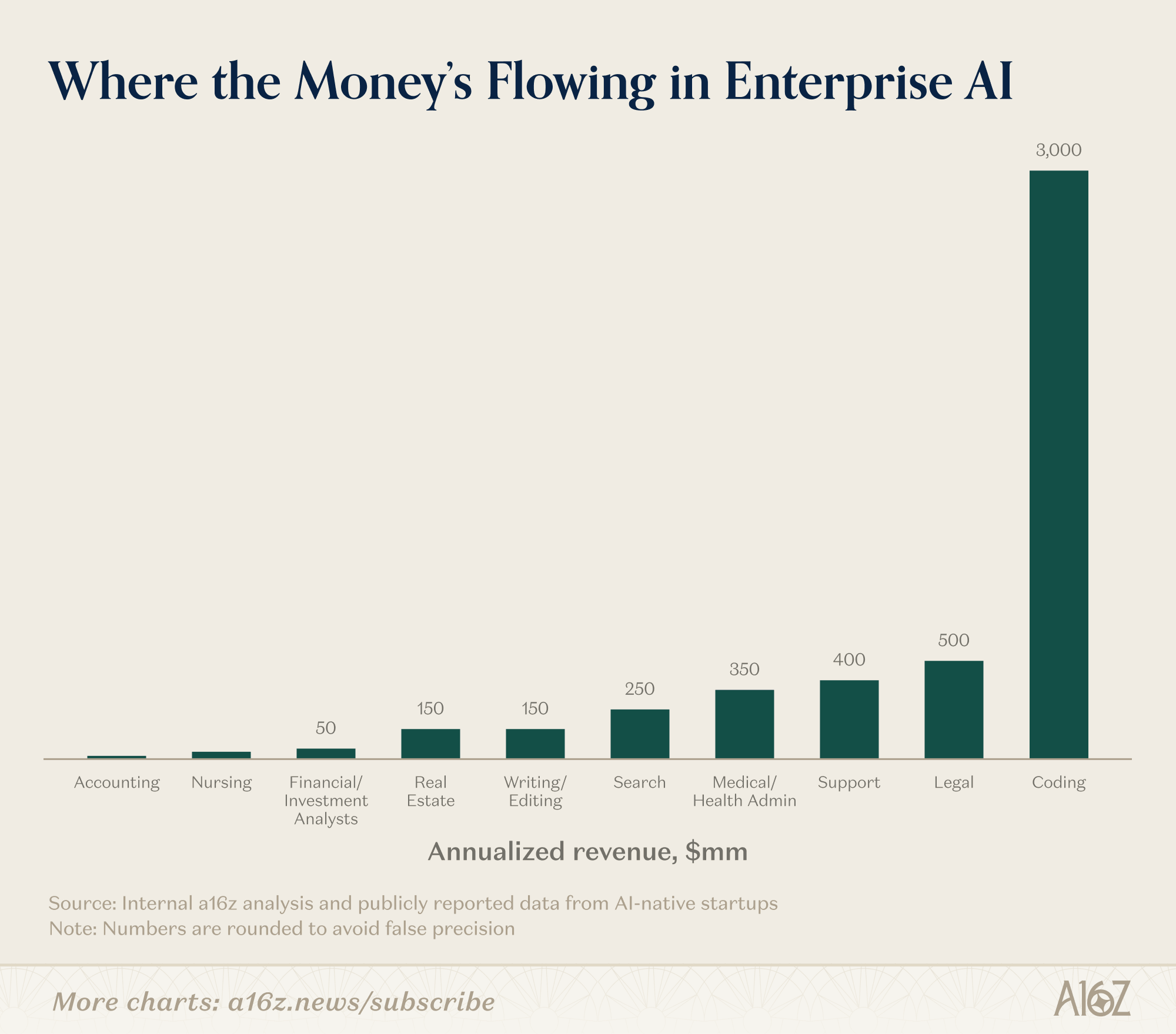
Coding: Coding is the dominant use case for AI by nearly an order of magnitude. It’s abundantly clear in the reported explosive growth of companies like Cursor, as well as the hyper growth of tools like Claude Code and Codex. These growth rates have outstripped virtually everyone’s even most-optimistic predictions, and by far the majority of Fortune 500 / Global 2000 adoption of AI tooling is in code.
In many ways, coding represents the ideal use case for AI, both in terms of what the technology can do and how readily the enterprise market will embrace it. Code is data dense, meaning there is a massive amount of high-quality code available online for the models to train on. It is also text-based, making it easy for models to parse. It is precise and unambiguous, with strict syntax and predictable outcomes. And crucially, it is verifiable: anyone can run it and know if it works, creating tight feedback loops for models to learn from and improve.
It’s also a great application from a business standpoint. We’ve consistently heard from portfolio companies that their best engineers’ productivity levels have increased 10-20x with AI coding tools. Hiring engineers has always been difficult and expensive, so anything that improves their productivity has clear ROI — and the magnitude of lift that AI coding tools provide creates a huge incentive to adopt. Engineers also tend to be early adopters who demand the best-of-breed tools, and because coding is a more solo task compared with most enterprise work, it’s easier for them to simply find the best tool and adopt it without getting bogged down by the coordination and bureaucracy that taxes many other functions in an enterprise.
Moreover, coding tools don’t need to complete the task 100% end-to-end to be value additive, as any acceleration (e.g., finding bugs, generating boilerplate code) is still time-saving and useful. And because coding has a tight human-in-the-loop workflow, with developers still overseeing the development process today, these tools enable accelerated output while still making space for human judgment to review, edit, and iterate. This both increases enterprise confidence and makes the adoption path smoother.
The coding capabilities are improving on an exponential, and every lab has a clear focus on winning code as a use case. This has enormous implications. Code is upstream of all other applications because it’s the core building block for any piece of software, so AI’s accelerating impact on code should accelerate every other domain. The floor to build in those domains drops, unlocking new opportunities to address with AI, but that same accessibility makes building durable competitive advantages more critical than ever for startups.
Support: Support is on the opposite side of the barbell from code. While software engineering often gets the most investment and attention in an organization, support is often overlooked. The work in a support org is back-office, entry-level work, which is often outsourced to offshore firms or business process outsourcing firms (BPOs) because companies deem it to be too tedious and complicated to manage themselves.
AI has proven to be exceptional at managing this work for several reasons. First, the nature of most support interactions is time-bound, with a constrained intent (e.g., issue a refund) that outputs a well-defined problem for agents to tackle. Support is also one of the only functions where the tasks involved in the role are cleanly defined. Support teams are high volume and high turnover, and thus need to train new reps in a fast and standardized way. To do so, they have clearly articulated standard operating procedures (SOPs) that guide the work of each rep. These SOPs create clear rules and guidelines that AI agents can model themselves off of. This sets it apart from most other enterprise work, which is often longer in duration, more ill-defined, and involves many more stakeholders beyond a customer and a service rep.
Support is also one of the clearest corporate functions to demonstrate ROI. Support operates on quantifiable metrics: number of tickets answered, CSAT (satisfaction) score of customers, and resolution rate. Any A/B test of the status quo against AI agents would yield favorable results for the AI agent: it would answer more tickets, increase the resolution rate, and improve consumer satisfaction scores — all for less cost. And because most support is outsourced to BPOs already, adopting AI solutions entails limited change management, making the adoption path much easier.
Support also doesn’t require 100 percent accuracy to be useful since it has natural off-ramps to a human (e.g., “I’m escalating you to a manager). This allows sales cycles to move faster and makes piloting AI support agents relatively low risk; in the worst case, 100% of the cases will simply get escalated and resolved by a human.
Lastly, support is transactional by nature. Customers are indifferent as to who is physically on the other line, meaning support doesn’t require any human relationships that would be difficult for AI to replicate. These characteristics explain why companies like Decagon and Sierra have grown so quickly, as well as more vertical-specific support players like Salient, HappyRobot, etc.
Search: The last horizontal category with clear enterprise market pull is search. ChatGPT’s primary use case is search itself, and so the impact of search is likely baked heavily into ChatGPT’s revenue and usage and is likely vastly understated here.
AI search is so broad as a category that it’s enabled many independent large startups to emerge. One of the primary pain points many enterprises have internally is enabling employees to simply locate and extract relevant information across a disparate set of their systems. Glean has thrived as the primary startup vendor for this use case. Many large industries also operate off of very specific industry information (both internal and external), and companies like Harvey (which began in legal search) as well as OpenEvidence (which began in medical search) have thrived building a core offering around that.
Industries
Technology: By far the most common industry to adopt AI so far is the tech industry. ChatGPT itself reported that 27 percent of its business users come from tech, and many of the early customers of companies like Cursor, Decagn and Glean were tech companies. This is wholly unsurprising given tech is almost always an early adopter and is the industry that spawned the AI wave.
What is more surprising is that markets that were historically not considered early adopters have proven to be eager this time around.
Legal: Legal was surprisingly one of the first-mover industries in AI. Legal was historically known to be a difficult market for software, with lengthy timelines and a less tech-forward buyer.
This was because traditional enterprise software provided limited value to lawyers: static workflow tools didn’t accelerate the unstructured, nuanced work that lawyers typically did. But AI has made the value prop of technology to lawyers much clearer. AI is excellent at parsing dense text, reasoning over large amounts of text, and summarizing and drafting responses — all work that lawyers regularly do. AI now acts often as a copilot to improve individual lawyer productivity, but has begun to extend beyond that: in some cases, it can actually be revenue-generating by allowing law firms to process more cases (as in the case of Eve, which specializes in plaintiff law).
The results are clear. Harvey reported around $200 million in annualized recurring revenue (ARR) within 3 years of founding, and companies like Eve have more than 450 customers and hit a $1 billion valuation this fall.
Healthcare: Healthcare is another market responding to AI in a way it never did for traditional software. Companies like Abridge, Ambience Healthcare, OpenEvidence, and Tennr have grown tremendously quickly in revenue off the back of discrete use cases like medical scribing, medical search, or back office automation of the byzantine rules governing how healthcare gets delivered and paid for.
Healthcare was historically a slower market to adopt software because 1) the highly skilled and complex work mapped poorly to the problems traditional workflow software could solve and 2) the dominance of the system-of-record EHRs like Epic squeezed net new software vendors. With AI, however, companies have been able to take on discrete human-labor work that circumvents the system of record by either replacing administrative work (e.g., medical scribes) or augmenting higher-value work doctors were doing. The work is distinct enough not to require a rip-and-replace of the EHR, allowing these companies to rapidly scale while not needing to replace existing software vendors.
A few notes on the analysis
These estimates are best estimates. It may likely underestimate the amount of revenue being generated in each category and overstate the capabilities of the models.
We are likely understating revenue because:
- The revenue analysis is purely based on which sectors and use cases have been successful enough to generate large, independent enterprise AI businesses and excludes the long tail of use cases other startups are tackling.
- Many of these markets have sizable non-startup players generating significant revenue as well (e.g., Codex/Claude Code in code, CoCounsel by Thomson Reuters in legal), but we have focused our analysis on independent startup players.
- Many of the job tasks articulated in our analysis may be baked into core offerings of the model companies (e.g., search in the case of ChatGPT and OpenAI) but was not broken out and included in this analysis.
- This analysis focused on enterprise businesses rather than consumer or prosumer businesses. There are successful businesses (e.g., Replit and Gamma in app generation and design, respectively) which have a sizable number of business users, but which today are primarily focused on the consumer or prosumer. Given this analysis was focused on enterprise AI and where enterprises are getting value, we excluded consumer-dominant businesses.
On the capabilities front, it’s extraordinarily difficult to measure AI impact on different sectors of the economy, though many economists are trying. Jobs are ill-defined and long-tailed by nature, making them extremely difficult to fully automate. And today it’s unclear how much value enterprises can get out of partial automation — if AI can do only 50 percent of a human’s tasks, the importance of the non-automatable tasks likely goes up since they become the bottlenecks, increasing their relative value. As a result, we are likely overestimating the state of capabilities today, as each incremental 1 percent capability doesn’t translate to 1 percent economic value, but it is still illustrative to note the relative capabilities and how they improve with each new model release.
AI is coming for all markets
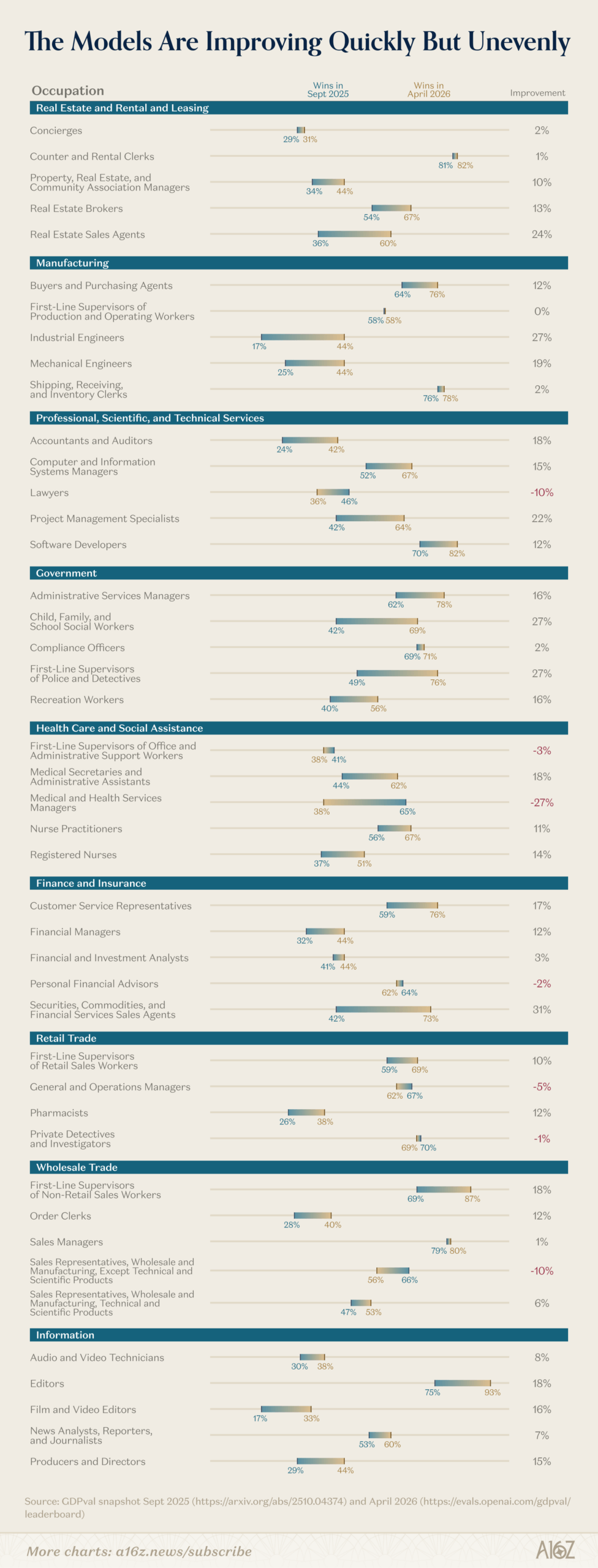
This analysis measures the win % that the top evaluated model had against human experts as benchmarked through GDPval. Based on that, it is clear that the models have gotten significantly better at economically valuable work since fall 2025.
Why, then, don’t we see all the industries who rank highly on this eval having the same type of revenue momentum that others have had?
The industries that have adopted AI with fervor so far have a few similarities: they are text-based, involve rote and repetitive work, have natural human-in-the-loop involvement to inject human judgment, limited regulation, and have clearly verifiable end outputs (e.g., code that runs, a resolved support ticket). Many industries don’t have these properties. They either deal with the physical world, rely heavily on interpersonal relationships, have clear coordination costs across many stakeholders, impose regulatory or compliance hurdles, or lack verifiable results. And while revenue momentum and model capability are clearly correlated, in domains where the model capabilities are theoretically at sub-50% win rates compared to a human (such as in the case of law), companies like Harvey have still been able to get market share rapidly through copilot offerings to enhance individual legal work, and then continuously improve their core product offerings as the models evolve.
The most notable finding here is that the model capabilities are improving fast. There are several domains that have shown dramatic improvements in the last 4 months — with accounting and auditing showing nearly a 20 percent jump on GDPval and even domains like police / detective work showing a nearly 30 percent improvement. We expect these jumps to yield compelling new products and companies in their relevant domains. In addition, the model companies have made clear declarations about their intentions to improve core capabilities in economically valuable work, with core work being done on spreadsheet and financial workflows, computer use to tackle thorny work on legacy systems and industries, and meaningful improvements on long-horizon tasks that opens up a whole new class of work that can’t easily be carved up into short, digestible bits.
Implication for builders
Knowing where enterprises are deriving value and how they’re thinking about ROI — as well as which sectors are clearly seeing pull vs which are to come — allows us to think more clearly about where the opportunities are for AI builders.
Serving tech, legal and healthcare buyers is clearly fertile ground right now, but we don’t believe there will be one “winner” in each category. In legal, for instance, there are many types of lawyers — in-house counsel, law firms, patent lawyers, plaintiff lawyers, etc. — who all have different workflows and different needs that companies could address. The same is true in healthcare given the patchwork of different types of doctors, healthcare facilities, etc.
Beyond these sectors, another fruitful way to think about it is where the capabilities are getting strong, but where there has yet to be a breakout company in terms of revenue. Many of the current businesses were built just before the model capabilities really unlocked the product, but they had built enough technical infrastructure and customer / market awareness that they were most advantaged when the model unlocks came around.
Lastly, it’s important to pay attention to where the labs are focusing their latest research efforts around economically valuable work. With long-horizon agents rapidly improving, serious investment in computer use, and research into reliable interfaces for modalities beyond text (e.g., spreadsheets, presentations), there are a whole class of new startups that will soon have the required enabling infrastructure to produce meaningful enterprise value.
