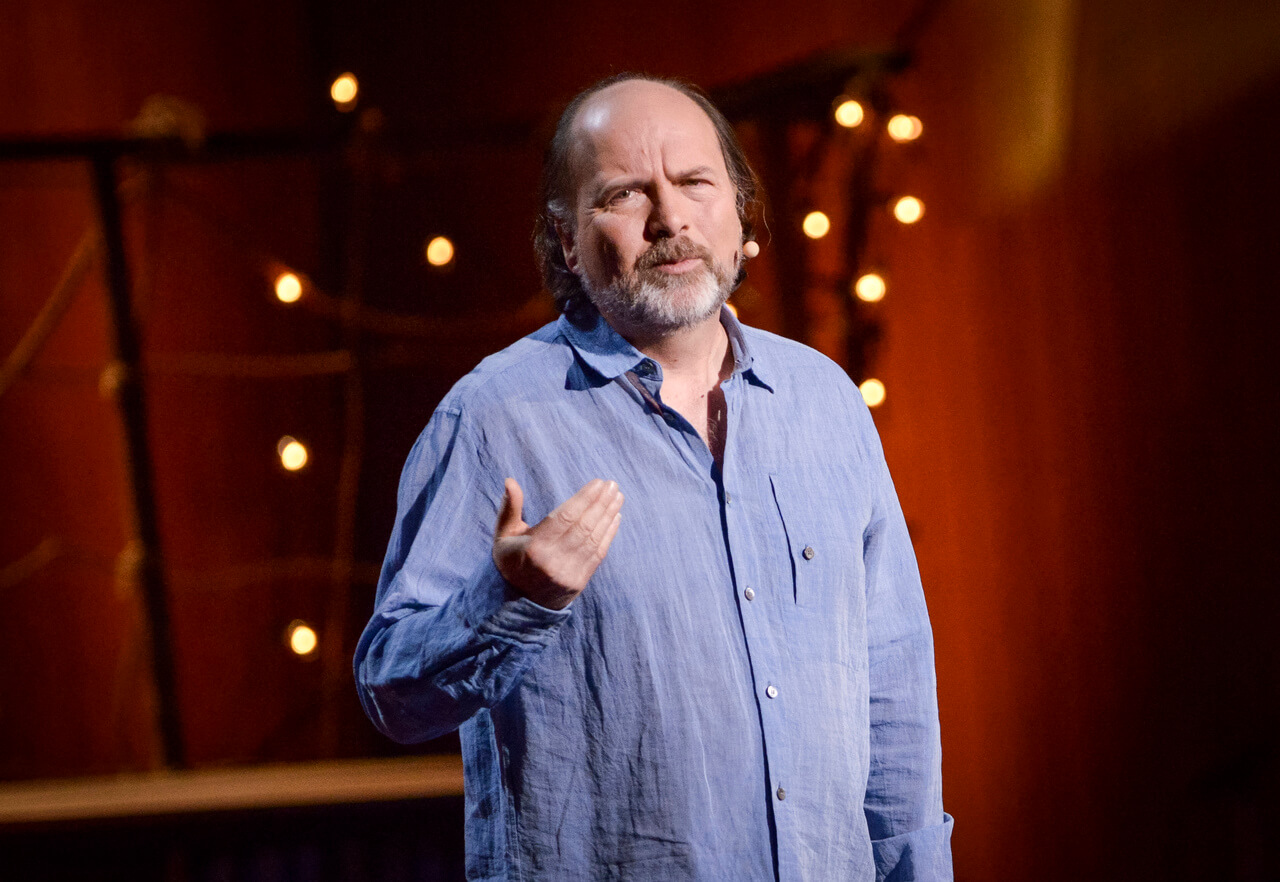
Danny Hillis. Photo: TED ConferenceBY
BY ALEXANDRA CHANG
The history of technology has always been about driving dramatic change. How we feed, clothe, move and amuse ourselves has been utterly altered by technology. But humankind’s transformation at the hands of things like electricity and the automobile, heck, even the sanitary sewer, has mostly been external. Danny Hillis, one of the technology world’s most creative and insightful thinkers, believes we are on the verge of technology-driven change so powerful it will reach into the fundamentals of who, and what, we are.
Hillis – a pioneer of massively parallel computing and RAID disk arrays – believes we are living in a historically unique age thanks to three major shifts accelerating in concert: information processing, globalization, and the merging of biology and technology.
“You put all of these together, and we really are at a transition point,” Hillis says. “We are going to become a new kind of human. It’s a wonderful time to be alive.”
Not only has Hillis watched the Internet and computing take shape, he’s played a key role in the process. While finishing his PhD in computer science at MIT, he cofounded Thinking Machines Corp., an early leader in massively parallel supercomputers and RAID disk arrays. He went on to work for Disney as a VP of research and development, where he developed and designed new technologies for the company’s parks, TV shows and movies. In 1995, he designed the 10,000-year clock, which is now under construction. Today, he’s the co-chairman of Applied Minds, an R&D and consulting firm – think of it as a skunk works-for-hire – and professor at both an engineering and medical school professor at the University of Southern California.
Sifting through his varied experience, Hillis pinpoints three current trends that are making today’s world so dramatically different than that of previous generations.
Machine Knowledge
For starters, how we process information has completely shifted. “For the first time in humanities’ history, most of the knowledge that is stored and thought about and processed is no longer in a human’s head,” Hillis says. Instead, we’ve moved the bulk of information to machines connected to massive stores of data. In particular it’s the devices we keep close to us all the time, ,the smartphone in your pocket and the tablet by your bed. “In a very real sense we have created a global brain that knows much more than any of us know individually. We’ve externalized it.”
Hillis likens this construct to a nervous system. “We’ve created the nervous system for the earth, and have externalized information processing,” he says. “It’s happening so quickly it’s hard to know to what degree it’s happening.”
Globalization
The second major trend is globalization. Though globalization has arguably been happening for centuries, it has never come to the fruition in the way it has today. “We now literally live in one world in a sense that we didn’t a decade ago,” Hillis says. “We have devices that we carry around in our pockets — and by we I mean people all over the world — have this short circuit in information space that connects us to every place.”
That a child in Calcutta can grow up in a very similar world as a child in San Francisco is possible for the first time. “They are going to be interested in the same brands, they will listen to the same music, they will have access to the same educational opportunities. Ultimately, they will compete for the same jobs and participate in the same marketplace,” Hillis says. But instead rather than starting local and going international from there, Hillis believes the current and next generation of companies will start global from day one. Hillis points to the creation of Facebook and Pinterest as evidence. Even in the relatively short gap between the creation of the two companies, Facebook started as a local social network before flipping the switch on the global market whereas Pinterest as been a global social network from the beginning.
Biology and Technology Merge
The final (and perhaps the most difficult for some to get comfortable with) trend driving massive change is the merging of biology and technology. We are already manipulating plant and animal DNA. Soon enough, Hillis says, we’ll be manipulating our own DNA in order to “fix things.”
“DNA is actually just the beginning,” he says. “I think it will turn out to be more important to see the proteins in the body and dynamically see what’s happening.” Thanks to biotechnology, Hillis says we’ll eventually move to a new type of healthcare, one in which we preemptively treat people for sickness and disease. “We will stop people from ever becoming sick.”
But just as much as biology is morphing because of technology, technology is beginning to mirror biology.
Hillis singles out the Internet as the perfect example. As much as the Internet was built by people, no one person can describe exactly how it works or explain various occurrences online. “It’s connecting together these big complex things that have emerged by evolutionary process, and we don’t quite understand,” he says. “It’s becoming more like a nature system. We negotiate with it. We understand its governance principles, but the fact is it does surprising things all the time and not always good things.”
In response to the overcomplicated and un-understandable Internet, Hillis says that there will be an increasing desire for an alternative or parallel “second Internet.” “You’re going to see people going toward simplicity,” he says. “There will be new Amish. There will be other protocols that have different trust assumptions, with rules that we do understand, that implement a much simpler set of features.” This second Internet will be more secure, and more stable in the face of honest SNAFUs and more sinister attacks.
You may be on the fence when it comes to inorganic systems that have minds of their own, and organic systems that will need a software upgrade from time to time, but Hillis believes that this new era for humanity is largely all for the better.
Globalization will bring billions of minds together to solve problems. We will have a symbiotic relationship with machines in storing our knowledge and processing information. And biotechnology will let us alter, as Hillis says, “the software that defines the hardware of who we are… it will completely change the way we construct and design technology.” And of course, ourselves.