From 1950 to 1990, Japan’s GDP grew at a remarkable 6.8% annually, lifting the country from the world’s 29th largest economy to the 2nd — and making it the first real economic rival to the post-war United States.
The Japanese economic boom was built on manufacturing dominance in the burgeoning consumer electronics and automotive industries. Japan figured out large-scale automation and perfected the assembly line, pioneering a production system that America struggled to match.

Japan’s rise terrified the American intelligentsia. Harvard professor Ezra Vogel released a bestselling book, “Japan as Number One: Lessons for America” that argued for the superiority of the Japanese economic and social model. Geopolitical author George Friedman predicted that the economic rivalry could only result in war between the two nations. Even future President Donald Trump observed in 1989 that “[Japanese companies] come over here, they sell their cars, their VCRs… they knock the hell out of our companies.”
And then the Internet happened.
In those days, the internet didn’t look like much. There were only a few million internet users worldwide in the early 1990s, and most users just sent email. Data rates were measured in the thousands of bytes per second, and before the release of the Mosaic web browser, there were only a few hundred websites in existence — and none of them had images.

In 1990, nobody would have believed that the internet would prove decisive in our economic rivalry with Japan.
And yet, it was. America took the early internet more seriously than any other nation, and owned the new, digital era as a result. From 1997 to 2001, the United States spent an average of 1.1% of GDP on the Internet, or more than $300 billion in today’s dollars. This investment laid a foundation robust enough to survive even a historic boom-and-bust cycle, and to support what would become the world’s most important and largest companies. Today, 19 of the world’s top 25 companies are American, and none are Japanese.
America won not because it learned how to manufacture cars and consumer electronics better than Japan, but because the American economy was a more fertile ground for early internet companies like Netscape, AOL, Amazon, and Google — and because American capital markets exuberantly doused those companies, and hundreds more, with the capital they needed to build infrastructure, to recruit the world’s top engineers, and to onboard millions of people onto the internet. Or in short, because America’s economy was dynamic enough to seize a new opportunity, and Japan’s was not.
Dynamism is a uniquely American superpower, and has helped the United States survive many existential threats throughout its young history as a nation.
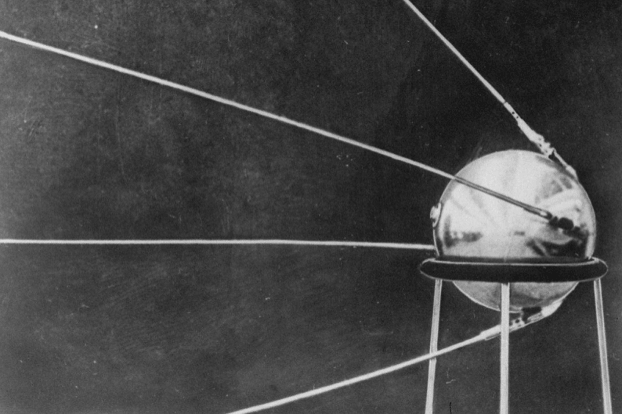
In 1957, America was caught off guard when the USSR launched Sputnik, the world’s first satellite, into orbit. The launch broadcast to the world that America’s chief geopolitical rival had the world’s most advanced missiles, and shattered the prevailing post-war belief that democracy was a global inevitability.
America responded with extreme urgency. NASA was formed in 1958, and doubled its budget six years in a row, ultimately peaking at a remarkable 4.4% of the federal budget in 1966. This incredible investment allowed the Apollo program to employ more than 400,000 people — including Wernher von Braun, a converted Nazi scientist — and establish physical infrastructure that the USSR’s relatively paltry budget forced them to skip. NASA’s Mississippi Test Facility, for instance, conducted tests that improved the Saturn V rocket’s design — a rocket that ultimately worked, where the USSR’s equivalent failed four consecutive times.
It was due to America’s dynamism — our ability to throw talent and capital at our country’s most existential problems — that the first, and still only, footprints on the moon are from American astronauts.
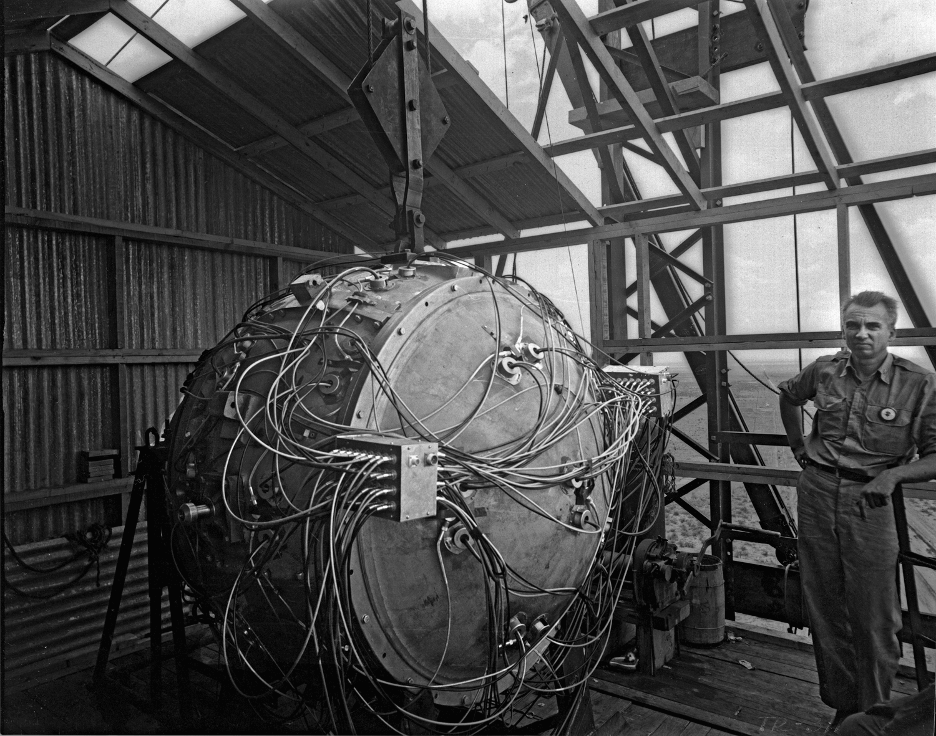
The story of the atomic bomb has been told and retold many times over — but one overlooked element is the difference between the American and German efforts to harness atomic energy.
Nuclear fission was discovered in 1938, and Einstein sent his famous letter to Roosevelt in 1939. But even years later and well into the war, it was far from obvious whether a nuclear chain reaction could actually be harnessed to create a superweapon.
The American response to this uncertainty was immense, and decisive. The Manhattan Project mobilized some 130,000 workers and deployed $35 billion of today’s dollars to design two nuclear bombs, scale three parallel uranium enrichment pathways, secure the world’s richest uranium mine, and import the world’s top scientists.
The German response to the same information was to give Werner Heisenberg a small lab, and let him dawdle away the war years. General Leslie Groves, the military leader of the Manhattan Engineer District, estimated that the entire German development effort at its peak was just 30 people.
Groves said that the entire Manhattan Project was “founded on a possibility… not a probability,” and thankfully, America’s uniquely dynamic culture saw that possibility through to its conclusion — and won the war.
America is a dynamic nation, as much because of our virtues as our vices.
It may have taken naivety to pursue the atomic bomb, foolishness to care about putting a footprint on the moon, and greed to pour billions of dollars into the still-unproven technology of the Internet. But history favored America’s boldness, and America sits today on top of the world as a result.
The principal lesson of the stories above, however, is that no geopolitical lead is safe from the effects of technological innovation — a lesson that demands some reflection, given the obvious paradigm shift we are living through today.
Artificial intelligence is the new national project.
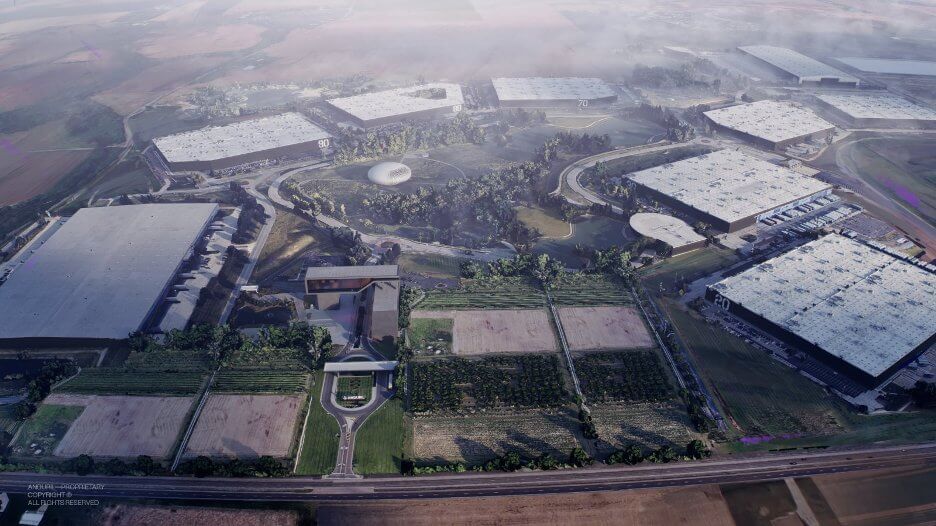
Arsenal-1, Anduril’s factory complex in Ohio
A shipyard in Louisiana’s bayou country is hiring welders and fabricators to build autonomous naval vessels. A factory in Ohio, deliberately designed for automotive workers to walk in and start contributing within days, is producing autonomous combat aircraft for the U.S. Air Force. AI-powered factories in Alabama and Arizona are training a new generation of factory technicians to produce the precision components that go into America’s submarines and missiles.
You don’t need to wonder what it would have been like to be alive during the Space Race, or the birth of the internet, or the Manhattan Project — because you are currently living through the latest massive mobilization of the American economy. (Perhaps this is comforting, if you worry about what a re-shaped world will look like. We’ve been here before!)
America wasn’t the first to split the atom, surf the web, or fly through space. But because we believed in the promise of these technologies more than anyone else, we mobilized faster than anyone else. So the question is not whether America has what it takes to win the AI-era geopolitical competition. We have proven time and time again that we do.
The question is whether we believe in the promise of AI.
If we do, America will win.
