As someone who goes back and forth between San Francisco and the Old World pretty frequently, I want to point something out without everybody getting mad. It’s that we’ve lost touch with mainstream, regular doomers.
I’m simplifying a lot here, but AI doomerism is mostly a fear of what will get built; like we went through with nuclear weapons two generations ago. Whereas mainstream doomerism, the kind I still hear from my normie friends, is about what will fall apart: the “Everything is going to collapse!” variety.
I have never had any patience for this way of thinking. Not only because thinking this way robs you of your agency, but also because for the 99% of people in the world who aren’t Balaji, I find it to be completely devoid of any critical thought or insight. The “Fall of the Roman Empire, Back to the Dark Ages” type doomer story is too smug and lazy to be useful. BUT! There is a subtler form of it that I do think is valid, and from which we can learn something. It’s the recognition that many of the load-bearing abstractions of the world aren’t going to collapse per se but they are going to leak a lot in the coming years.
The concept of “Leaky Abstractions” (popularized in our circles by Joel Spolsky’s blog years ago), is a good way to get a handle on the following forces in the world:
- Why abstractions both large and small, in domains like energy, money, and the internet, are getting the curtain pulled back on the sausage-making underneath
- What happens when people (and their elected governments) see the details, and try to directly grab the controls themselves
- The costly second-order consequence, which is rational actors everywhere hardening their defenses against these reflexive attacks on their autonomy.
A few things you didn’t know about online shopping
What are ‘abstractions’, and why do they matter so much?
Abstractions, the way I’m going to use the term non-technically in this essay, are “reliable interfaces built out of less-than-reliable parts”. TCP (a reliable information protocol) is built on top of IP (an unreliable information protocol); global commodity markets (with reliable liquidity and prices) are built on top of not-always-reliable contracts and marketmaking. At their best, they are robust yet simple for the end user; this requires non-trivial engineering to get right.
Let me give you an example. Prior to coming to a16z I worked at Shopify for five years, and one of the great privileges of working there is getting to look behind the curtain at how much complexity there is in commerce. Shopify takes great pride in maintaining what many consider the best version of a critical online abstraction: the humble ecommerce checkout. A checkout page does not look like it has much to it – it’s a form you fill out; how hard could it be?
You learn at Shopify that checkout is a more complex negotiation than you’d think. To give you one example, when you check out a product from an online store, the retailer likely won’t know some details yet, including “from what warehouse am I going to ship this item?” They may not know this answer for a few days. But it matters because, depending on which warehouse they send from, the tax calculated on the item might be different if it was sent from the warehouse on the New York side of the line vs the New Jersey side of the line. (This is why, if you look carefully next time you buy something online, you’ll see estimated tax in small print somewhere.) The checkout may have to guess how much you’re going to pay. Which begs the further question, “Well, what if they guess wrong? Does the merchant have to eat the difference?” This takes you down another abstraction, which is how credit card payments work; I’ll spare you the details. Anyway, there is ample complexity under the hood of a checkout. But if it all goes well, you never see it.
The real miracle of online checkout isn’t just that it works at all; but that it works despite the efforts of various sovereign entities (European countries; Apple) to impose their own ideas on what they feel consumers want in a checkout experience. For example, there is a recurring assumption by those sovereigns that “users care about privacy, and we need to protect it for them”, but in practice, some of those privacy measures (e.g. around shipping addresses), however well intentioned, can poke holes in the abstraction.
With hands-on experience, you’ll find many abstractions like this, that perform non-trivial work everywhere. Behind the simple interface, there’s a complex, intricate mechanism for providing slack in the system, and progressive finality towards the outcome, that makes it look and feel and behave like a simple system to the end user. Some of these mechanisms are contracts and conventions of private actors; some are legal constraints written in public policy. Some of them are social licenses that are granted by a population but could be revoked if moods change, or (more likely) interfered with unwittingly.
Checks and DOGE
In early 2025, following President Trump’s return to office and at the height of DOGE zeal to streamline government services, one of the directives we got from Treasury was, “The government needs to stop writing paper checks. It costs us $2 each to process them, enough is enough, let’s move on from this antiquated technology.” The second I saw this news, I thought two things: one, “Oh no, this is going to affect me personally in an annoying way”, and two, “There has got to be a Patrick McKenzie thread on this,” which sure enough there was.
Paper checks are a remarkable abstraction, by the definition I’m using here. Out of unreliable inputs – an account routing number of a sender, the name and address of the receiver – we have a reliable mechanism for transferring funds from one individual to another, that is resilient to all kinds of exceptional circumstances.
The topic is close to home for me. As an American living abroad, I still pay taxes to the IRS like the rest of you, but for various reasons I no longer have a US bank account from which I can easily arrange direct deposits. Prior to recently, this wasn’t much of a problem, because I could walk to my nearest bank branch and arrange for a certified check made out in US Dollars without any fuss. But my bank stopped providing this service recently, and it’s become tricky to actually get money to the IRS, without paying exorbitant credit card fees. (Another resilient system, albeit a more expensive one.) I have had to find alternate arrangements, however trivial it sounds, in order to harden and defend my ability to remain in the IRS’s good graces every year.
Sure enough, as Patrick documents with some satisfaction, the US Treasury has since conceded that there remain quite a few edge cases where “put a check in the mail” works a lot better than anything else we’ve got. A few examples he offers include “Unbanked individuals, emergency hardships, national security and law enforcement, international taxpayers, temporary US residents without social security numbers, estates and trusts with complicated signatories…” You get the idea. Nonetheless, the political promise of “We’re going to stop issuing paper checks” took on an inertia of its own, and the US Treasury now quietly pays a third party to do it for them.
Two weeks to flatten the curve open the strait
It is not a good thing, for anyone, that “paper barrels versus physical barrels” has made it into popular consciousness.
The global energy market is one of the most sophisticated, resilient, impressive human accomplishments of the 20th century. Even at the current moment (as I write this on April 27th, the Strait of Hormuz has been essentially closed off to commercial shipping for 8 weeks now), it has held up remarkably well. And over this period of time, everyone monitoring the situation online has become much more aware of how the oil market works; although not necessarily smarter about how it works.
In addition to the literal supply crisis unfolding before us, the other funny thing that’s happening at the online meta-layer above it all, is that oil is now the current thing, so everyone now has an opinion about it. And when popular opinion (or presidential opinion) latches onto specific details within a complex system, and says “Let’s focus on this”; you have the potential for some serious reflexivity. By reflexivity here, I mean the kind of feedback loop where someone’s perception of a situation is an important causal input into the situation itself.
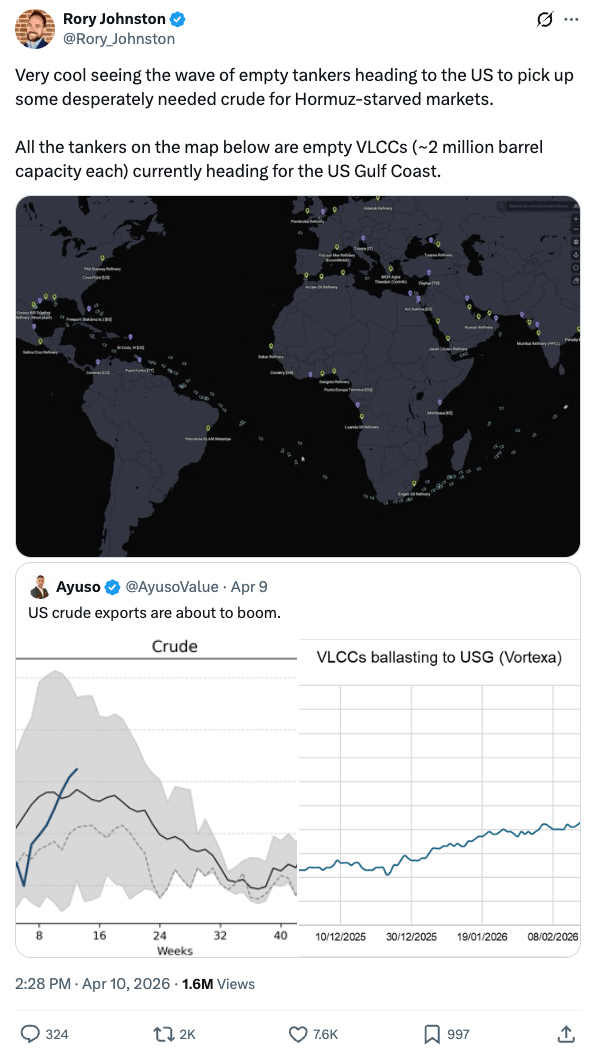
My friend Rory (who’s a great follow, if you’re into this sort of thing) recently got some firsthand experience with this. A few weeks ago shared a map he made on X, showing empty oil tankers heading towards the US Gulf Coast to get product where it’s still available. It got sent out in the context of his nuanced energy market commentary; but the map escaped containment, ended up being prominently posted on Truth Social, where it may have played a role in shaping a select few upstream perceptions, and therefore, downstream events. A similar error of public perception occurred on a few days where the headline WTI (i.e. American) oil price rose higher than Brent (international), inviting the narrative, “The world wants our oil so badly now!” (The real reason why this happened is left as an exercise to the reader; if you want a hint, it’s that these prices reflect futures contracts that roll over on particular days of the month.)
We don’t yet know how the Hormuz crisis is going to resolve, but one thing that’s clearly happening is countries scrambling to not only secure fuel supplies, but also form bilateral deals of mutual interest, like one recently announced between Brazil (a producer) and India (a refiner and consumer). A year ago, a deal like this wouldn’t have registered in public perception; but today it has meaning, as a detail announced in public, on purpose. And just as I write this, the UAE just announced they’re leaving OPEC; I mean, that’s news no matter when it happens. Again, same story – countries want to reassert control over their destiny here. We’re also seeing countries rapidly reevaluate some of their domestic policies that concern their energy sovereignty, as public opinion now allows. The reliable abstraction (the global commodity markets) looks an awful lot like a collection of component parts, at least for the moment.
Leaky abstractions lead to private deals
This past January, former Goldman partner, central banker and now Canadian Prime Minister Mark Carney spoke to the World Economic Forum in Davos, concisely and irrevocably closing the door on the old world order. He did not flinch: ‘The old world and its unified institutions – where we had one global market for trade and one standard for global norms – is finished. The new situation in front of us is a world of individually negotiated deals. There is no “single global anything” anymore; there are only arrangements of mutual interest. Good luck out there.’
From afar, it’s easy to label Carney an ‘anti-Trump’ type character. His approach, aesthetics, and career pedigree are certainly different. But his governance has been consistent with the new Trump world order, where the great 20th century abstractions like free trade have suddenly been exposed, as if under a bare light bulb, to be no more than the sum of many individual agreements.
Now, it’s fair to say, “It always was.” Of course it always was. But the great 20th century global abstractions – free(ish) trade, global energy and commodity markets, the US Dollar system, and maritime Pax Americana – were so smooth, so functional, that outside observers and beneficiaries could just treat them as “one solid thing”. The abstractions held for a very long time. But, just as I’ve had to find alternate arrangements for paying the IRS, don’t be surprised to see countries and other sovereign actors take matters into their own hands, to harden their capacity to do their thing. Will some of that hardening be done technocratically, in the manner of Joel Spolsky’s “software engineer who has to plug the leaky abstraction?” In some cases yes. Will some of that hardening be the worst kind of impulse populism? Also yes.
Closer to home, the tech industry is going through a similar experience, when it comes to “digital sovereignty” and the future of the internet. Like the global energy market, the internet is a modern miracle of universal access and resiliency, built out of highly obscured technological pieces and long-held-by-convention American laws. And in recent years, this abstraction has started to leak – like, for instance, Cloudflare IP addresses (which are a lot of the internet) getting blocked in Spain during soccer games.
The publicly visible consequences of this kind of internet-police legislation are predictable: you train a new generation how to use VPNs, and then the government tries to ban VPNs. But below the surface, the architecture of the internet has already been changing for a long time. The original, public internet is a thing of the past, at this point; it’s more accurate to imagine the internet as actually many private internets that seamlessly hand off and interact with each other.
This new state of affairs wasn’t what anybody wanted; at least at first. But it proved necessary; if for nothing else, for security reasons. Layer by layer, the internet reinvents itself every year – as the saying goes, “by interpreting censorship as damage and routing around it.” The iterative nature of it, where those defenses are built and maintained one layer at a time, is why the internet still almost always works; it’s the best example we have of “you can’t build a complex system from scratch, you can only iterate it out of a simple system that works.”
One possible beneficiary here, over the long run, is what Byrne Hobart calls “Deeply horizontal companies” – an odd collection of tech giants that address the need for “end-to-end defenses” like this. Another world I would study, if you have the time, is other eras of history where our modern abstractions were not yet formed up, yet we got by anyway – early maritime insurance is an example. Across all of these problem spaces, the more you learn about them, the less the doomers make any sense – the world is too motivated, and too skilled. But the world’s abstractions will leak; a lot. So get to know some plumbers.