Have you spoken to a normie recently? They aren’t actually normal anymore. Nobody is. In all aspects of American life, the internet is upstream of everything else. Sooner or later (and, more often than not, sooner) everyone ends up thinking, speaking, and acting on terms that have been set online. The internet is real life.
News now exists to summarize things that have already happened online. Politicians communicate with the public directly, or in conversations with internet personalities. Stories originate on internet platforms, where the underlying details can be viewed in full without the selective editing and spin of a traditional media outlet. And entire discourse cycles in the legacy media are dedicated to memetic phenomena, such as the now multi-month looksmaxxing saga–most recently featured on 60 Minutes.
All this remains true to a remarkable extent even in the context of events where the traditional news media’s edge should remain uniquely durable, such as the ongoing Iran War. The relative distance, inaccessibility of on-the-ground internet reporting, and proliferation of unreliable AI slop might all in principle be thought to accentuate the value of legacy reporting, but a flight back to traditional media doesn’t seem to be in the cards.
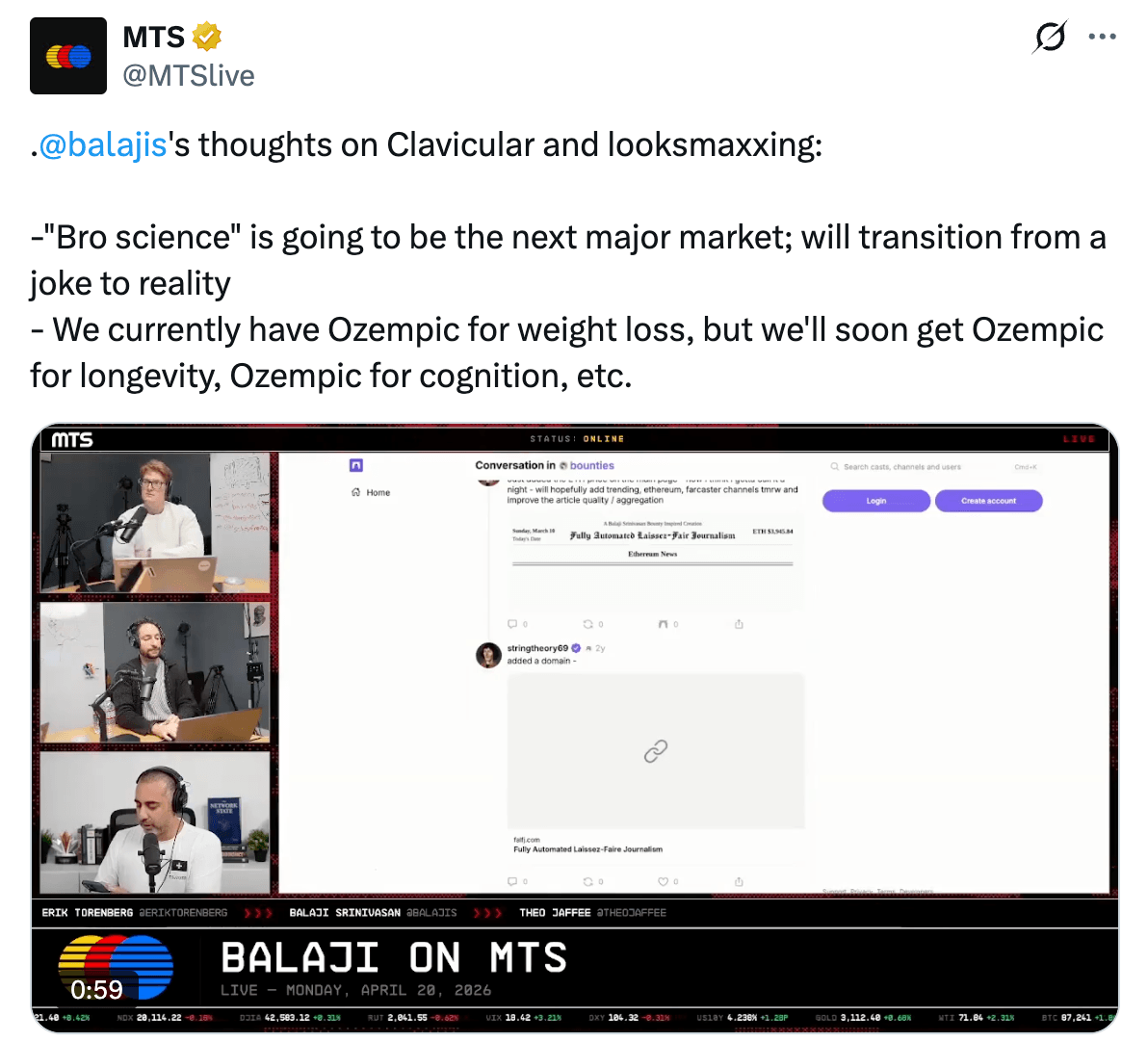
Music now achieves popularity via viral takeoff in TikTok reels. Indeed, TikTok has become so significant that various older bands have seen a mass influx of Gen-Z listeners launch them to new heights of success. This also means, of course, that songs are now being written with Tiktok in mind. Just as the constraints of radio defined song length and structure historically, a musician seeking to achieve success in the present day needs to write a riff that will work well over a 15-second video clip.
Songs don’t need to have a verse-chorus-verse-chorus-bridge-chorus structure anymore, or even a nice-sounding radio edit. But they do need to capture a mood, or be able to hook audiences in the first second rather than after a build-up, or be generally memeable. Where the tweet was a bite-sized article, the TikTok reel is giving us bite-sized music.
Movies are now often created with the aim of appealing to distinct and existing online subcultures, rather than trying to hook a general audience. In a world where film captures an increasingly lower share of audience attention, the strategy of being vaguely interesting to a large number of people may lose out to one of being extremely interesting to a small number of people–particularly ones for whom the movie is not a standalone product but rather a piece of a larger subcultural identity. If participation in an existing identity requires being able to discuss a particular piece of media, then that piece of media has a dedicated audience from the start. Where competition for attention is tight, a guaranteed audience–one that will spend a lot of time talking about the product, no less–is better than a marginal one.
No surprise, then, that movies have increasingly leaned into implicit affiliation with internet subcultures. Take last year’s Oscar nominee Bugonia as an example. At first blush, the most salient fact about Bugonia may be the fact that its entire plot is rooted in the timely question of internet-brained conspiracism. And it’s true that this, even on its own, is indicative of how the internet has become real life. As interesting, however, and less-remarked on, was the choice to cast comedian and podcaster Stavros Halkias in a minor role. The only apparent explanation for this decision was that it would immediately create buzz around the film in the existing online communities that followed Halkias’ work.
This is only one example of how movies are increasingly shaped by the existence of a separate and upstream online cultural sphere. In addition to adapting books, plays, or comics, movies are now adapting 4chan greentext memes as well. And, in addition to the reels-oriented memeability discussed above, movies are also themselves coming to resemble fast-paced sequences of memes themselves. The high-stress, frenetic, constant-attention grabbing style of an Anora or Marty Supreme is the future of filmmaking, if for no other reason than that it is the only way to prevent an audience member from constantly checking his phone.
Politics are downstream of the internet now as well. This sounds like conventional wisdom in the present day–after all, haven’t we been talking about Russian Facebook ads and social media information silos for the past decade? But while it’s true enough that the influence of internet media on voting patterns has been documented for some time now, less widely discussed has been the influence of internet discourse on the underlying shape of politics itself.
We can use the proliferation of meme language in public discussion as a kind of dye-trace methodology to see how far this has gone. When we look, it’s clear that major politicians in both major parties are increasingly familiar with and even fluent in the memetic discourses of their respective bases. See: J.D. Vance discouraging “blackpilling” or Tim Walz mentioning the couch. And even where politicians are not doing the memeing themselves, they are increasingly directing their messaging toward an online audience via “Rapid Response” pages and internet-native press offices.
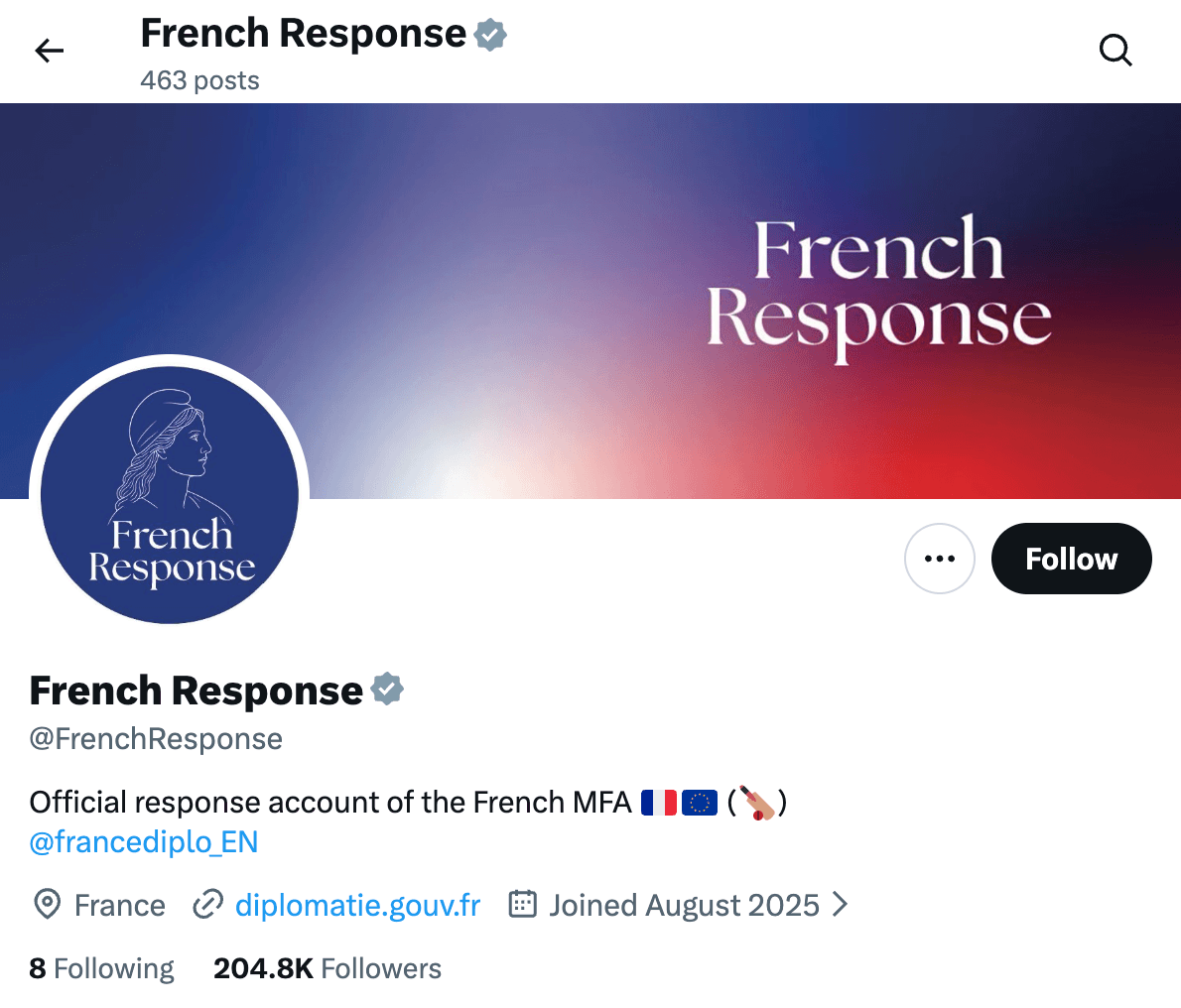
If this were limited to a shift in rhetoric, that would be one thing, but the important point is that politicians and their staffers are increasingly forming their views and attitudes in an online milieu. That means that they are paying attention to different issues, listening to different influencers, and generally being socialized in an entirely new cultural sphere. If Donald Trump was the first online President in the sense of being a viral internet personality, then JD Vance is the first online Vice President in the sense of being a habitual blogosphere content consumer.
Language most fundamentally is being shaped by the internet. Slang now not only spreads through the internet, but actually originates on it. Right-wing memes are displacing African-American Vernacular English as the most dynamic source of linguistic innovation.
Indeed, even the language that people use to talk about the need for more in-person, authentically “human” interaction occurs in an internet vernacular. When someone tells you that you are “extremely online,” or need to “touch grass,” they are–intentionally or not–confessing that they too have had their brain colonized by internet cliches.
So, what is traditional media even good for anymore?
It’s actually still good at a few things.
First, it retains its edge as a reliable channel for the dissemination of leaks. Laundering private information that, for one reason or another (think: legal liability, internal political disputes, broadcasting messages that conflict with an organization’s official position) has been one of the media’s historic roles, and is one that the development of alternative channels for learning facts about the outside world does not displace.
In this area, institutional media branding exists not so much to signify reliable let alone unbiased reporting, but to distinguish certain channels as megaphones for important figures who need to get their messages out anonymously. That job is not as easily accomplished by a random twitter account, which will tend to lack the accumulated personal network and differentiated public persona that make leaking work, but require years of investment. In other words, leaking is often actually more “capital intensive” than firsthand factual reporting.
Second, the traditional media continues to play a role in coordination games, identifying positions for decentralized political actors to coalesce around. In the wake of the first presidential debate during the 2024 election, for instance, traditional media was able to help usher forth a synchronized move away from Joe Biden as the democratic nominee. But this is not a novel function. Walter Cronkite’s denunciation of American involvement in Vietnam famously affected public opinion around the war.
In other words, traditional media can focus attention on particular stories at particular times. While the decentralized online ecosystem does allow dissenters to locate one another pseudonymously, or observe the existence of alternative perspectives that might previously have been shut out of official channels, it is not as capable of informally “issuing orders” at pivotal moments.
Third, but really a subset of the above, traditional media can “normalize.” Like the coordination problem described above, normalization involves the question of “common knowledge”–whether everyone not only knows Fact X, but also knows that everyone else knows it. Normalization, i.e., the creation of “official knowledge” need not be a matter of targeted and well-timed action. Instead, it refers to the much broader enterprise of crafting consensus reality. And that remains a valuable edge in a world of increasingly individualized online experience. As the existence term “extremely online” may indicate, people are often shy to reference unofficial knowledge in a way that might mark them as “weird” or socially destabilizing.
To take a relatively apolitical example, this is why anime retains a “niche” aura despite being much more widespread among Gen-Z than, e.g., the NFL. The presence of the latter, but not the former, in traditional media is no doubt a big part of the explanation for that vibe.
The internet is literally real life.
If that sounds like a crazy statement, consider for a moment that even real life is not “real life.” From the beginning of history, we’ve used technology to mediate between ourselves and the world. Domesticating the horse doesn’t mean that you stop being an embodied, physical being. But it does mean that life is no longer limited to the space that a “natural” human might have been able to traverse on foot. Gardening and agriculture accomplish the same with food, clothes and shelter with climate, and so on… All of these represent a mediative layer between the natural state of mankind and “real life” as it is actually experienced.
The mediative layer is not limited to physical technologies, of course. Social technology is just as if not more important. Mathematics allows us to model the world in abstract. Governments scale trust and cooperation. Currencies enable trade. We take all of these for granted in one form or another, even though none of them are inherent features of the human animal. A human today lives a life vastly different from one several thousand years ago; a bird or a fish does not. Nevertheless, we find nothing counterintuitive about thinking of these developments as a part of human experience as such.
Still, rapid shifts in the environment (whether physical or as part of the meditative layer) can disrupt our lives in important ways. Just as the introduction of a novel disease can devastate populations without a history of evolved resistance, so too can the introduction of novel technologies. That’s true of basic physical goods, like alcohol. But why not social technologies as well? What happens to humanity when you rapidly introduce a new social paradigm?
Dealing with that question requires holding two thoughts in one’s head at once.
First, the new paradigm is “real life”–at least for the time being. That is, it is now an inherent aspect of life that must be accounted for, just like mathematics and government and currency, and that cannot be dismissed simply because it is new.
Second, the new paradigm is potentially dangerous. Humans haven’t had time to evolve alongside it, to ascertain its full implications, to develop resistance, to reach some kind of equilibrium.
The essence of mastering a new technology therefore means understanding what life might look like without it, what it changes, what it improves, and what it damages. The advent of mass radio and televised communication in the 20th century brought about centralization of narrative. Did that make it more “true”? Perhaps not. Nevertheless, it meant greater perception of truth. Success in such a world meant learning to wield that tool, or inventing a new one. For the boomer, mass media was real life.
The internet is a form of mass communication as well, albeit one with very different logic. Whereas centralization meant that truth, as understood by the masses, could be determined at one or a few nodes, the internet at least in principle enables a distributed and emergent sense of reality. Does that make it more “true”? In some ways, it may not either, and understanding why that is may be useful. But the most important thing to understand is that the internet is now the fundamental mediating layer through which the rest of the world is filtered and understood. For humans living today, the internet is real life, and navigating life means navigating the internet.
So, what is the upshot of all this?
Ironically, the only way to be “offline”–that is, to understand the filter that the mediating layer of the internet puts on base reality–is to be online. To account for the gravitational pull that online media now exerts on everyone’s life, one must observe the source directly. And for what it’s worth, a conscious attempt to think in these terms has the added benefit of helping to demystify other, traditional mediating layers as well through parallax. In theory, the most online media consumer can be the most critical media consumer.
If the internet is real life, then people have a need to understand it. Our bet is that this need is not currently being served or–if it is–is being done so in a manner that is biased toward what the online media consumer is already most familiar with.
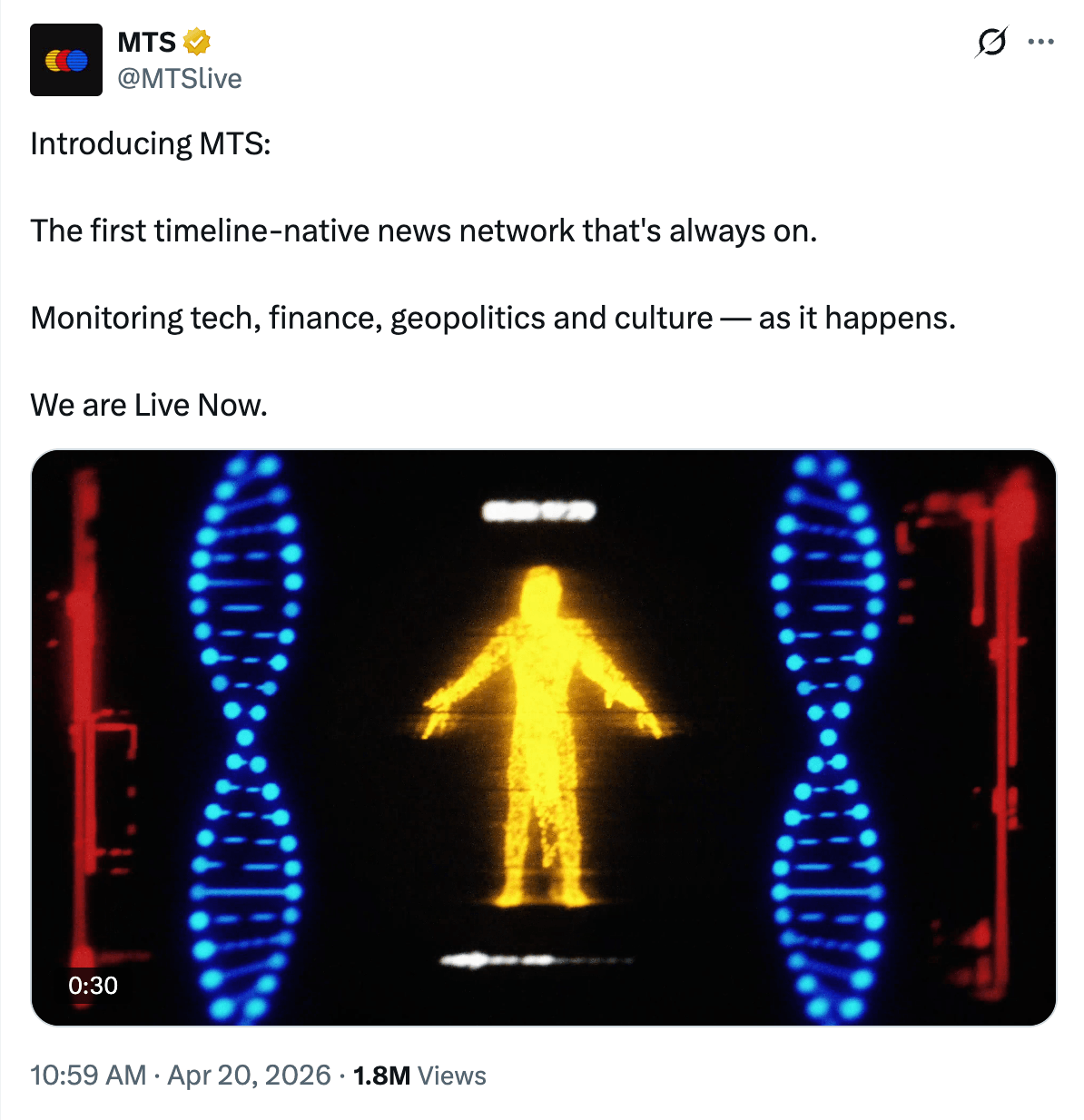
Thus the logic of Monitoring the Situation–a live and natively online news channel. Where traditional channels have their edge in leaks and distributed political organizing, MTS’ edge is…to be not that. To provide the accessibility and convenience of a traditional channel without the pretensions, the obfuscated motives, or the cultural inarticulacy that continues to plague them.
Everyone understands in principle that the internet has already reshaped our world. But many fewer have taken steps to stay ahead of the curve in the informational environment that it has created. They have let themselves become prey–or rather, let themselves remain prey–in the face of deteriorating consensus about the nature of reality itself. That means opportunity for those who care enough to pay attention and have the wherewithal to monitor the situation.
