Many CEOs hesitate to bring on a chief human resources officer (CHRO) for a number of reasons, chiefly because they don’t always understand what CHROs do, or the strategic value they bring to the table, and they’re concerned that the processes they put in place will slow the company’s growth or erode their culture. But a CHRO is a critical growth-stage hire who manages your greatest asset and biggest cost center: your people.
As your company grows, the organizational structure that emerged in your early days will evolve and become more complex, and your culture will become more difficult to maintain—particularly if you operate in a hybrid or remote workplace. A best-in-class CHRO understands your company, knows where it’s headed, and builds out programs to attract, retain, develop, and motivate the talent to get you there.
Far from just managing payroll and the recruiting process, CHROs typically own:
- Designing and administering employee policies and standards
- Compensation planning, including salary structures and incentive programs
- Employee engagement
- Manager enablement
- Talent management, including career development and performance management
- Benefits planning and administration
- Organizational development, including onboarding, training, retention, and offboarding
- Staff and executive recruiting
- HR information systems
- Labor and employment law
- Implementation of company culture
Though your CHRO will architect the people aspect of your business strategy, they’ll also report to the CEO and help to develop the business strategy for the company. If you’re considering expanding internationally, for instance, a great CHRO can outline all the benefits and drawbacks of operating in a new country, including the quality of the talent pool, regulatory hurdles, and labor and employment laws.
CHROs are also critical partners in navigating internal issues like layoffs, terminations, workplace disputes, and lawsuits. Your people are also the biggest unknowns in your company, and the more people you add to your org, the more important it is to have a CHRO who can put processes in place to legally protect the company and everyone who interacts with it. This is particularly important during layoffs and terminations—one of the hardest parts of the job for CEOs. Great CHROs not only ensure layoff and termination processes are compliant with local labor and employment laws, but also help departing employees feel respected and valued as much as possible.
The best CHROs are also extensions of the founder. Founders own the company’s culture, while the CHRO owns the implementation of that culture. A great CHRO distills what makes your company unique, then uses those insights to shape programs that help everyone understand and feel connected to that vision. If the CEO sets the tone for managing performance issues, for instance, the CHRO establishes clear performance review and feedback programs to ensure that the same tone is applied throughout the org.
TABLE OF CONTENTS
When to hire
TABLE OF CONTENTS
The bigger your headcount and the more complex your operations, the likelier it is you’ll need to bring on an experienced CHRO.
Some indications that you might need to hire a CHRO include:
- Setting ambitious goals to increase your head count. Hitting head count targets for sales and engineering, in particular, is critical for growth-stage companies, because their output drives topline revenue.
- Struggling to retain key talent. Turnover is very costly, both financially and in terms of institutional knowledge, and company morale can take a huge hit when there’s a revolving door of talent.
- Operating and hiring internationally. Expanding internationally requires familiarity with a host of issues, including local labor and employment laws, tax requirements, and data privacy laws. You’ll also need to develop an understanding of the talent pool and the cultural context in order to effectively manage new hires in that location, and you’ll need to be mindful that your compensation packages balance local expectations with existing packages in your home office.
- Operating a remote or hybrid workforce. Maintaining productivity and engagement are key when your employees aren’t all working in the same place. You’ll need processes in place to motivate and develop your teams, facilitate communication, prevent turnover, and onboard and integrate new talent.
Writing the MOC
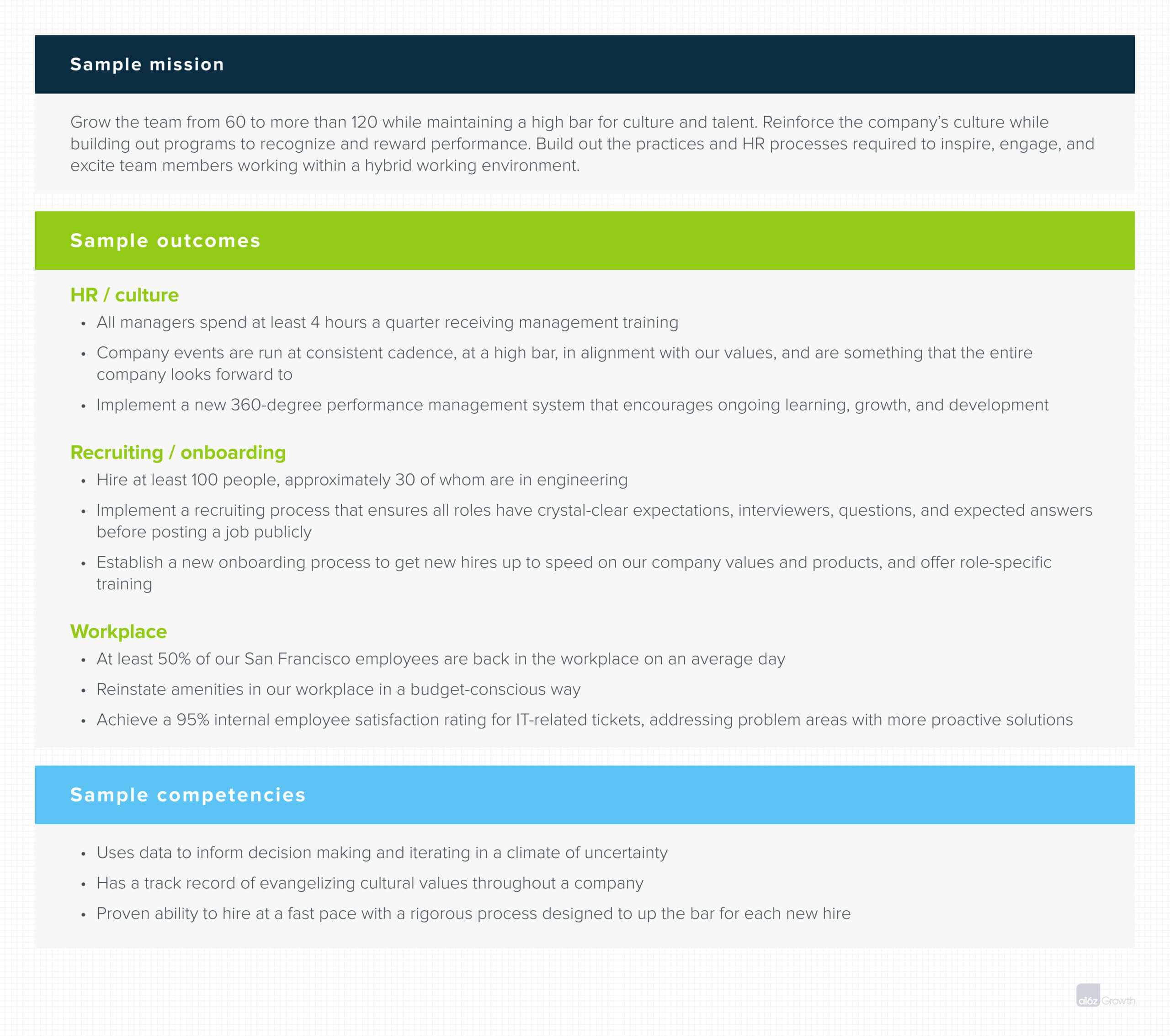
We discuss writing a mission–outcomes–competencies (MOC) document in greater detail in The Hiring Process.
One of the most important qualities to look for in a CHRO is the ability to influence others from behind the scenes. They’re unconcerned with getting credit for great ideas, and they know how to pose the right questions to the right people to guide decision making.
Great CHROs operate in “customer service mode.” They’ll develop strong relationships with other executives to understand what each part of the company wants and needs out of HR, then help them understand how HR can help them reach their goals.
Though they’ll always need to put out fires, your CHRO will also build out programs that anticipate and address issues you’ll face as you scale, so they have more leeway to strategically develop the org.
What experience should your CHRO have?
Given the breadth of functions that they must take on, no HR leader excels at or has a passion for every part of the job. Instead, we’ve found it most helpful to pattern-match your business needs with a candidate’s experience.
Scaling experience
Generally, it’s helpful to look for someone who has 1) experience scaling headcount to where you want yours to be in 24–36 months and 2) has worked at both early-stage companies and big companies. These HR leaders have “seen the tapes” at bigger companies and can anticipate the problems you might face as you scale, but still have a collaborative problem-solving mentality that’s well-suited to growth-stage companies.
Functional expertise
Identify your 1–2 most critical HR issues and look for candidates who have demonstrated expertise in those areas. If you run a company in a particularly complex context—like a consumer company operating in a regulated industry, for instance—you’ll likely want someone who has experience navigating those regulations. Recruiting agencies are especially helpful at finding candidates with these qualities. Your candidate should also recognize where they aren’t strong and will need to hire others to complement their skill set.
HR generalists vs. HR business partners vs. recruiters
When we’ve counseled companies on hiring a CHRO, we’ve generally found that great CHROs have experience both as generalists and business partners. They develop fluency in all aspects of HR and roll up their sleeves to build and scale HR programs and initiatives as generalists, then partner with senior management to develop workforce plans and ensure that HR practices are aligned with the company’s values. It’s key that your candidate doesn’t just roll out centrally developed HR policies; they leave playbooks from previous roles at the door and partner with your leadership team to create the programs your org needs.
Recruiters, on the other hand, don’t always make the best CHROs. The best recruiters are often great salespeople, and salespeople tend to want their time in the spotlight. When done well, however, HR is a very low-profile endeavor, and recruiters who thrive in the limelight might struggle to work behind the scenes. There are many recruiters who want to take on HR, but bringing them on as a CHRO can also mean that you’re not leveraging the best recruiter you have to go out and build a killer recruiting org.
Sample MOC
Setting up your CHRO for success
We cover best practices in The Hiring Process, but we’ve included some recommendations below for what different members of your executive team may want to focus on when interviewing engineering leaders.
Does your candidate lead with questions or solutions?
The best CHROs approach their roles collaboratively and understand that respect is earned, not given. They build credibility with small wins—like making recommendations on how to tweak communications within the org—while asking questions, gaining context, and forging relationships with stakeholders before building out significant programs. It can be a red flag when a CHRO comes in with prescriptive takes about what needs to change in your org before spending time with your team. What worked at their last company probably won’t work at yours.
How, specifically, did they scale their previous orgs?
Many HR leaders come up in companies with established HR programs, so it’s critical that your candidate explain to you, in great detail, how they scaled the HR function and headcount in their previous roles, and how they led their teams to do it. Someone who rolled up their sleeves and partnered across the org to build great programs generally has the do-more-with-less mentality companies look for.
Are they coming to the interview process like a business partner and owner?
Because CHROs must have a comprehensive understanding of your company in order to do their job well, it’s important that they show up to the interview process like owners of the company. If your candidates aren’t asking questions about why your products are disruptive, the competitive landscape, or your balance sheet and financial plans, that can be a red flag.
Where does internal communications fit into your org structure?
The bigger a company gets, the likelier it is they’ll need to bring on an internal communications team to ensure everyone is on the same page about the company’s mission and goals. Because HR is the torch-bearer of a company’s culture, some companies have internal communications teams report to the HR team and partner directly with leadership on messaging. Others, however, have internal comms report to marketing. This is because great communications professionals tend to be great marketers, and HR professionals generally struggle to offer strong career guidance and development to employees with this background.
Did people go to the candidate when they had problems, or did the candidate cause the problems?
It can be difficult to gauge if your candidate has built a trustworthy HR program during interviews, so it’s particularly important to consult your CHRO candidate’s references. While it’s important to speak with their previous executive partners to better understand how the candidate got work done, we also recommend speaking with other non-executive colleagues to assess how they approached HR when problems arose. If the candidate’s colleagues immediately contacted HR when they had a problem, that signals they valued HR’s insights.
On the other hand, HR departments can have a reputation for incubating politics and gossip, and some CHROs leverage their access to sensitive employee and company information to curry favor with other executives. You want your CHRO to come to the role with positive intent and an eagerness to partner with others, not a penchant for stirring the pot.
Thanks to Kristina Graci-deLuna for contributing her hard-earned wisdom and expertise to this guide.
Further reading
We’ve drawn insights from some of our previously published content and other sources, listed below. In some instances, we’ve repurposed the most compelling or useful advice from a16z posts directly into this guide.
Protecting Your Company from Itself—Why You Need HR, a16z podcast with Ben Horowitz and Shannon Shiltz
Not having an HR person can be very damaging to your company. This podcast answers questions about looking for your next HR leader, including how to partner with HR, preserving your company culture while implementing HR processes, and the qualities you should look for in a candidate.
Where to Go After Product-Market Fit: An Interview with Marc Andreessen, Marc Andreessen and Elad Gil
Where do you go once you hit product-market fit? In an edited transcript of a conversation that appears in Gil’s book, High Growth Handbook: Scaling Startups from 10 to 10,000 People, Andreessen offers insight into why you should take HR seriously sooner, to prevent future catastrophes.