While the marketplace business model is evergreen, every new platform changes how and where transactions happen. The Internet took us from classifieds and poster boards to sites like Amazon, eBay, and Craigslist, while mobile enabled apps like DoorDash, Uber, and Instacart.
Now, we believe generative AI promises to revolutionize marketplaces again. It will not only transform how products and services are sold — but also how they are made.
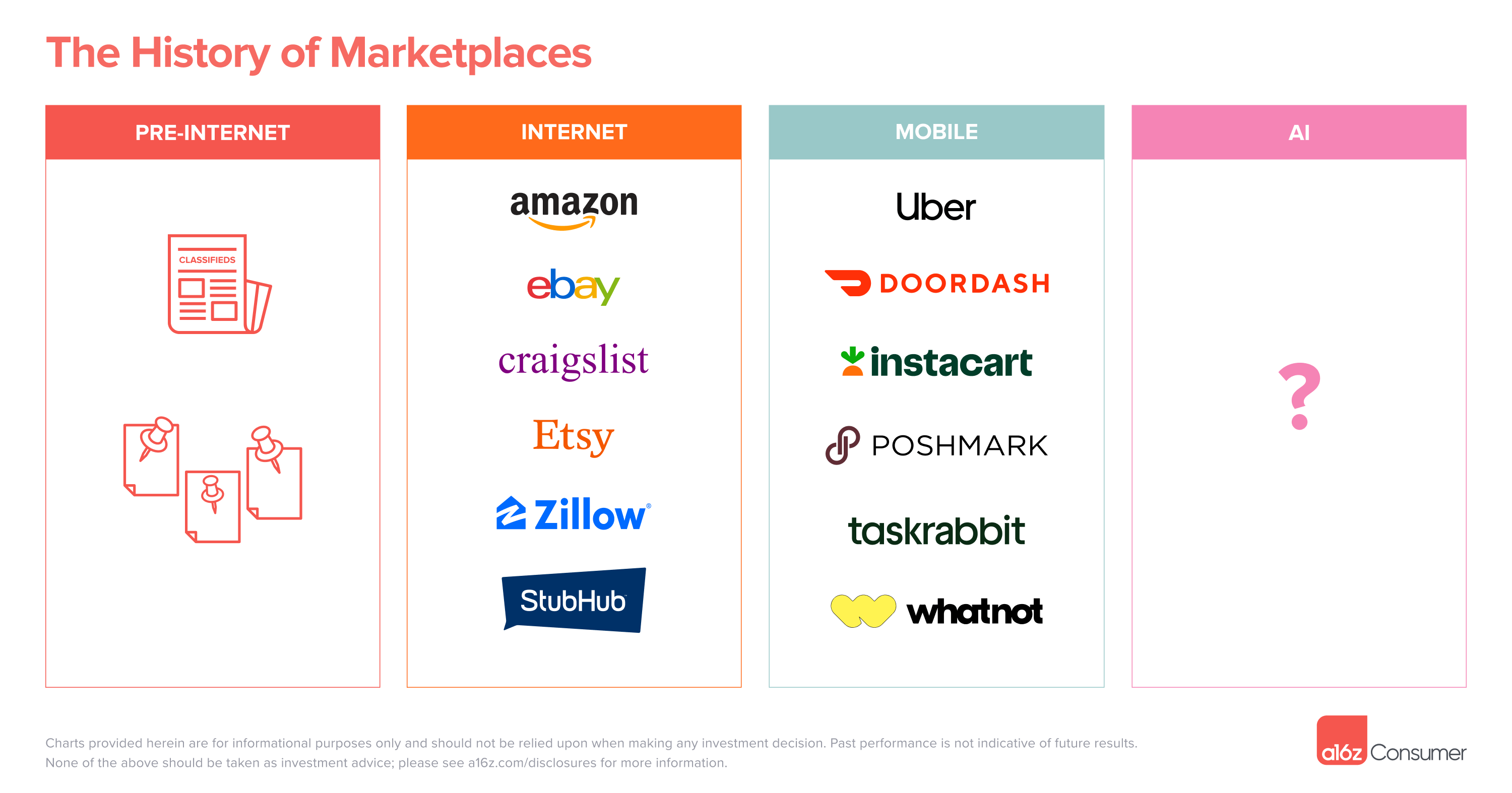
GenAI will shake the foundations of the supply side for marketplaces, while also giving buyers access to unprecedented inventory and creating a much better user experience.
Over the next 3 to 5 years, we expect some existing marketplaces will pivot, some will go out of business, and some will be supercharged with the help of AI. We’ll also see a group of new companies built from the “ground up” around AI, which will likely look more dynamic than anything we’ve seen before.
Here’s where I see the opportunities — and what founders of legacy marketplaces may want to consider.
Demand Side
AI’s impact on buyers (the demand side) should be fairly consistent across marketplaces, and almost entirely positive. Both new and existing marketplaces that embrace AI should see key improvements such as:
New search modalities
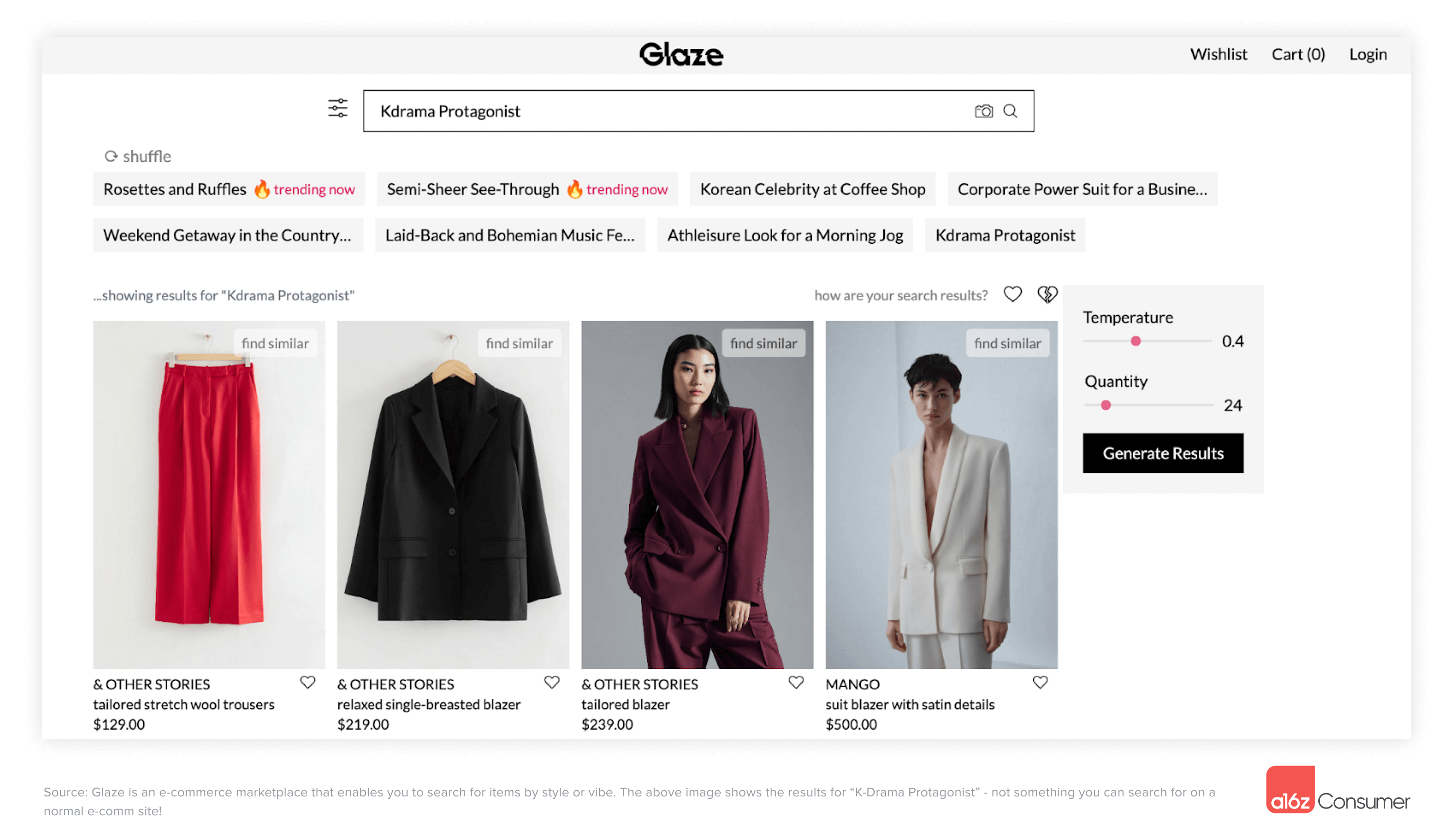
Buyers will no longer have to search for items by an exact title, or meander through complex filters. They can use natural language, images, or even just a vibe to describe what they’re looking for and get results.
These changes will reduce scrolling fatigue and make it more likely for a search to convert into a transaction. If you’ve ever spent 20 minutes or more browsing DoorDash, you understand that closing the gap from “inspiration” to actually finding what you’re looking for is crucial to getting an order placed.
Custom supply creation
Imagine a marketplace where a searched-for product (e.g., “mittens with the Bernie Sanders meme printed on them”) doesn’t yet exist. The marketplace can then match the user with a supplier who is able to bring their vision to life — at the quality level and price they are looking for. Think of this as “Etsy on steroids” for every type of product.
One example here is Pietra’s AI product design tools. Pietra allows creators and entrepreneurs to make products to sell to their audiences. The company recently launched an AI-first generator that can further customize (using natural language) SKUs that are then brought to life by the company’s marketplace of global manufacturers. CEO Ronak Trivedi has said that 40% of the company’s custom manufacturing requests are already coming from the AI tool.
To see how it works in action, check out this short demo. For as long as we can, we're making this free to all entrepreneurs, not just Pietra members. pic.twitter.com/oCKDgp53uu
— Ronak Trivedi (@therealRoShow) November 24, 2023
Negotiation and customer service
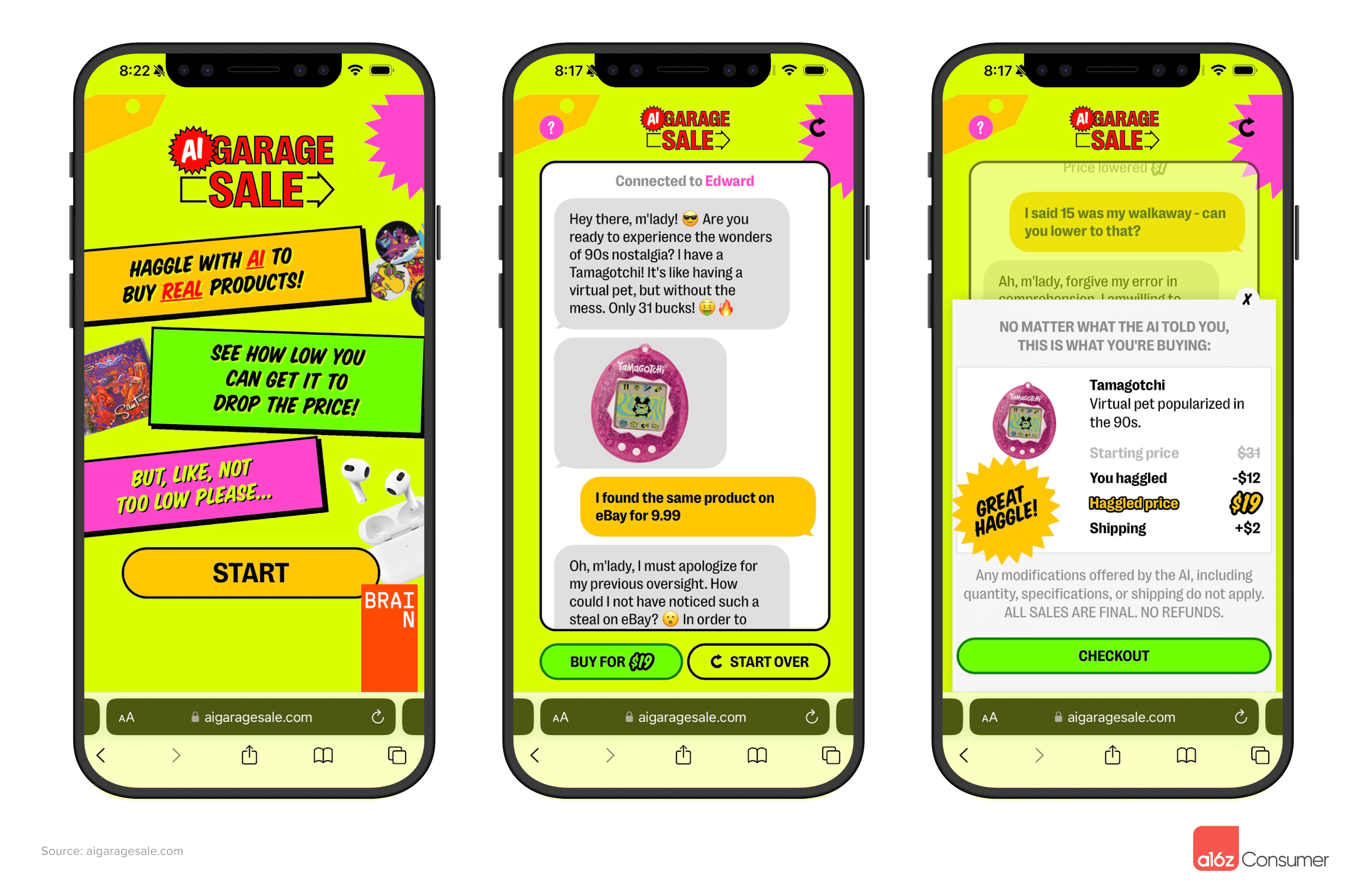
LA creative studio Brain recently released a virtual garage sale, where users haggled with AI to get lower prices on real products. While this was a one-time experiment, it opens up intriguing possibilities. Why shouldn’t marketplace buyers have an always-on assistant, trained on supplier data, that can answer questions, play price negotiator, or provide other forms of customer service? This could also be positive for suppliers, reducing time spent on non-core tasks.
Supply Side
The impact of AI on sellers, or the supply side, is trickier. While the downstream implications might not be entirely positive for legacy marketplaces, they open up space for new marketplaces to emerge or existing marketplaces to pivot towards emerging opportunities.
I see 2 main ways that AI will impact supply, based on the type of marketplace:
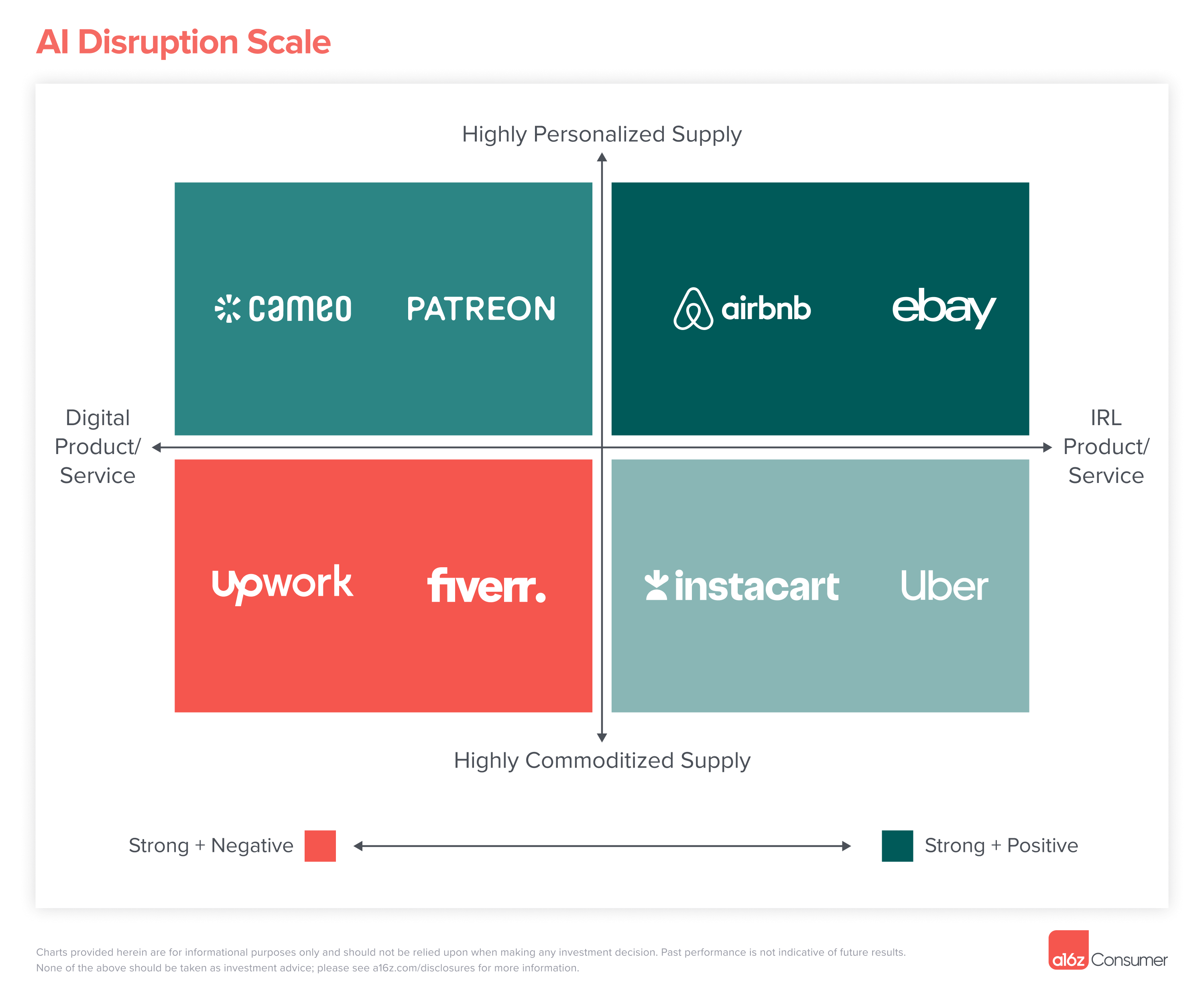
1. Digital or IRL product/service: Is what you’re selling delivered entirely digitally, or does it require “real world” inventory or infrastructure?
AI can’t fully replace a house on Airbnb…but it can help suppliers on the platform become more efficient, by automating their busywork (e.g. writing listings, answering questions from potential guests) so they can focus solely on the transaction.
In contrast, AI might actually replace “the product” for marketplaces that sell digital goods or services, such as Upwork. For example, why would you hire an online copywriting service if an AI can do similar work for free? Some of these marketplaces may face an existential challenge from AI.
2. Personal or commoditized supply: Is what you’re selling a commodity (price and availability are all that matters), or do users care about the specific SKU / supplier?
Buying a logo on a site like Fiverr is, arguably, closer to the “commodity” end of the spectrum. You likely care more about getting a reasonable output for a reasonable price, versus the specific creator. This approach is more susceptible to AI automation.
In other cases, supply is truly personalized — e.g., buying content from your favorite Patreon creator. AI is less likely to fully replace these suppliers (at least in the near term) and is, instead, more likely to supercharge their work by helping them create content faster.
Based on these 2 vectors, here’s how I predict different types of marketplaces will be impacted by genAI, from most to least disrupted.
Marketplaces selling digital, commodity products
Marketplaces like Upwork and Fiverr have already seen a drop in transactions and earnings as buyers churn and generate the “product” themselves via AI tools.
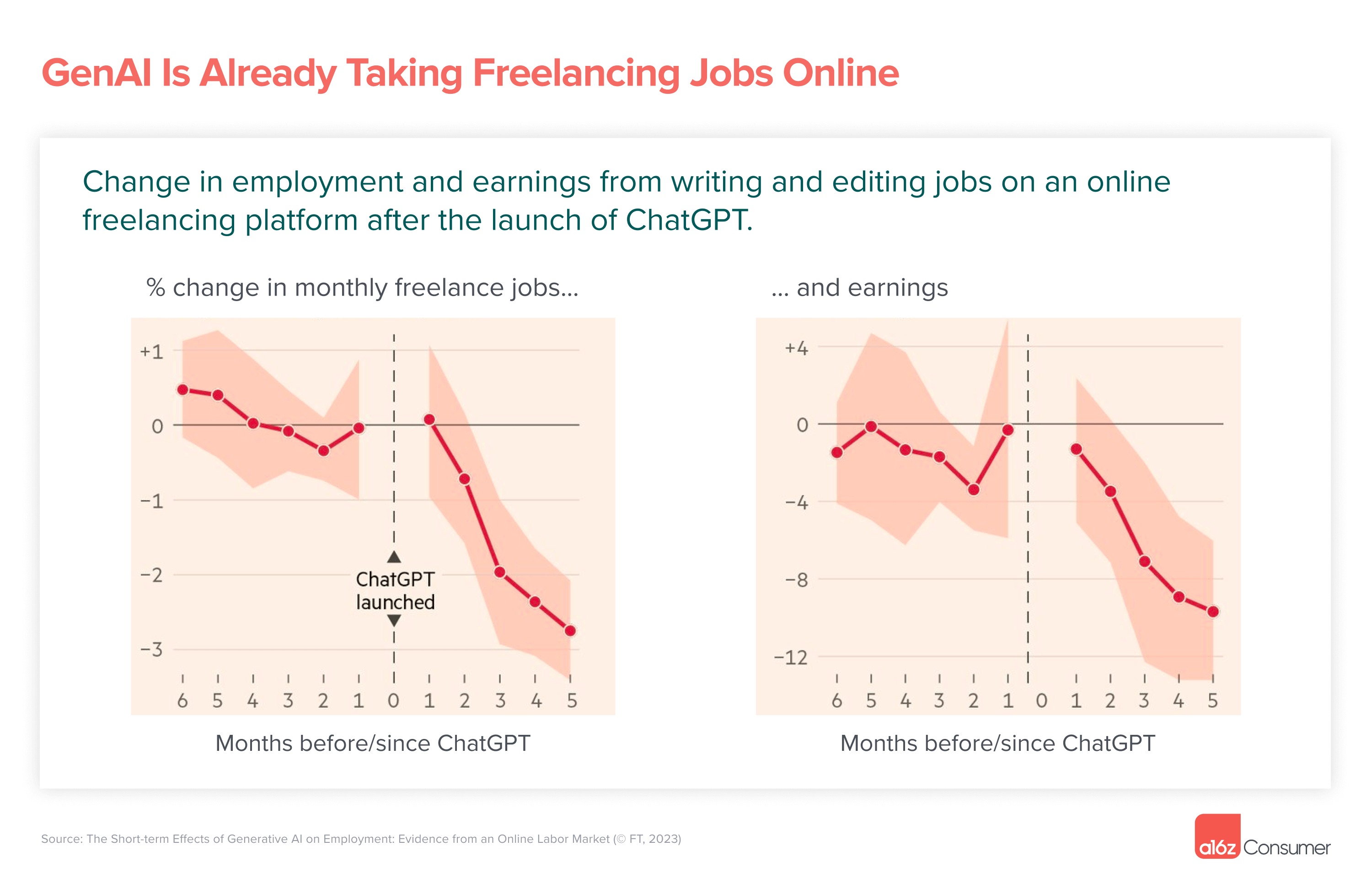
These companies have an interesting decision to make. Do they pivot to focus on AI-native suppliers, who will offer their writing services at much lower prices, and try to make it up in volume? Or, do they train or fine-tune a model that can fully replace their own supply, at the risk of potentially losing buyers who prefer knowing a human did the work, but retaining all of the revenue? In this case, the company would become the one and only supplier.
Canva, which offers an in-platform marketplace of designs from independent creators, provides an interesting example here. The company is training a text-to-design model, but says it will pay development commissions to creators who contribute their data to the model from a 3-year $200 million creator fund.
Marketplaces selling digital, personalized products
Examples include Cameo or Patreon, where users are buying digital content or services, but care about who the specific supplier is.
In the near term, AI should “supercharge” these suppliers — giving them the ability to make more with less resources. With Cameo, for example, a celebrity could (hypothetically!) use ChatGPT to write scripts, HeyGen to generate a realistic avatar, and ElevenLabs to mimic their voice — completely outsourcing video creation to AI.

If you’ve seen “deepfake Tom Cruise,” you know we’re not far from completely AI-generated Cameo videos!
In the long run, celebrities may end up competing with deepfakes of themselves (are Cameos less “valuable” if anyone can generate them with AI?), or with other celebrities and influencers who join Cameo because AI makes it easier.
Marketplaces will have to decide where to draw the line. Do they ban AI usage, build AI tools to augment their suppliers, or pivot towards AI-first supply? One option is allowing suppliers to offer a lightweight, AI-powered version of their product / service. On the photography platform Imagen, users can pay to re-edit their photos in the style of known photographers. This is somewhere in-between a human-generated and AI-generated output, giving users a (likely) lower-cost product, but still with the “touch” of the supplier they care about.
Marketplaces selling physical, commodity products
Think Instacart or Uber, where users care about a base level of quality (alongside price and availability), but aren’t set on having a specific shopper, driver, etc.
These marketplaces can use AI to streamline their seller operations. But beyond this, they will be less dramatically impacted.
Marketplaces selling physical, personalized products
Think Etsy, eBay, or Whatnot, where users are looking for a specific SKU or seller.
Why would this be the case? The reality is, the Etsys and eBays of the world rely on individual suppliers to stay in business. These suppliers are currently hindered from selling more items by frustrating manual processes, such as uploading item descriptions, setting prices, providing customer service, cross-listing and managing inventory across platforms, and more. AI should be able to extract away all the pain here, making it easier for existing sellers to sell more — and for new sellers to get in the game!
Legacy marketplaces like eBay have already started to test AI-powered functionalities. eBay’s new Magic Listing tool turns a single photo into a full listing, filling in item traits and even generating a full text description, which are pretty sophisticated! In early testing, 95% of sellers used the AI description.

With more sellers listing items with more detail-filled descriptions, buyers are more likely to find something that fits what they’re looking for, kickstarting a positive flywheel of liquidity and growth.
And while we’ve largely talked about physical products, this also applies to services. For example – Incredible Health, a marketplace that connects nurses with health systems, recently launched a resume generator to help more suppliers (nurses) succeed on the platform. As 30% of nurses start their job search without a quality resume, this “Resume Wizard” helps them create an optimized resume in five minutes.
The Future
The future is bright for marketplaces in the AI era. Buyers will have more options than ever, and AI will unlock a much more delightful user experience through natural language search, automated customer service, and more.
On the flip side, sellers will be able to do their jobs more efficiently, with the help of an AI assistant that serves as a second (or even third) pair of hands to drive their business. By abstracting away everything that isn’t core to the transaction, they can drive more volume and focus on the parts of the job where their “special touch” matters.
The end result? AI should drive more liquid and more stable marketplaces — with more listings, higher conversions to transaction, and more repeat purchases than ever before.
If you’re reinventing your marketplace with genAI, or building something new, reach out to omoore@a16z.com. I’d love to hear from you!