A Tale of Two Exponentials
Harnessing Moore to combat Eroom
Computers today are roughly 1000x more powerful, at the same price, than those a decade ago. And they are roughly a million times more powerful than twenty years ago. This dramatic period of growth from the 1970’s through today has led to software eating the world. Tech is powerful because it rides Moore’s law—the decades-long ability for the tech industry to exponentially decrease cost and improve capabilities.
In contrast, drug design and healthcare delivery sit on Eroom’s law, coined from the reverse of “Moore.” These industries have suffered from a decades-long increase in cost, which has reached such extreme levels that healthcare costs are reaching approximately a quarter of US GDP (and rising). Between rising labor costs, clinical trial costs, administrative costs, increasingly hostile payor-provider relations, and more, therapeutics and healthcare costs are following the wrong curve.
Turning services into compute
Given that one is exponentially decreasing and the other is exponentially increasing, the obvious goal is to transition from Eroom’s law to Moore’s law. But how is that possible? One would have to turn human driven services (i.e., delivery of care services) into compute (i.e., commoditizing a service through technology). This is precisely what we’re seeing with AI.
This transformation begins with less-complex, one-off models (typically referred to as machine learning) to do simple tasks that are forgiving to mistakes; for example, Netflix using AI to recommend shows.
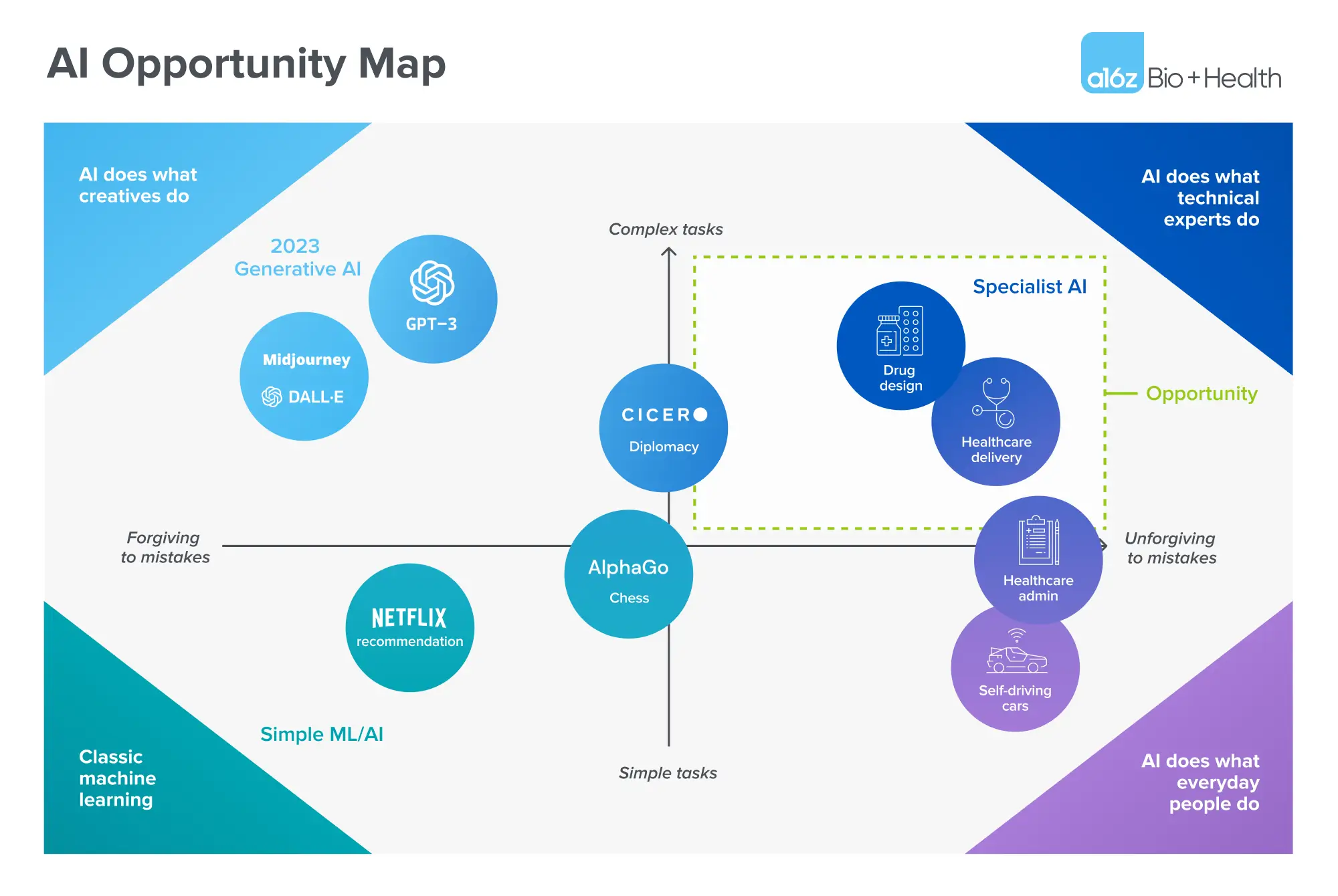 As AI becomes more sophisticated, we’re increasingly moving into new categories of possibility. Generative AI methods can now produce text and images, as well as complete complex tasks, albeit with mistakes (aka hallucinations). For example, chatGPT can produce English answers to questions, but occasionally fails spectacularly on certain questions, “hallucinating” made-up answers.
Over time, this progression leads to the potential for AI-driven co-pilots for life sciences and healthcare that greatly scale skilled labor or that uplevel less-skilled labor. For example, AI could suggest answers or ideas, allowing trained humans to choose the best ones, curating results and skipping over any wrong answers. This approach integrates AI naturally into existing workflows.
In time, the ratio of human work lessens, eventually getting closer to full automation even in areas which require a human specialist—i.e., where small mistakes can have disastrous effects—but likely not without a human somewhere in the loop, especially in areas that are particularly unforgiving to mistakes, such as diagnoses, drug prescriptions, or medical procedures. Developing AI that can succeed at these specialist tasks and not be tainted by critical errors is an outstanding area for the future of AI development along the path towards AGI, and the natural place where future AI advances will ultimately have the greatest impact on life sciences and healthcare.
A renaissance in algorithms and compute power combined with advances in biology and healthcare
The immense progress of AI is only part of the story. AI is maturing at a time when life sciences and healthcare are also transforming, both industries increasingly driven by engineering with its power and opportunity to change how we diagnose, treat, and manage disease and deliver health.
In life sciences, advances in gene editing, cellular biology, stem cells, robotic experiments, and more have allowed scientists to manipulate biology in previously unheard of ways. These advances have enabled biology at scale but also with a newfound consistency, both key elements for connecting with AI. Moreover, with AI becoming embedded in life science experiments, there is a strong feedback loop where the experiments improve the AI’s predictive power, which in turn improves the experiments.
Similarly, healthcare is going through a renaissance in its utilization of technology. The sheer enormity of the cost of healthcare weighs heavily upon the field, and innovators are hungry for technology which can improve outcomes and lower costs. The shift towards value based payment models, in which proactive patient and provider engagement is paramount, is also a tempting tailwind that further creates deep utility for AI in healthcare.
Underlying all of these advances is an immense amount of computing and data storage, which has only recently become possible. For the first time, a renaissance in algorithms has been married with the pure compute power to test, iterate, and run these programs.
Implications: Tackling Our Greatest Challenges
Simply put: We have the opportunity to use AI to tackle our greatest challenges in healthcare and drug design.
First, the cost of healthcare. The exponential increase in cost stems partially from the need for highly trained staff (PhDs, MDs, nurses, etc)—especially as the cost of skilled labor is growing far faster than inflation. As AI becomes increasingly able to function as a technical expert, there are opportunities to extend the abilities of our existing providers to deliver care at a much lower cost. If AI can be implemented with empathy, it can engender engagement and maintain compliance with clinical recommendations, as well as mitigate clinician burnout.
Second, with reduced cost comes the ability to address issues of access (scale) and quality (reduction in variance of performance). As more care becomes AI-enabled, AI has the potential to democratize healthcare, giving the best healthcare services to everyone. AI has the ability to amplify existing wisdom, meaning that patients are more likely to receive the correct diagnosis and treatment plan earlier.
In addition, a key part of both the reduction in cost and improvement in outcomes will likely come from AI’s impact in the development of new therapies. Here, AI serves as a key driver in the understanding of biology. Much as calculus plays a foundational role in physics, AI becomes the driver for unraveling the complexity of biology, a complexity which surely exceeds what a human can completely understand. We are today seeing AI models of human disease which point the way to considerably more effective drugs that can more quickly come to market, with fewer failures. In short, AI can understand biology beyond the abilities of human scientists. This allows research to be scaled far beyond the current model (which primarily relies on serendipitous discovery enabled by hours of human labor in the lab).
With all of this said, it’s also important to note the potential concerns around AI. We recognize the possibility for embedded bias and the other failures that come from training early AI models on data collected by humans. As AI is applied to new industries, scientists, healthcare providers, and regulators will need to remain vigilant for potentially harmful side effects.
Indeed, the existing regulatory framework in life sciences and healthcare tests everything (therapeutics, devices, etc) for efficacy and adverse effects. And for those who fear that AI is a black box, we argue that AI can be completely interrogated and, given enough time, any AI can be understood in detail; ironically, human reasoning is the true black box in healthcare.
The New Industrial Revolution Is Now
Clearly, this isn’t a transition that happens overnight, as healthcare (and biopharma) is in fact a group of multiple intertwined industries with regulatory oversight. Those who will expect AI’s impact to occur in months will either be disappointed or may use the gradual nature of the transition to point to AI’s failure. Instead, we look forward to a transition that will likely occur over 10 to 20 years, in a fashion that all of the stakeholders can become aware and comfortable with the transition, but at the same time, radically transforming a giant part of US GDP that has historically been completely impervious to innovation from the tech landscape.
To solve our greatest challenges in healthcare and life sciences, we need specialist AIs in specific domains more than an overarching AI that can do anything an average human can do. We imagine an array of specialist AI companies, designed with specialized large models, built by specialized teams.
Builders will need to understand both a) how to exploit the latest and greatest AI tech, and (perhaps more importantly) b) how to commercialize a product or platform in biopharma and healthcare with a defensible product and go-to-market strategy. As such, we believe teams with depth in both (scientists, AI experts, healthcare builders and operators, product and go-to-market experts) will be best poised to lead and win in this new era.
We see AI turning every nurse into an inpatient superhero and pushing the industry to consider what it would mean if every patient had an always-on, professionally trained companion that could converse for as long as they want, at a cost of just cents per hour. On the therapeutics side, we’ve been following the development of therapeutics aimed at increasing healthspan; AI-enabled research into better antibody therapies to tackle some of humanity’s worst conditions; and R&D that goes beyond the abilities of human scientists.
We’ve been investing in such groundbreaking companies for years—you can see a full list of our AI and other investments here—and our conviction is growing. The new industrial revolution is here, and we’re excited to play a role in its development.
