Bio + Health

Underestimating AI in Healthcare

Daisy Wolf, Adela Tomsejova, Jay Rughani, and Vijay Pande Posted December 13, 2023

Over the past half century, Wall Street was completely revolutionized by computers.

Not so long ago, human brokers on the stock exchange floor haggled to buy and sell every stock, writing their agreements on pieces of paper.

But in 1971, the NASDAQ, the world’s first electronic stock exchange, was introduced. Electronic trading platforms followed in the 1980s, and the rise of the internet in the 1990s brought online brokerages like E*TRADE.

In the 2000s, technology radically changed not just how stocks were traded, but the decision behind which stocks to trade. Firms like Citadel, DE Shaw, and Two Sigma started to employ High Frequency Trading, computer algorithms capable of executing thousands of trades per second.

Quants, the algorithm writers, overtook master traders, who manually studied companies. Algorithms overtook hunches. The quant funds who led the pack raked in hundreds of billions of dollars.

100% of stock trades used to be made by humans. Today, 80% are made by computer algorithms.

AI is about to bring a similar revolution to healthcare.

Over the next few decades, at least half of the $4.3 trillion dollar American healthcare industry will be AI-driven.

AI will drive drug discovery, proposing medicines not yet dreamed up by man. AI will play a key role in diagnosis, helping humans know what’s wrong sooner so they can get access to life-saving treatments. AI will change how care is delivered, as every human will have a world-class AI doctor in their pocket. And AI will eliminate a lot of the infuriating back office minutia in healthcare.

The markets are significantly undervaluing this opportunity.

This is partially because the market only knows non-AI healthcare companies today. In the digital health public markets, there are (1) tech-enabled service companies that have excelled in speedy go-to-markets, but have been low margin due to human labor, and (2) healthcare SaaS companies that are high-margin, but have struggled in go-to-market because of the difficulties of selling SaaS to human-loving healthcare entities.

AI health companies will not have these limitations. Margins will be way better than human services. Go-to-market will be far easier because AI companies can sell “AI humans,” as opposed to fighting the uphill battle of selling software on which healthcare companies must train their overworked employees. Just like the internet completely transformed go-to-market for software companies, AI will transform go-to-market for healthtech companies.

To demonstrate the scale of the AI opportunity in healthcare, consider that publicly traded, profitable healthcare companies today (excluding pharma) generate $2.6 trillion in revenue and yet turn only $170 billion (~6.5%) of that revenue into profit. Imagine if these were able to achieve even a 15% increase in efficiency1 for having infinite access to low-cost AI “workers.” That alone would drive $314 billion more in operating profit and ultimately $5.6 trillion in incremental enterprise value, even assuming no improvement in valuation multiples or growth in topline revenue. That would nearly triple the enterprise value of profitable public healthcare companies, and we believe that number is conservative!
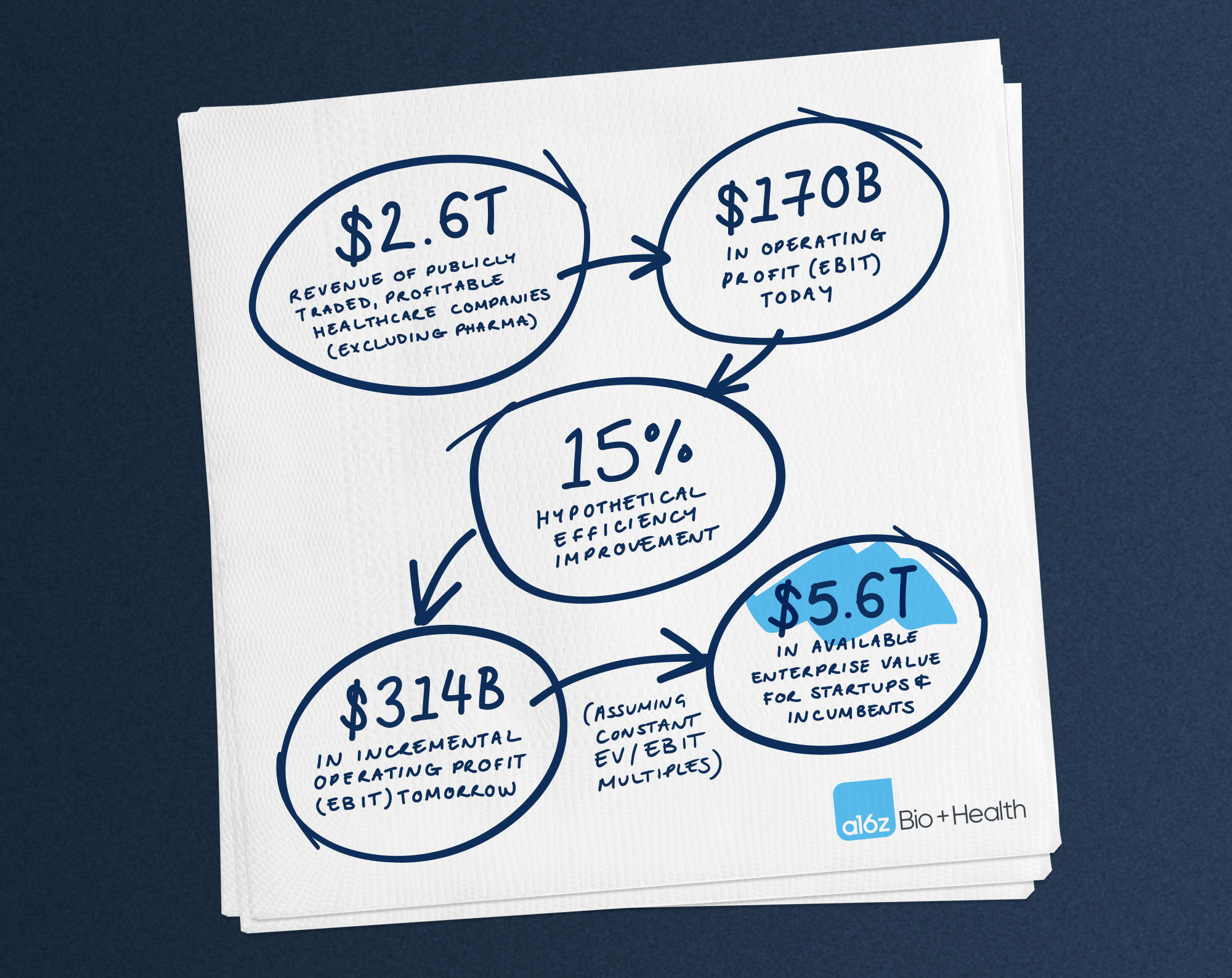
Source: CapIQ as of 11/30/2023; Andreessen Horowitz analysis

So will this happen? What kinds of companies will capture this AI opportunity?

We can look to the introduction of the internet in the 1990s to see what happened in the last technological revolution. Pre-internet—in 1990—the biggest companies at the time were largely in non-tech industries like oil and gas (Exxon Mobil), pharma (Merck), CPG (Coca-Cola), auto (GM), and telecom (AT&T). While some small public companies in the 1990s like Apple and Microsoft embraced the internet and 500x-ed to become the biggest companies in the world, the vast majority of value accrued to startups founded as the internet was taking off. Today these startups—Alphabet, Meta, Amazon—have knocked all of the aforementioned biggest companies of 1990 off the top 10 list.

The same will likely happen with AI in healthcare. While some public healthcare companies will transform their strategies with AI and excel because of it, the vast majority of the value will accrue to AI health companies being started now.

Today resembles the early days of the internet. Will there be an AI bubble that bursts just like the dot com one did? Probably. But the best companies will rise from the ashes and transform human health.

***

1“15% efficiency improvement” denotes a 15% reduction in COGS and 15% reduction in OpEx

About the Contributors
Want More a16z Bio + Health?

Insights, analysis, and additional reading on bio and health, and how both are shaping our future.

Learn More
Recommended For You
Bio + Health

new Infinite Healthcare: What’s It Worth?

Jay Rughani, Jane Rhee, and Julie Yoo
Enterprise

Can AI Help Save Lives?

Kimberly Tan and Michael Chime

Want More Bio+Health?

Insights, analysis, and additional reading on bio and health, and how both are shaping our future.

Sign Up On Substack

Views expressed in “posts” (including podcasts, videos, and social media) are those of the individual a16z personnel quoted therein and are not the views of a16z Capital Management, L.L.C. (“a16z”) or its respective affiliates. a16z Capital Management is an investment adviser registered with the Securities and Exchange Commission. Registration as an investment adviser does not imply any special skill or training. The posts are not directed to any investors or potential investors, and do not constitute an offer to sell — or a solicitation of an offer to buy — any securities, and may not be used or relied upon in evaluating the merits of any investment.

The contents in here — and available on any associated distribution platforms and any public a16z online social media accounts, platforms, and sites (collectively, “content distribution outlets”) — should not be construed as or relied upon in any manner as investment, legal, tax, or other advice. You should consult your own advisers as to legal, business, tax, and other related matters concerning any investment. Any projections, estimates, forecasts, targets, prospects and/or opinions expressed in these materials are subject to change without notice and may differ or be contrary to opinions expressed by others. Any charts provided here or on a16z content distribution outlets are for informational purposes only, and should not be relied upon when making any investment decision. Certain information contained in here has been obtained from third-party sources, including from portfolio companies of funds managed by a16z. While taken from sources believed to be reliable, a16z has not independently verified such information and makes no representations about the enduring accuracy of the information or its appropriateness for a given situation. In addition, posts may include third-party advertisements; a16z has not reviewed such advertisements and does not endorse any advertising content contained therein. All content speaks only as of the date indicated.

Under no circumstances should any posts or other information provided on this website — or on associated content distribution outlets — be construed as an offer soliciting the purchase or sale of any security or interest in any pooled investment vehicle sponsored, discussed, or mentioned by a16z personnel. Nor should it be construed as an offer to provide investment advisory services; an offer to invest in an a16z-managed pooled investment vehicle will be made separately and only by means of the confidential offering documents of the specific pooled investment vehicles — which should be read in their entirety, and only to those who, among other requirements, meet certain qualifications under federal securities laws. Such investors, defined as accredited investors and qualified purchasers, are generally deemed capable of evaluating the merits and risks of prospective investments and financial matters.

There can be no assurances that a16z’s investment objectives will be achieved or investment strategies will be successful. Any investment in a vehicle managed by a16z involves a high degree of risk including the risk that the entire amount invested is lost. Any investments or portfolio companies mentioned, referred to, or described are not representative of all investments in vehicles managed by a16z and there can be no assurance that the investments will be profitable or that other investments made in the future will have similar characteristics or results. A list of investments made by funds managed by a16z is available here: https://a16z.com/investments/. Past results of a16z’s investments, pooled investment vehicles, or investment strategies are not necessarily indicative of future results. Excluded from this list are investments (and certain publicly traded cryptocurrencies/ digital assets) for which the issuer has not provided permission for a16z to disclose publicly. As for its investments in any cryptocurrency or token project, a16z is acting in its own financial interest, not necessarily in the interests of other token holders. a16z has no special role in any of these projects or power over their management. a16z does not undertake to continue to have any involvement in these projects other than as an investor and token holder, and other token holders should not expect that it will or rely on it to have any particular involvement.

With respect to funds managed by a16z that are registered in Japan, a16z will provide to any member of the Japanese public a copy of such documents as are required to be made publicly available pursuant to Article 63 of the Financial Instruments and Exchange Act of Japan. Please contact compliance@a16z.com to request such documents.

For other site terms of use, please go here. Additional important information about a16z, including our Form ADV Part 2A Brochure, is available at the SEC’s website: http://www.adviserinfo.sec.gov.