Fintech

Fintech Sees Renewed Focus in Colombia

Santiago Suarez Posted September 21, 2023

Lee este artículo en Español.

Colombia’s finance sector has historically been one of the most regulated in the world. Over the past decade, however, the country has quietly become the third-largest fintech hub in Latin America (trailing only Brazil and Mexico), home to nearly 300 fintech companies. Seventy-six percent of Colombians use fintech services, according to an Ernst & Young report, the highest fintech adoption rate in Latin America, and from 2008 to 2022, the percentage of Colombian adults who hold a banking product rose from 55% to over 90%.

Given that the majority of Colombians now have access to a smartphone, the internet, and a basic bank account, the conditions are set for an acceleration of financial innovation and inclusion. That trend is being reinforced by advances in licensing and Open Finance, the promise of ubiquitous instant payments, and regulatory support for innovative fintech solutions. 
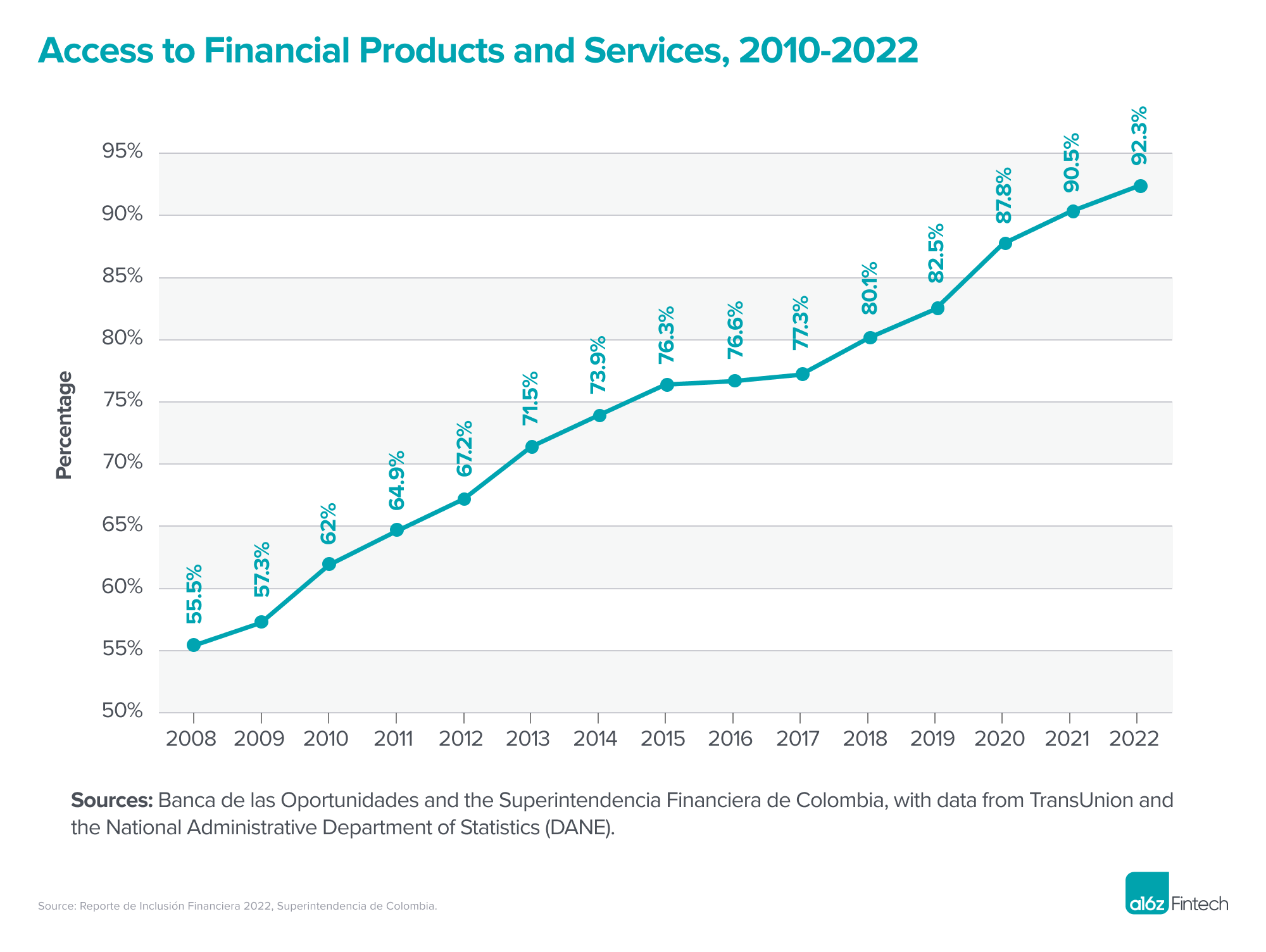
Graph of access to financial products and services in Colombia, 2010-2022

In particular, several government actions have expanded fintech’s capabilities in Colombia in recent years.

De novo licenses spur market competition 

For years, it was difficult and expensive to obtain a de novo banking license in Colombia, a response to the government’s historic struggle to tamp down drug trafficking and money laundering. Today, the banking sector in Colombia remains highly concentrated: there are only 29 fully-licensed banks (establecimientos de credito), and the three largest banking conglomerates control over 60% of deposits, according to the International Monetary Fund.

However, a few years ago the Superintendencia Financiera de Colombia, the local regulator, opened up the market by introducing what’s known as a Compania de Financiamiento license. This license has lighter capital and regulatory requirements, while still allowing its holder to gather deposits via savings or electronic deposit accounts, offer loans backed by these deposits, and issue cards. 

Since then, fintech companies including Rappi, Uala, Bold, Mercado Pago, and Nubank have received approval to offer deposit, transaction, and credit accounts. Not only does this allow new entrants to offer a comprehensive suite of financial products (and capture the full economics that lead to sustainable business models), it also gives Colombian consumers greater confidence that new entrants can be trusted with their money. 

Open banking expands access and inclusion

Alongside opening the market to new entrants, the government has also committed to developing a robust Open Finance framework, following Brazil’s example. Last year, the government included Open Finance in its National Development Plan, a foundational law that sets the economic development program for the next four years. If fully implemented, this will allow Colombians to own and access their banking data regardless of which institution they bank with. In addition, the government has signaled an openness to the potential for full bank account portability, allowing people to migrate account information between banks, just like they do their cell phone numbers when they switch carriers.

Instant, interoperable payments will accelerate digitization

Following the success of Pix in Brazil, the Colombian government has committed to launching its own version of an instant, interoperable and free payment system in the next two years. Recently, the Central Bank governor (who regulates payments) indicated that they will announce the technology partner by October of this year, and that they expect the system to be live before the end of 2024. Considering that most interbank payments still carry meaningful costs (up to $2 per payment), this will be a boon for the further digitization of payments in the country. 

The future of fintech in Colombia

In Colombia, fintech continues to expand its reach—the industry is estimated to be growing at  around 120% a year, and the number of fintech companies in the country has more than doubled in the past five years.

Through recent government actions, Colombia is moving toward a more open and transparent financial system—one where a greater number of fintech companies compete to earn users’ trust, money, and business based on the quality of their products and services. The new superintendent has reaffirmed the government’s commitment to an inclusive agenda that fosters competition and innovation. Now it’s up to founders and entrepreneurs to seize the moment by continuing to build the products that will power the future of banking and finance in Colombia.

See a16z.com/global-payments for more. 

About the Contributor

Santiago Suarez

is the cofounder and CEO of Addi, a fintech company that enables digital commerce in Latin America.

Want More a16z Fintech?

Commentary and analysis on recent news, and compelling trends in the fintech space.

Learn More
Recommended For You

Fintech Fuels Global Payments

Angela Strange, Joe Schmidt, Gabriel Vasquez, Lauren Murrow, and Denis Young
Fintech

Software Transcends Borders—Why Not Money?

Angela Strange, Joe Schmidt, and Gabriel Vasquez
Fintech

Brazil’s Surprising Fintech Tailwind

Angela Strange and Flora Oliveira
Fintech

A Market Map of Brazil’s Credit Landscape

Gabriel Vasquez and David Haber
Fintech

Why India Leads in Digital Payments

Matt Flannery

Want More Fintech?

Commentary and analysis on recent news, and compelling trends in the fintech space.

Sign Up On Substack

Views expressed in “posts” (including podcasts, videos, and social media) are those of the individual a16z personnel quoted therein and are not the views of a16z Capital Management, L.L.C. (“a16z”) or its respective affiliates. a16z Capital Management is an investment adviser registered with the Securities and Exchange Commission. Registration as an investment adviser does not imply any special skill or training. The posts are not directed to any investors or potential investors, and do not constitute an offer to sell — or a solicitation of an offer to buy — any securities, and may not be used or relied upon in evaluating the merits of any investment.

The contents in here — and available on any associated distribution platforms and any public a16z online social media accounts, platforms, and sites (collectively, “content distribution outlets”) — should not be construed as or relied upon in any manner as investment, legal, tax, or other advice. You should consult your own advisers as to legal, business, tax, and other related matters concerning any investment. Any projections, estimates, forecasts, targets, prospects and/or opinions expressed in these materials are subject to change without notice and may differ or be contrary to opinions expressed by others. Any charts provided here or on a16z content distribution outlets are for informational purposes only, and should not be relied upon when making any investment decision. Certain information contained in here has been obtained from third-party sources, including from portfolio companies of funds managed by a16z. While taken from sources believed to be reliable, a16z has not independently verified such information and makes no representations about the enduring accuracy of the information or its appropriateness for a given situation. In addition, posts may include third-party advertisements; a16z has not reviewed such advertisements and does not endorse any advertising content contained therein. All content speaks only as of the date indicated.

Under no circumstances should any posts or other information provided on this website — or on associated content distribution outlets — be construed as an offer soliciting the purchase or sale of any security or interest in any pooled investment vehicle sponsored, discussed, or mentioned by a16z personnel. Nor should it be construed as an offer to provide investment advisory services; an offer to invest in an a16z-managed pooled investment vehicle will be made separately and only by means of the confidential offering documents of the specific pooled investment vehicles — which should be read in their entirety, and only to those who, among other requirements, meet certain qualifications under federal securities laws. Such investors, defined as accredited investors and qualified purchasers, are generally deemed capable of evaluating the merits and risks of prospective investments and financial matters.

There can be no assurances that a16z’s investment objectives will be achieved or investment strategies will be successful. Any investment in a vehicle managed by a16z involves a high degree of risk including the risk that the entire amount invested is lost. Any investments or portfolio companies mentioned, referred to, or described are not representative of all investments in vehicles managed by a16z and there can be no assurance that the investments will be profitable or that other investments made in the future will have similar characteristics or results. A list of investments made by funds managed by a16z is available here: https://a16z.com/investments/. Past results of a16z’s investments, pooled investment vehicles, or investment strategies are not necessarily indicative of future results. Excluded from this list are investments (and certain publicly traded cryptocurrencies/ digital assets) for which the issuer has not provided permission for a16z to disclose publicly. As for its investments in any cryptocurrency or token project, a16z is acting in its own financial interest, not necessarily in the interests of other token holders. a16z has no special role in any of these projects or power over their management. a16z does not undertake to continue to have any involvement in these projects other than as an investor and token holder, and other token holders should not expect that it will or rely on it to have any particular involvement.

With respect to funds managed by a16z that are registered in Japan, a16z will provide to any member of the Japanese public a copy of such documents as are required to be made publicly available pursuant to Article 63 of the Financial Instruments and Exchange Act of Japan. Please contact compliance@a16z.com to request such documents.

For other site terms of use, please go here. Additional important information about a16z, including our Form ADV Part 2A Brochure, is available at the SEC’s website: http://www.adviserinfo.sec.gov.