During the wars in Iraq and Afghanistan, officers joked that there was “nothing unmanned about unmanned aircraft.” A single MQ-9 required over 180 people to keep it running, including pilots, sensor operators, launch-and-recovery crews, and analysts to process the firehose of data. As Major General Michael McCurry once said, “unmanned” formations often demand more people than the manned formations they were meant to replace.
Yet the push towards autonomy only accelerates, as it must. When Deputy Secretary of Defense Kathleen Hicks unveiled Replicator in 2023, the Pentagon committed to fielding “multiple thousands” of attritable autonomous systems across all domains. Nearly three years later, that effort is set to scale dramatically under initiatives like the Defense Autonomous Warfare Group (DAWG), a $54 billion FY27 request and a 240x increase from the year prior. This is more than the budget for the entire Marine Corps.
Automation reduces risk to force and risk to mission, helping replace “big, juicy targets” with distributed and attritable mass overseen by lean teams. However, our ports and bases were built around crewed platforms. The assumption has been that manpower scales with metal, but unmanned systems completely break that model.
Building the autonomous force is straightforward. Keeping the drones alive and fighting in the field is where most of these programs will fail. Without reinventing how we sustain these systems, taking humans off platforms only moves the bottleneck.
The sustainment bottleneck
Imagine a near-future operation. A fleet of unmanned vessels and airborne drones are spread across the Western Pacific. They patrol for weeks, building a live picture of the battlespace and striking targets. But sustainment catches up with them. A vessel that outran a missile salvo must fall back hundreds of miles to refuel at a manned port, or a drone tracking a fast-moving submarine threat is forced to ditch because no recovery node is in range.
American defense companies are proving that operations can run at “machine speed”. The Pentagon hasn’t yet figured out how to support them in the field at the same tempo.
The Government Accountability Office (GAO) has already warned that the Navy’s autonomy plans don’t account for the infrastructure required to make these systems work. So far, they expect to spend roughly $4.3 billion to acquire 21 uncrewed surface and undersea vehicles, but even that estimate omits other lifecycle costs.
On top of this, GAO has already documented declining mission-capable rates due to shortages of spare parts, skilled maintainers, and aging infrastructure. Adding thousands of unmanned systems on top of this without having a better plan for support risks compounding a known problem. This can be quite significant, too; GAO has noted that sustainment accounts for 70% of a platform’s lifecycle cost, and that nearly half of the sampled systems had costs that had grown beyond expectations.
This is obviously important because poorly supported systems ruin the whole point of autonomy. Department of War efforts focus on “attritable” systems — platforms meant to be lost and replaced fast. But attritability only matters if resupply is nearly frictionless. Without the ability to flow new stuff into theater and turn them quickly, commanders will hoard “attritable” assets the same way they hoard everything else that’s hard to replace.
There is also early evidence of market failure. In their June 2025 LRAE forecast, NAVSEA noted that the incumbent vendor for the XLUUV undersea vehicle program (Boeing) did not bid on follow-on operations and sustainment work for the vehicles at all. Both legacy primes and newer startups struggle when support programs are unclear or underfunded. The logical conclusion of this is how you end up with an arsenal of prototypes.
Perhaps most importantly for the near future, the Indo-Pacific is vast and we cannot flood it with people to hand-carry fuel and ammo the way we did in World War II. The Army’s own work on “precision logistics” and autonomous resupply acknowledges this on land, and the point is even more compelling at sea.
What autonomous sustainment looks like
On the bright side, some of the building blocks for autonomous sustainment already do exist. DARPA’s NOMARS program, for example, has demonstrated automated at-sea refueling and autonomous harbor operations with the USX-1 Defiant unmanned ship. Sea Hunter has already crossed from San Diego to Hawaii and back without a crew, with only brief boardings from an escort vessel to check propulsion. These are glimpses of what autonomous sustainment could become.
But they are early pieces, not a complete system.
A true autonomous sustainment architecture for the Pacific fight would center on infrastructure built for machines:
- Hardened, tiered autonomous ports and airbases. A mesh of autonomous ports and airbases that enable unmanned systems to recover without personnel, and to survive during months of high-tempo conflict.
- Containerized “base in a box” modules. Standardized ISO-container kits for power, weapons, storage, launch/recovery, and C2 that can be dropped into place and chained together into larger sites as demand scales.
- Robotic handling and turnaround infrastructure. Fixed and mobile systems for automated launch, recovery, and reload of drones, sized from small-craft racks up to ship-scale piers.
- Integrated energy and data spine. Forward-deployable power and hardened comms & compute stacks at every node, giving each site the ability to sustain operations and host autonomy at the edge even when disconnected.
All of this also depends on a digital nervous system that keeps the broader enterprise working. You need fleet-wide telemetry and predictive maintenance so commanders always know the health and status of every platform, and you need powerful software that treats sustainment as a live optimization problem. Companies like Rune Technologies are among those leading this evolution in contested logistics.
None of this is wildy high-octane stuff compared to the fighter jets or missiles many are familiar with. But Eisenhower had it right: wars are won on logistics, and that’s even more true for a war fought with autonomous systems.
Congress must stay ahead
The good news is that Congress and the Department of War are not starting from zero. Lawmakers are already scrutinizing the Navy’s future plans, in particular, but the bad news is that oversight alone can’t keep up with reality.
We are watching in real time what it looks like when new technology outruns infrastructure. To homeport Ford-class carriers like CVN-78 and CVN-79 on the West Coast, the Navy is now planning major electrical upgrades at Naval Base Kitsap: substations, demolition of legacy facilities, and new 13.8 kV shore power distribution to support both Nimitz- and Ford-class carriers at the same pier. The USS Gerald R. Ford entered service in 2017, but nearly ten years later the Pacific still lacks the infrastructure it needs to dock.
This is not an isolated lack of readiness. A similar – and in some ways even more troubling – disjointed dynamic has surfaced in the Navy’s past automation experiments. The GAO writes:
Previous attempts by the Navy to reduce crew size by increasing automation did not go as planned. For example, in 2017 and 2021, we reported that the Navy’s attempts to reduce crew sizes on crewed ships through increased automation, called optimal manning, resulted in large increases to maintenance costs when the automated systems failed to work as intended, ultimately leading the Navy to assign additional crew to its ships. Given this trend, the Navy cannot fully assess the affordability of uncrewed maritime systems without understanding the extent to which the replacement of a crew on board with automated systems affects operations and sustainment costs.
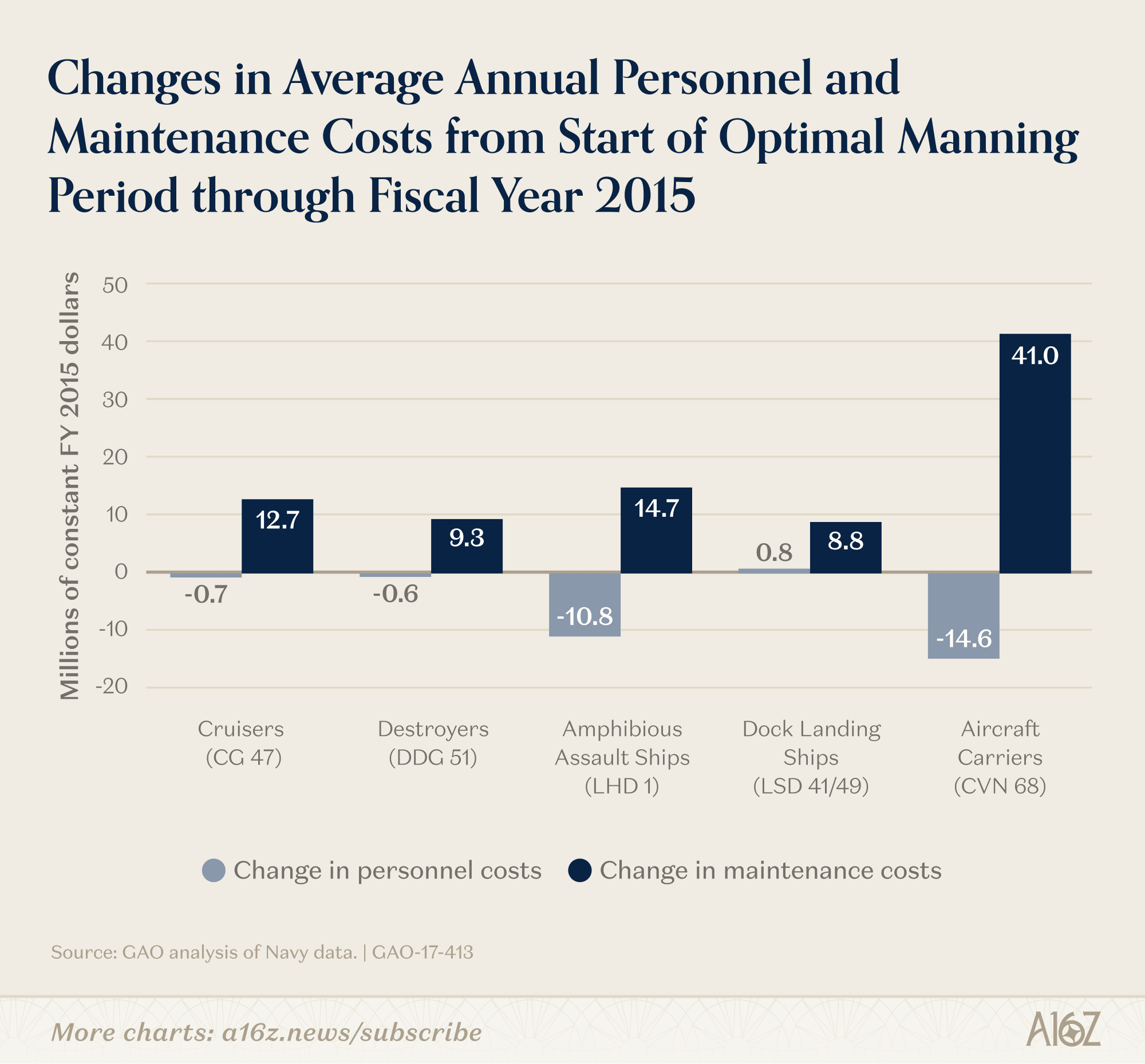
Past automation efforts went poorly and ended up actually needing more people. That’s obviously a big problem, but the alternative — not automating sustainment at all — locks us into a model that will surely lead to failure in the next conflict. Quite simply, the entire autonomy investment fails unless sustaining it works, too.
Despite this, most of the excitement and funding remains tied to platforms. Things like uncrewed surface vessels, undersea vehicles, loitering munitions, FPV drones, and the software that makes them all move. All the while the ports and bases that would actually keep a mass of autonomous systems in the fight are treated as background infrastructure, usually buried in MILCON or operations and sustainment accounts.
From the Hill’s perspective, this creates three problems:
- No one owns the full architecture. Different offices own platforms and infrastructure, and there is no single “program” to ask about when a staffer wants to know how an autonomous system will be supported in, say, the Western Pacific.
- MILCON and sustainment become the bill-payer. When budgets tighten, it is easier to trim or delay infrastructure than to cut a named weapon system. That bias is understandable and dangerous.
- Industry gets the wrong signal. If operations and sustainment aren’t clearly funded, vendors rationally optimize for prototypes. If Operations & Sustainment isn’t real money, it will not be a real business.
At this rate, we will have an impressive set of autonomous demonstrations and not much that can survive repeated deployments in a contested theater.
A plan for sustainment
So what should Congress and the Pentagon do? What we need is a real plan for autonomous sustainment. This means a concrete effort with accountable leadership and real deliverables focused on four things:
- Prototype real autonomous ports and bases: Field a small number of integrated autonomous sustainment nodes in the Indo-Pacific within a fixed timeline. Measure success by systems turned per human per day, resilience under cyber and kinetic attack, and interoperability across vendors. Treat these nodes as joint assets from day one.
- Fund infrastructure as part of autonomy programs: Require every major autonomous-system program to brief Congress about the infrastructure nodes needed to sustain them and the manpower those nodes require. Create dedicated authorizations and appropriations for autonomous sustainment pilots instead of forcing services to squeeze them into existing accounts.
- Test as you fight: Adopt a “test as you fight” approach – rapid, realistic exercises followed by quick fielding of what works. Accept that autonomy is attritable: losing drones and ASVs in testing or high-risk missions is part of the process. And recognize that new sustainment gaps will appear as these systems scale.
- Long-term planning. China is structurally better positioned for long-horizon industrial mobilization because it can align priorities and budgets over significant periods of time. For the U.S. to compete in autonomous warfare at scale, Congress must create durable industrial signals.
For the Pentagon, this is an opportunity to solidify the technology integration and culture change that has already started. If we can focus leadership attention and funds toward fielding new systems, you bet we can apply that same playbook to the infrastructure necessary to support them.
For Congress, this is a chance to shape the next decade of American overmatch. The question in hearings should not just be, “How many unmanned systems will you field by 2027?” But, “Where will they plug in, and how many people will it take to keep them running?”
The United States is betting that autonomy will increase its lethality at lower cost in blood and treasure. At Andreessen Horowitz, we’re betting that this is correct — but it only pays off if the supporting infrastructure exists, too. We don’t want capabilities that just wors on a test range and then sits in a warehouse in CONUS.
What’s required to prevent this from happening is a shift from a rigid sustainment backbone to a more adaptive spine – infrastructure that can keep a distributed robotic force moving under contested conditions. Without it, the more likely failure mode for an autonomous swarm isn’t combat losses, but sitting at a forward node with no power and no one to recover it.
The autonomous platforms are here. Only a flexible sustainment spine can make them a fighting force.