As a former software engineer and CEO, I used to hold the “engineer-centric” view that sales is not a critical function in an organization. I believed that product excellence and market fit obviated the need for a formal sales function: Build a great product, and customers will come.
That view was short-sighted, to say the least. The technology companies that are able to both build great products and integrate a strong sales function are the ones that succeed, whether consumer or enterprise — from Microsoft to Salesforce and yes, even Apple and Facebook. You may not hear about it, but all the world-class companies have a strong sales force. Still, I’m often asked the question of “Why sales?” by entrepreneurs and technical founders.
Yes, even if people are already virally adopting your product…
The “why sales” question becomes even more pressing given the trend towards “bottoms-up” product adoption — i.e., getting the user (including developers as buyers) to use a given product by offering it for free or without a formal top-down sales motion, as is common with SaaS. So why not simply invest in hiring more engineers and let the targeted end-user virally adopt the product of their choice?
The answer is that an unstructured, bottoms-up, user-generated sales motion does not unlock the full value of a given product. If you build it, they may come… but they probably won’t discover — or use — every feature you want them to. Most users view it only through the lens of their own use case, not through the personas of all the users in an enterprise (which is a view someone at the top, like a CIO, is more likely to have). For example, a security or audit feature that is critical to a CIO might be completely irrelevant to an individual user.
A formal sales function promotes the value of a product to an organization in ways that individual adoption and usage can’t. They demonstrate the importance of features across the board, including criteria-setting, pricing, and packaging that lets you unlock more of the value you’re materially creating for that organization with your product. The result is greater penetration into the enterprise, higher product appreciation, and more revenue from a given customer.
This is not to say that “bottoms-up” adoption is bad strategy; quite the opposite. With a bottoms-up motion, a great product often sees exciting initial revenue traction. The number of customers increase and the dollars per customer correspondingly grow. However, as a product achieves broader adoption, the dollar per customer tends to flatten. This reflects an individual user ascribing a fixed value to a given product:
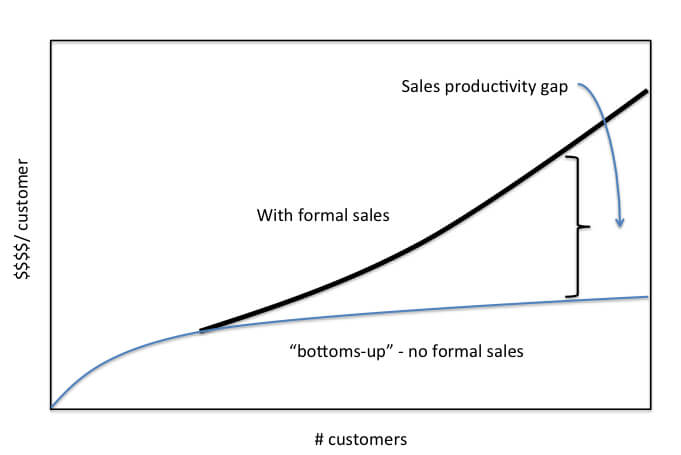
That’s why combining a tops-down and bottoms-up approach by layering a formal sales function yields the best results. While it might seem that a sales organization is too expensive, the revenue added can far exceed the cost (you want your sales organization to generate 3x its loaded cost). Creating a formal sales organization will help accelerate revenue and product adoption, as well as result in more satisfied customers.
Yet sales is deceptively complex, in ways that are often unappreciated. Details such as hiring, forecasting, account management, and go-to-market strategy are tasks that require deep expertise and prior experience. So how to hire a head of sales?
The startup CEO’s journey to hiring a head of sales
One of the most common mistakes made by technical CEOs (me included!) is assuming they can run sales themselves. The journey goes something like this:
Day 1: I’m going to run sales because it’s not very complicated and I can learn this stuff an a few months. After all, I created our product, raised venture capital, and sold our first big deals. I know how to sell.
Day 30: This sales stuff is coming along great. I just read a book on sales management, and now understand that a top-of-the-funnel pipeline is important to quantify. We’re going to implement some way of developing a pipeline.
Day 90: We now have a pipeline, but I’m not sure how to exactly create qualified leads or a methodology of prioritizing what opportunities will close when. I talked with a friend of mine who has a certain scoring system. Also not sure whether to use salesforce.com or excel to manage all of this.
Day 180: Read another book on hiring sales people. But all the sales people I meet seem terrific; they all met their quotas at their previous companies and attained President’s Club (hey, do we need one of these too?). Not sure which one to hire, plus they have such different backgrounds. We seem to have a pipeline built, but only four of the thirty deals we had forecasted for the quarter closed. I need to do a better job on our pipeline analytics. In fact, this past weekend I wrote a machine-learning algorithm to help us better understand our sales leads and pipeline. I’m going to ask that our sales org use this on a regular basis.
Day 270: This sure is taking a lot of time. I hired three reps, but only one of them is working out. If I fire two of them, I start back at zero. I think I need to spend more time with the individual reps and teach them everything I know about the product. That will make them way more efficient. I’m having a sales deep-dive offsite next week to go through the sales process and technical material.
Day 365/ one year in: Holy fuck. This sales stuff is way more complex than I thought. Just get me out of this mess so I can go back to building great product. In the year that I’ve spent trying to run sales, I took my eye off of product and now we have three competitors beating us on features that should have been in our product six months ago. And on top of it the viral adoption I had among users is now being crowded out from the top by some fancy-pants big company with its own huge sales force and deep relationships in place. Shit-shit-shit…
The moral of this (very familiar) story? Hire a proper head of sales! (By proper I mean someone you can trust to run the function on their own, not just a junior proxy with you as de facto lead.) The right sales lead will intuitively understand how to build out a sales team and process without your getting into the weeds and diverting your precious time into an unknown arena.
But that doesn’t mean you should treat sales as a “black box” that you don’t have eyes into or are completely hands off about, either. A CEO can make sure the sales team and sales leadership is well-integrated into the company. There a few practical ways to be needs involved in the sales process as a CEO:
- Have a weekly meeting with your sales VP where you review the pipeline and forecast, have the VP sales educate you on what he or she is doing, and ask questions
- Ask what you can do to help your sales VP: Can I help with closing a deal, visiting a customer, or rallying the troops?
- Spend time together! In fact, there’s no better way to build morale with your sales team than to do so with them and your customer
- Hold your sales VP accountable by setting clear objectives with quantitative (not qualitative!) agreed-upon metrics; you should also know the quotas and productivity of each sales person
- Be sure to interview the first sales hires to ensure alignment with your head of sales as well as with organizational culture and values
- Encourage engineers to spend time with sales, and sales to spend time with engineers; the more the two organizations interact solving real product and customer issues, the less foreign each will be to one another and the better your product will be
Managing a head of sales isn’t easy, but whatever you do, don’t micro-manage. Let your head of sales do the heavy lifting, but understand the high-level levers and sales economics too. Your job is to make sure sales becomes a seamless part of your company’s success. Finally, don’t forget that your job as CEO is to also help close deals as necessary — you should be doing this at least a few times a month.
* * *
Remember, your first head of sales will likely not be the last. Hiring the right person at the right time with the right background is critical for success, and in a startup, an early head of sales is likely to be a hands-on contributor who also has the capability to manage a handful of people. These “renaissance” VPs also understand how to deal with the ambiguities of an early startup. But as your company grows and the sales organization becomes larger and more transactional, that early hire may not have the interest or skill set to scale with the operation.
Also, scale only when you know a model works. It is very tempting to scale sales far ahead of demand. But this often results in a bloated and expensive sales force that’s not able to sell much product. The consequence is cash burn, disenfranchised sales people, and unhappy customers. Build sales only when you see demand. It’s better to be a bit late than overbuild too early.
Finally, sales has the power to — and surely will — change your company’s culture, and many CEOs (and startup employees) talk about the negative cultural changes as a result of building out a sales force. This does not have to be the case, but you need to take responsibility for guiding the alignment of these functions in your company. Left to their own devices without this guidance, engineering and sales have a high chance of blowing each other up. A CEO needs to be very involved in the process of getting these two important pillars of your organization to integrate well with each other.
This is not to say that your culture won’t change. Every new function changes your culture — the question is whether it is a positive or negative change. CEOs who embrace sales as a positive and important influence on the company, understanding the full potential that sales can unlock, will achieve the best results.
