One thing I love about Amjad is, sometimes he really says the thing and articulates something that other people weren’t brave enough or clear enough in their thinking to express. He has one of those today, as part of Replit’s idea of an Agent Habitat as the way that more businesses are going to become self-driving companies. What Amjad says that’s so on the money is one great word: chaos.
“Today, most agents live somewhere chaotic. They run in chat windows, personal accounts, and one-off scripts, holding whatever credentials and data someone handed them. Nobody decided what they could touch, and nobody can see what they did.”
Chaos! It’s one of the most underrated concepts in disruptive technology adoption. One of the best tells that a technology will actually change the world is, “Does it make a chaotic entrance?” And then the most important question thereafter, as Andy Grove put it, is, who is going to let chaos reign, and then rein in the chaos?
Throughout the history of computers and the internet, the most interesting, disruptive and ultimately consequential technologies are the ones that enter workplaces in a chaotic sort of way. What Replit really gets is that this joyful chaos can’t be extinguished: it has to be reined in just the right amount, so that all of the bottoms-up enthusiasm and ownership stays alive within an optimal habitat. Because the same excitement and ambition driving the initial chaos is also what’s creating deep organizational alignment, from the bottom up inside businesses, that makes these companies come alive.
Agents are joining a long tradition of technologies that started as chaos and got reined in just the right amount:
Computers
Many people working in tech today have no memory of this, but the early wave of adoption for personal computers at work was an incredible “let chaos rein, and then rein in chaos” sort of story. Not because IT wanted it that way! But because that’s just how it happened.
Like ChatGPT a few years ago, PCs mostly arrived because people brought them to work and plugged them in, allowed or not, because they helped them get things done. Once the secret was out, everyone wanted one. People lied on their procurement forms, claiming they were buying an oscilloscope, or a typewriter, or even a desk. People wanted PCs so badly that they were just necessarily going to arrive in the office in a pretty chaotic way.
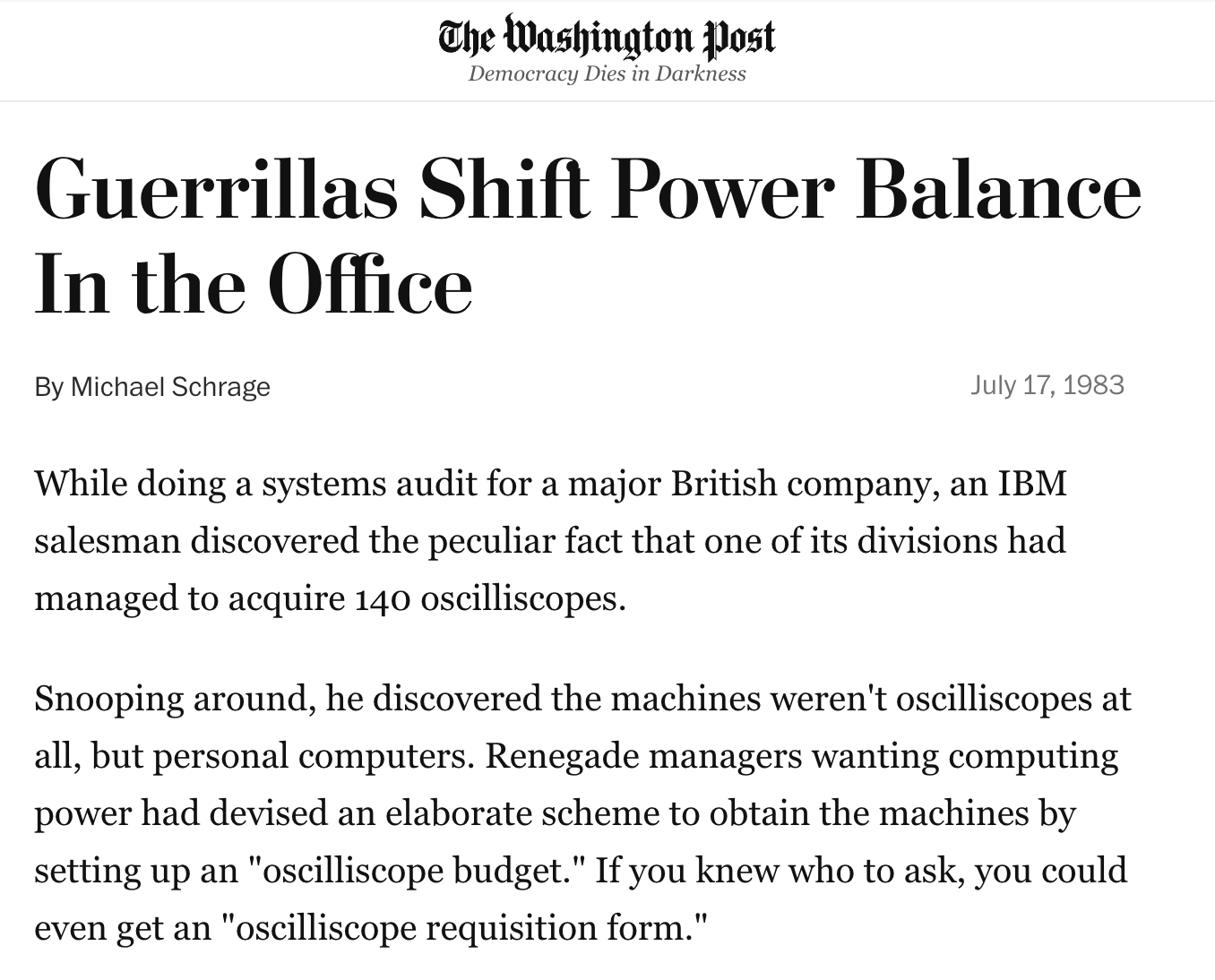
IT departments did not like this chaos! From a 1983 article, “Guerrillas Shift Power Balance In The Office”:
With a personal computer, Keen notes, the enterprising employee can often bypass the company’s main computers to calculate profit-and-loss projections or track sales calls. More important, the personal computer can be linked to the main computer to siphon off desired information.
If a corporation isn’t careful, says Keen, the proliferation of personal computers will lead to “shadow” data processing departments that perform corporate calculations hidden from top management’s view.
Despite this knee-jerk reaction to regain control over these rogue PC users, smart business leaders understood how valuable this behavior was. Employees were staking a claim on new ways to work, and taking fierce ownership over them. Furthermore, this new behavior was illuminating and reinforcing the alignment inside the company that actually mattered. You can’t become an order of magnitude more productive overnight, just by adding a new tool, unless you know what to do, and have the alignment you need with the business to go out and do it.
What they needed was the right habitat for people to have computers at work. Which meant a bunch of learned IT practices and workplace “harnesses,” for people to actually use PCs in a way that kept the bottom-up productivity intact without sinking the organization into chaos.
Spreadsheets
Meanwhile, the PC’s original killer app – the spreadsheet – was itself creating a new kind of chaos.
Spreadsheets, in another sort of way, also have a claim to be the original “workplace agent.” Suddenly all kinds of people who didn’t consider themselves “programmers” could model how they felt their business should run, calculate how it was doing, and project what was possible. Spreadsheets caught on so quickly that they became the single most important reason why people wanted their own PCs.
This may be difficult to imagine in 2026, but “rogue spreadsheets” back then created a very similar challenge to “rogue agents” today. You had all of these people who were now able to create real-looking business artifacts and projections, and while some of them were phenomenally valuable, you also got a lot of spreadsheets that were, essentially, hallucinations. They could be horribly documented, hard to audit, full of formula errors, and usually exactly one employee actually understood what was in them: the person who’d made it. Mitch Kapor, the original spreadsheet king, put it to Steven Levy in 1984: “You can just randomly make formulas, all of which depend on each other. And when you look at the final results, you have no way of knowing what the rules are, unless somebody tells you.” Chaos!
The answer, again, was a habitat where chaos could be reined in a little bit. Data access rules inside organizations, conventions around locking cells, version histories, standardizing formulas, and auditing output. And then inside that habitat, people continued to use that individual empowerment and autonomy that the spreadsheet gave them, and they’ve been indispensable to organizations ever since.
Yes, even email entered the workplace more chaotically than you might’ve realized.
Back before email, companies had the mailroom. It looked unimportant, but it was one of the most politically important functions in the company. The mailroom was where the company could control the flow of information inside the organization. Who could reach out to whom, and who could view, copy, or circulate what. All of it ran through the mailroom.
And then email came out, and suddenly, it became really easy, at least in principle, for anyone to contact anybody inside the company. Chaos! This was, in complete seriousness, a bit of a crisis of authority and control for executive teams. And it prompted huge anxiety around secrecy and information control: what happens if employees accidentally forwarded sensitive information? What if they shared it with someone they shouldn’t? What if they did it on purpose? It was considered a reasonable idea, for a minute, to have to get managerial approval to send an email.
Thankfully, again, we created habitats for company communication where employees could reap all of the benefits of instant communication and applied initiative, with the necessary permissions and access control to rein in the communication chaos just enough.
So there are two lessons here from the history of computers. One is, someone has to rein in the chaos a little bit, and create the habitat for the behavior to thrive in an optimal way. The second lesson is that the chaos is an important indicator in the first place for a kind of behavior that’s really valuable: the kind that creates deep alignment inside the company, for it to do its best work.
The self-driving company
In all of those examples from earlier in the computing era, why was the initial chaos such a strong indicator of something important and valuable? Because people were staking a claim on something they immediately found valuable, and wanted to homestead. People felt they’d discovered something deeply aligned with their individual ability to contribute, and with the organization’s needs.
Businesses are made of people who care. That was true before computers and before agents, and it will be true when companies become “self-driving,” as Amjad puts it. A successful business needs employees who are empowered and aligned with the company’s goals, and a way to turn that alignment into real artifacts at work.
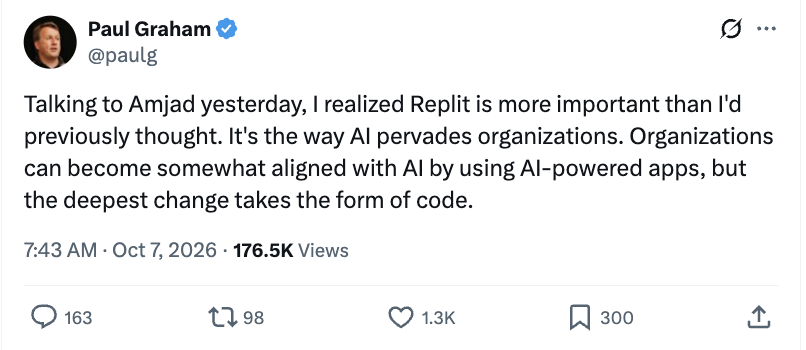
When disruptive technology comes along that makes people radically more productive, the first people who really come alive are the people who know what to do. There is no substitute for these people. They know what needs to be done, and now they have a tool – whether it’s the PC, the spreadsheet, or now a fleet of agents – that lets them get it done 100x more productively than they could before. I believe Replit has an example where one employee at Sumitomo Mitsui Finance and Leasing took over a development process that was supposed to take six people six months, and did it themselves in one week. That one person who knows whats going on can now just do it themselves.
And, to a first order of approximation, the business succeeds based on how successfully these people are able to translate their individual alignment with the business into overall alignment on the part of the whole org, through the artifacts that they produce, and by the followers they attract.
Code is the ultimate “aligning artifact” that someone can produce, because it literally is the business logic of the organization. But it’s an inherently chaotic thing to generate, if suddenly all kinds of new people are creating it from the bottom up. That chaos is an important sign that something important has happened – just like people bringing their own PCs and creating “shadow IT departments”, or people creating their own spreadsheets or sending their own emails. And it’s a good indicator that you need a habitat for that behavior to thrive. You don’t want to put it in a cage. Nor do you want to let it run completely free. But you want it free-range.
To become self-driving, a company has to become aligned. And nothing creates alignment quite like expanding the opportunity set of who can contribute code. Soon, you’ll be able to measure a company’s alignment by the richness of its agent habitat. Replit and its customers already get this. Most companies don’t yet. In hindsight, it’ll be pretty obvious, once the self-driving companies have pulled ahead.