We are pleased to release the second edition of a16z’s State of Markets.
If you recall the first State of Markets (and even if you don’t), then you know what to expect for SoM II: the canonical chartapalooza of 2026 from the perspective of equity markets and tech (for the first two quarters, at least).
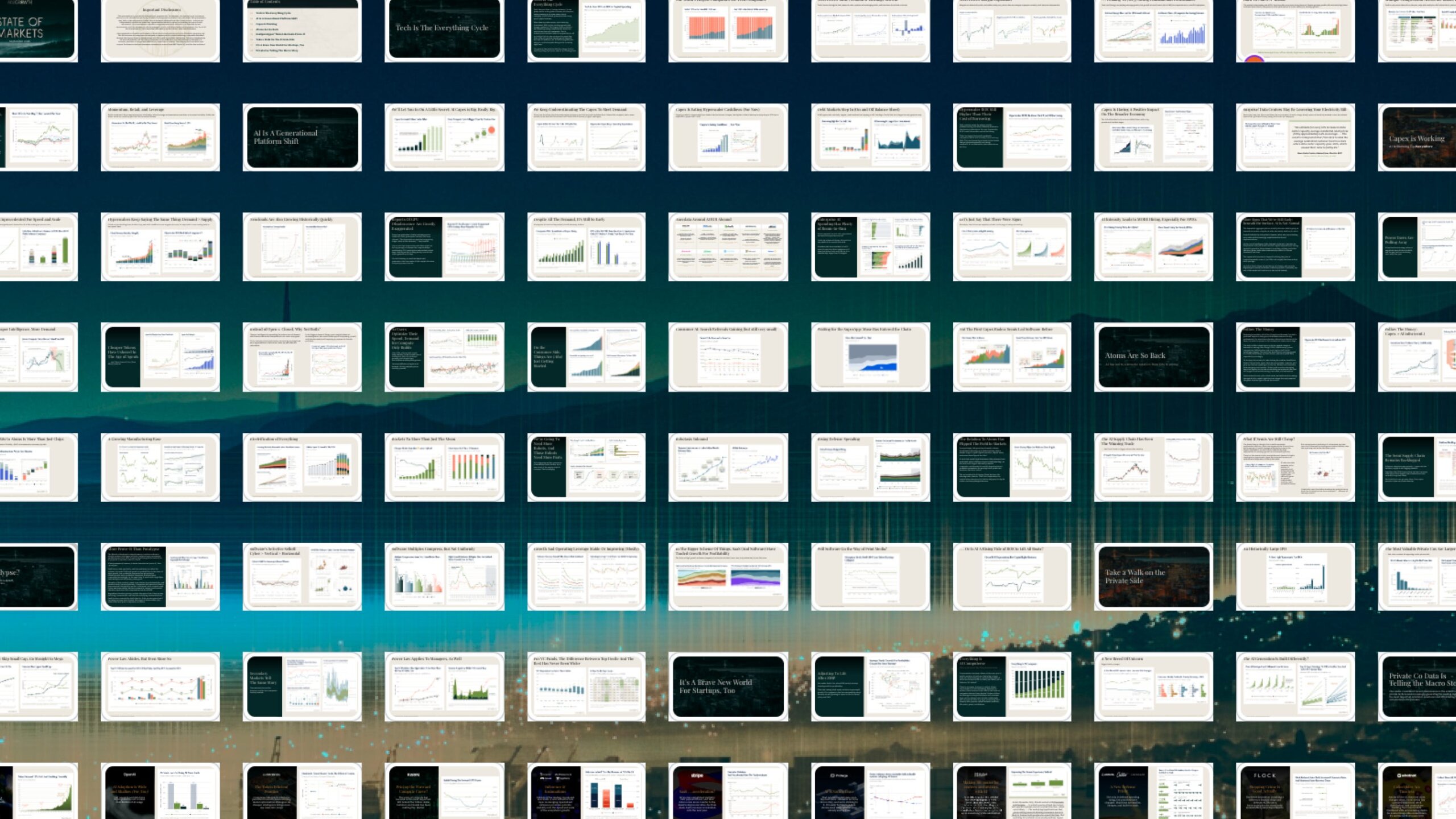
Behold, just a small preview of what’s inside.
Tech Is The Everything Cycle
As a force in capital markets, tech really took off following the GFC. After the housing bust and credit crunch, tech offered a high-growth, capital-light alternative to the asset-wary. Perhaps more importantly, tech offered massive embedded operating leverage, given substantially untapped TAM, and software’s near-zero marginal cost. Hindsight is 20/20, but the investors who remained skeptical that loss-making techcos would ever grow into high-margin machines, missed out on the theme of the previous decade.
That’s all true, and software did, in fact, eat the world, but tech’s centrality to capital markets has risen to a whole other level:
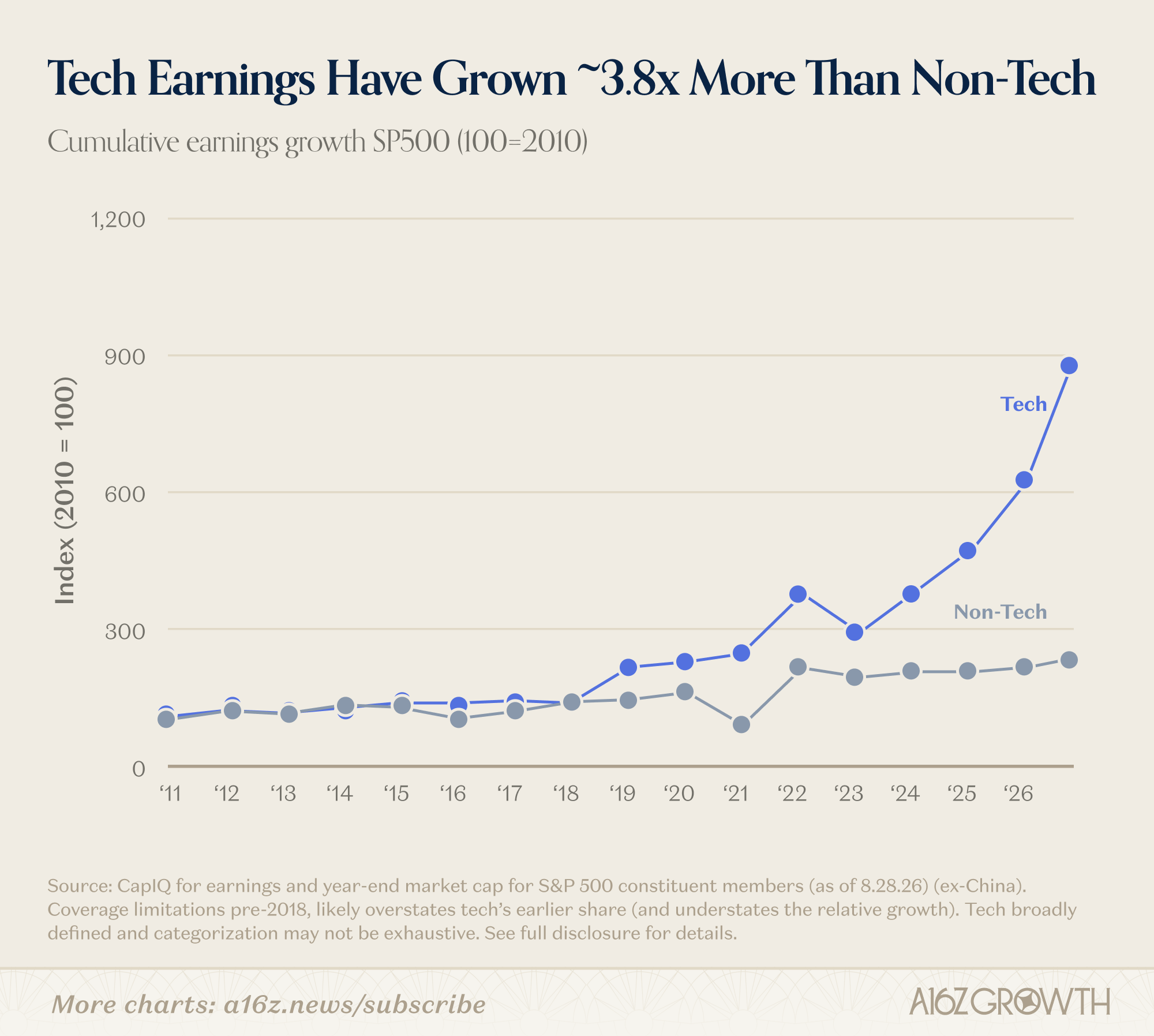
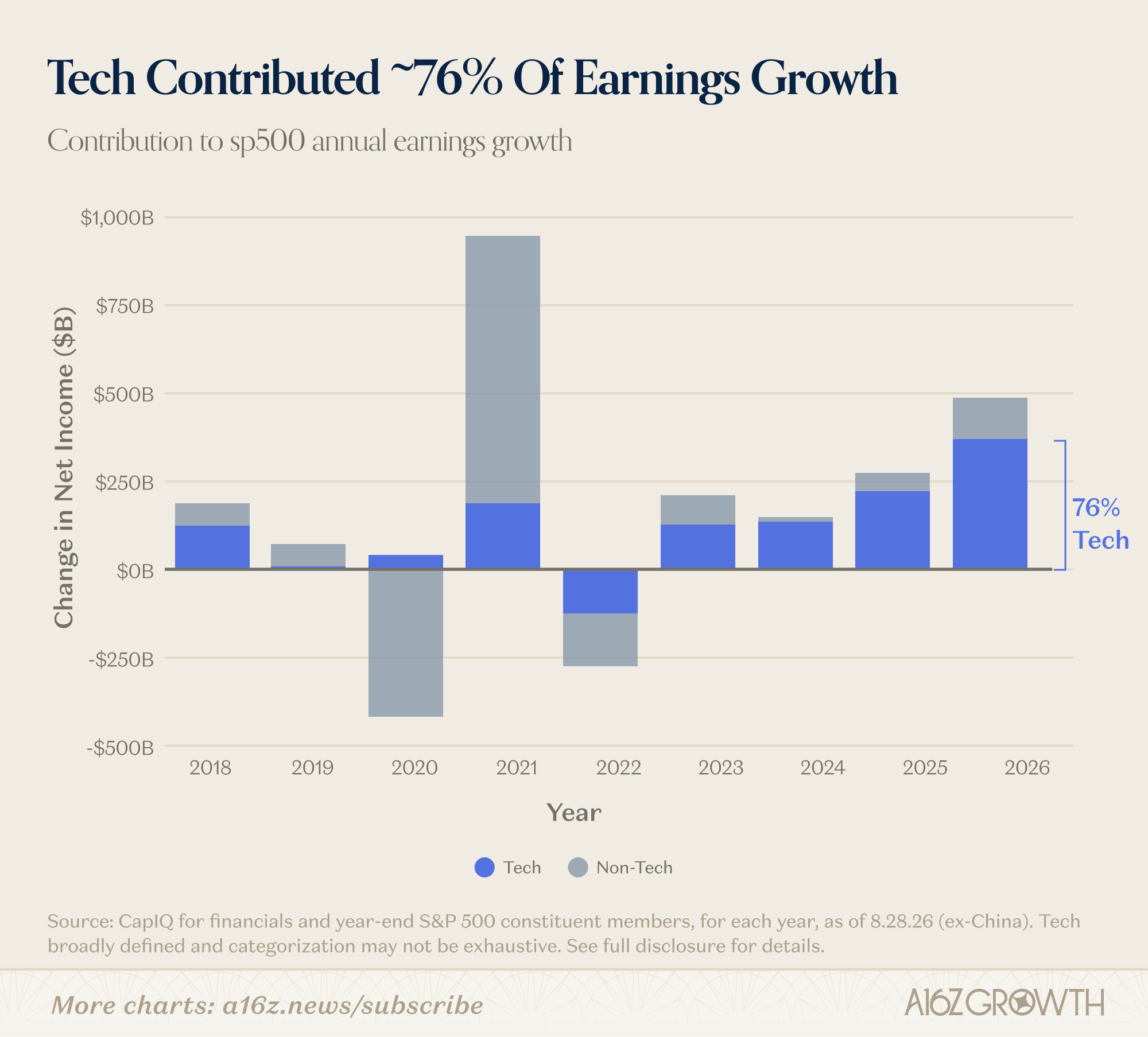
Tech has steadily compounded earnings growth, albeit off a lower base, much more so relative to the field. Since 2023, however, it’s fair to say that tech is the earnings growth story, contributing ~76% of the SP500’s total earnings growth in 2026 (as of late August).
What lies beneath that earnings growth is an interesting story in and of itself, but you can’t really call tech just a sector anymore. In the old days, durable goods defined the cycle–houses, dishwashers, cars, etc.–but tech has taken their place. Tech is everywhere and in everything. Tech is the everything cycle, now.
From Bits to Atoms
Within tech, the theme of the year (and beyond), has been the rotation from bits to atoms.
While software dominated the previous tech cycle, hardware is now the star of the show, and it’s pretty easy to see why:
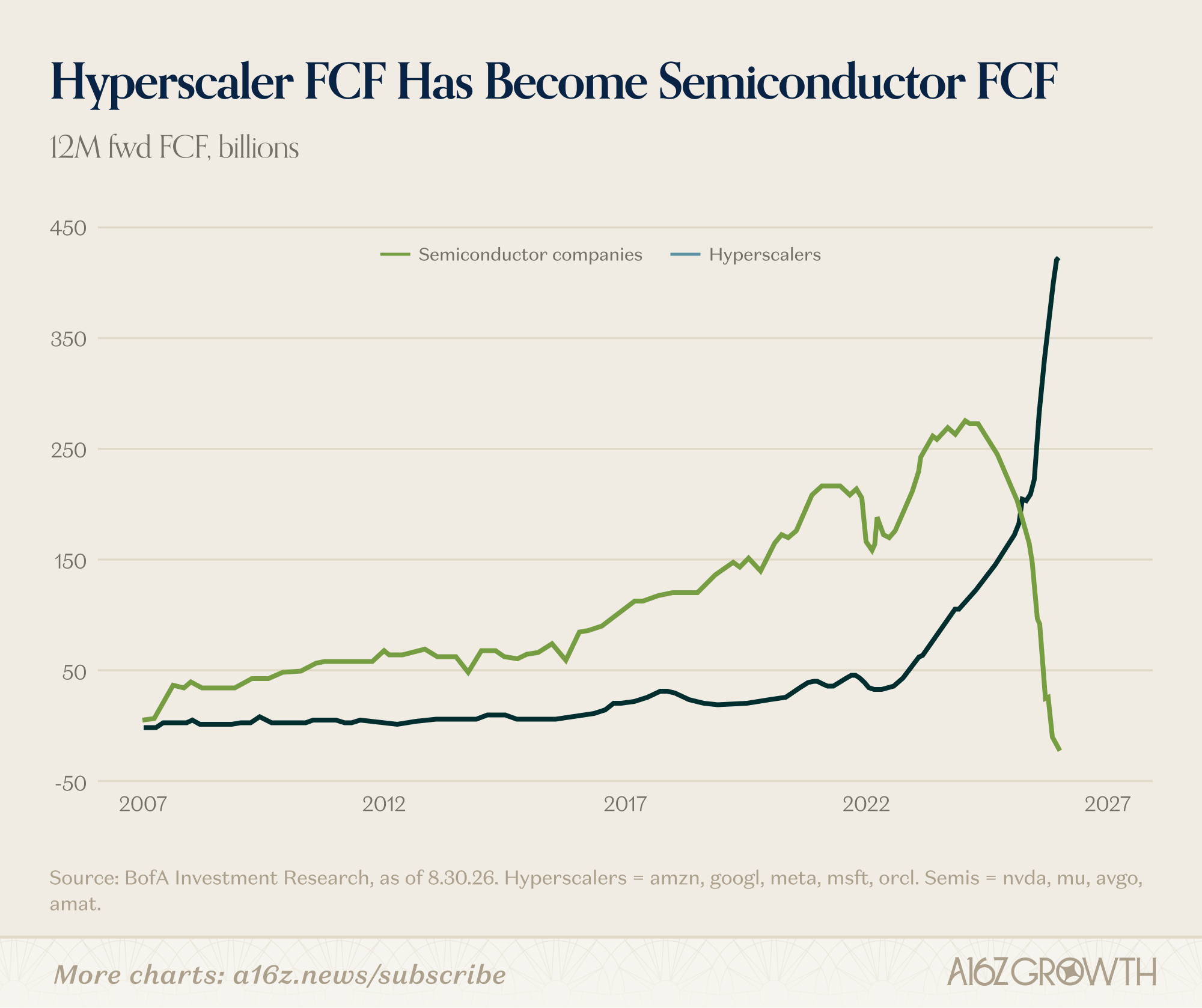
The AI buildout has caused a surge in demand for traditionally sleepy, cyclical, and capital intensive industries like semiconductors (but power and networking, as well). That demand has been funded in large part by the historically massive profits generated by the world’s largest tech companies–functionally converting hyperscaler free cashflow into semiconductor free cashflow—but increasingly by debt, as well.
It’s not just AI that’s spawned a revival for the world of atoms, however. Global infrastructure needs are measured in trillions, defense spending is rising, grids are grappling with the electrification of everything, manufacturing is being reshored, and robots and robotaxis are inbound.
In all events, hardware and infrastructure have emerged as the apple of the market’s eye, after years of trailing in software’s wake. Both public and private equity is funding innovation in compute, memory, power, robotics, manufacturing, and defense, with an intensity we haven’t seen in decades (if not longer). The point being: atoms are so back.
Reports of GPU Obsolescence Have Been Greatly Exaggerated
On the subject of all that capex, one thing has been clear: demand for compute is still outpacing supply.
At least one prominent bear of the buildout expressed some skepticism whether all this money invested in GPUs could possibly be worth it, given that they’d become obsolete in 3-4 years’ time. It’s great that Nvidia is selling B200s like gangbusters, but what does that mean for all the A100s that were installed a year or two before?
Well, for now at least, it turns out that the upward inflecting demand curve for AI-compute has meant that the A100s are still pretty useful:
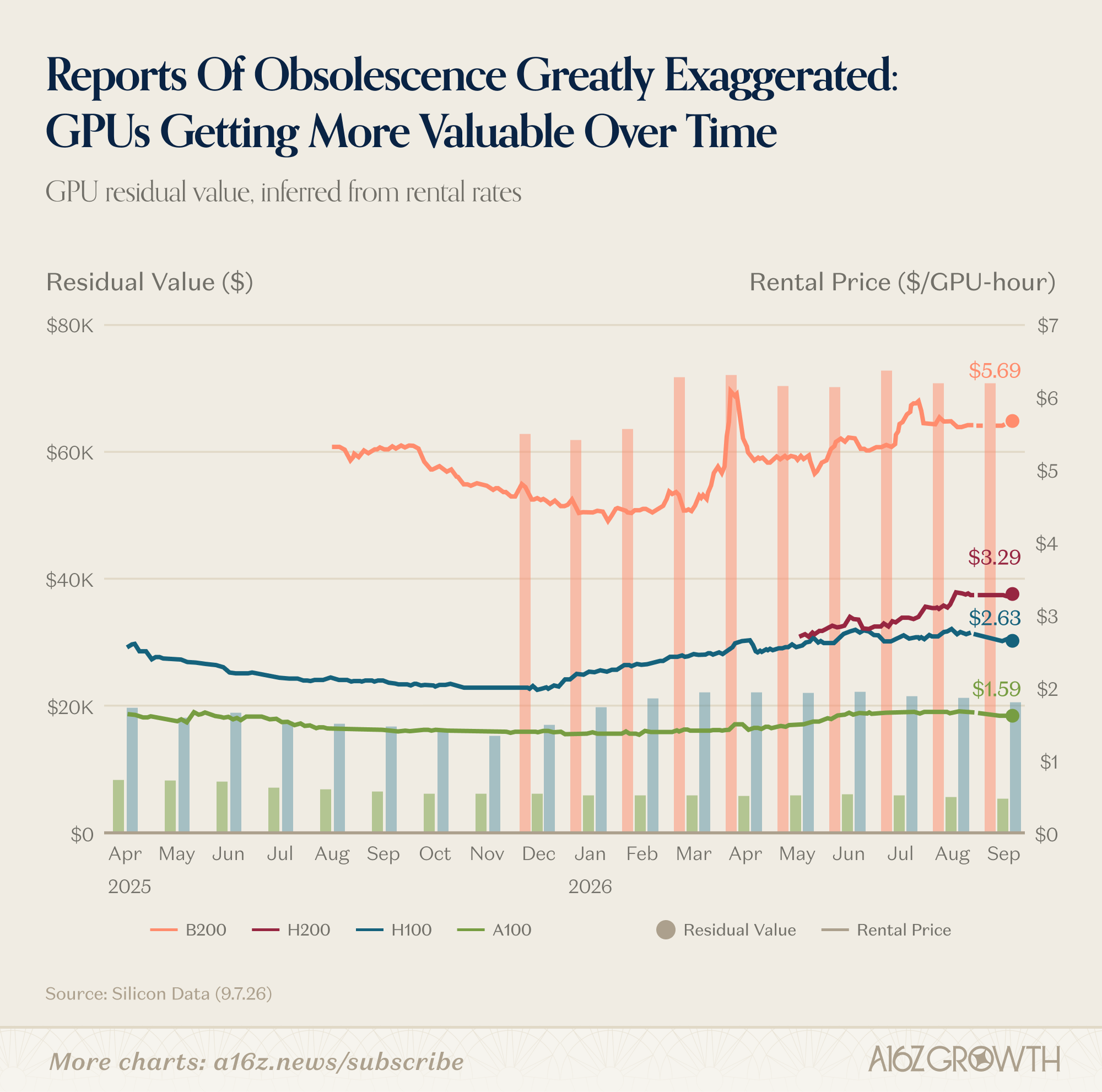
Rental rates (and thereby residual values for GPUs) are supposed to decrease over time, but that’s not really what’s been happening. As intelligence gets cheaper, demand for compute is only rising, causing GPU pricing to climb upwards for the latest chips (and stay pretty for the older ones). Even the A100 is pricing at-or-above what it was at the beginning of the year.
The story is far from over, of course, but so far, neither compute nor model advancements have been a zero-sum game. Better, cheaper, intelligence is accruing value to the entire ecosystem, with both older chips and models retaining substantial value well past the expiration dates assigned by the bears.
And, oh, by the way, all of this is happening while AI adoption remains relatively immature. Adoption is broad, but for the most part, it’s relatively shallow:
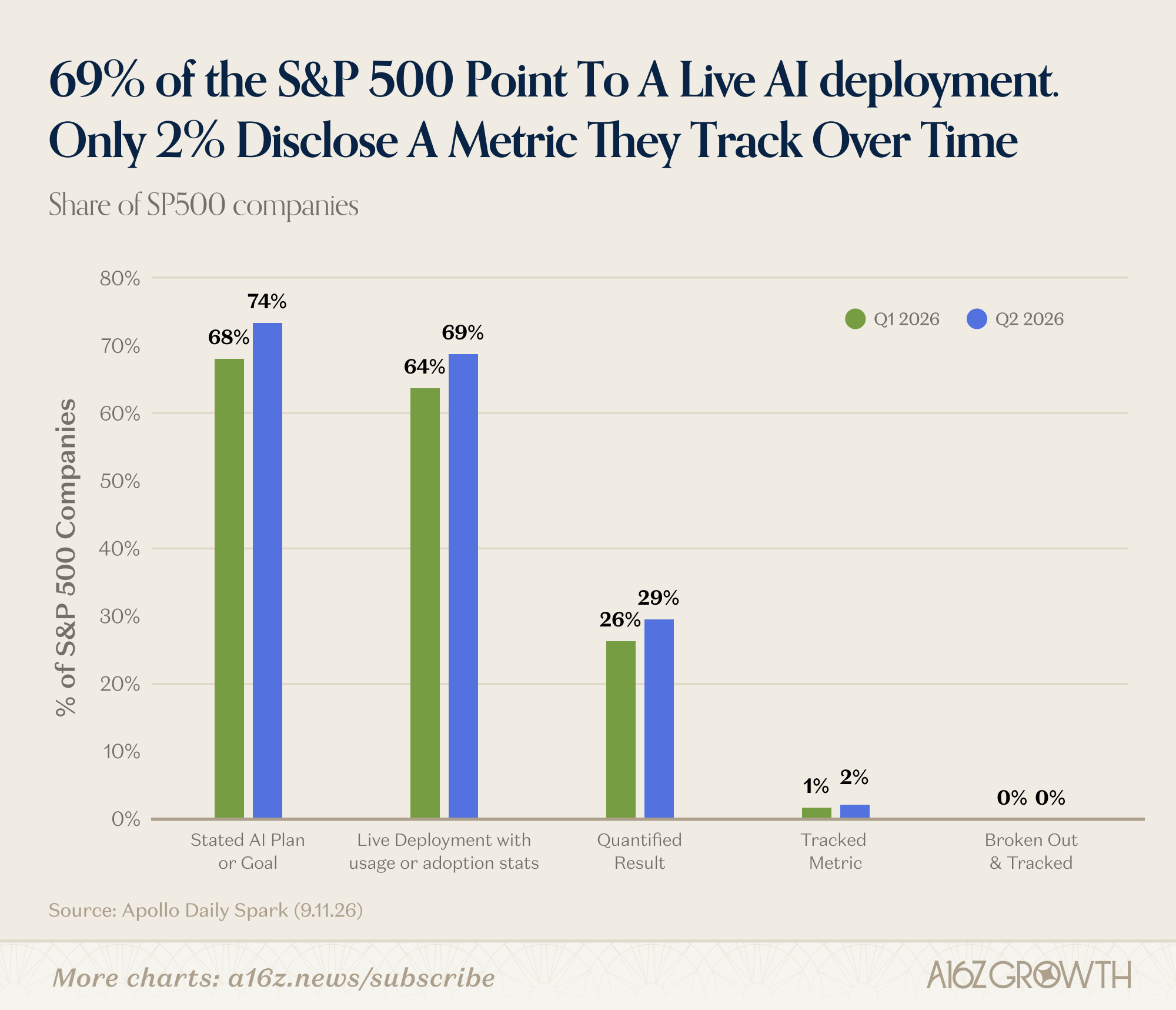
While nearly 30% of SP500 companies report some “quantifiable impact” of AI, only ~2% are reporting any tracked metric. The same goes for agentic use-cases, where a tiny share of the overall userbase is meaningfully deploying agents with any scale.
Likewise, on the consumer side, paid penetration is still tiny:
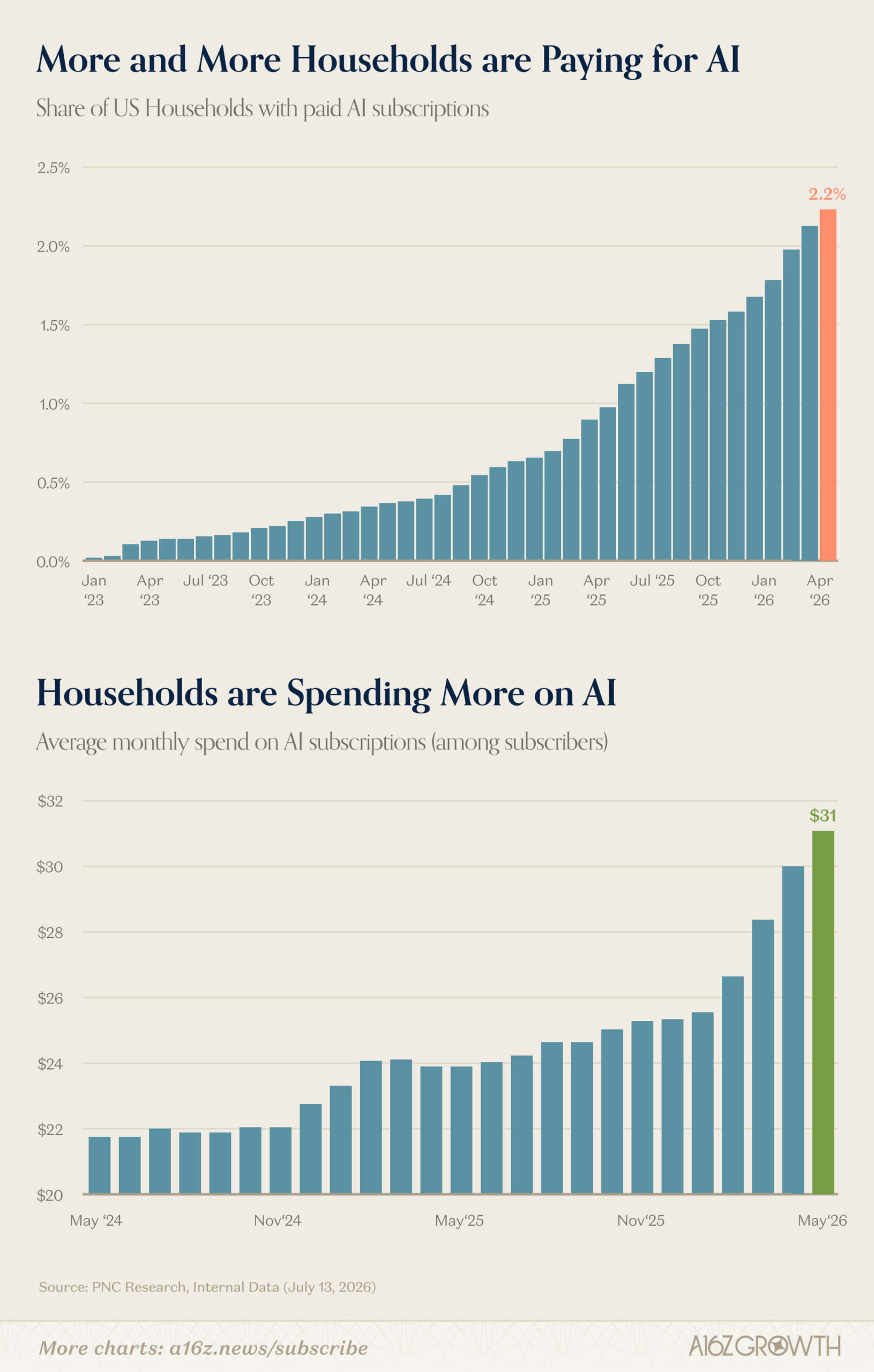
As of April, barely ~2% of US households were paying for some AI service. The number is higher now, and growing, but it’s still tiny in the big scheme of things.
The point is that GPUs are already running hot, even while the data indicates that it’s still so early when it comes to mature AI adoption and utilization.
SaaS-Prove-It, Not -Pocalypse
The year started with the declaration that software was dead, a sure fire victim of AI’s vibe-coded everything. SaaSpocalypse was nigh. Run for the hills, enterprise SaaS, and don’t let the door hit you on the way out.
Reality, as it often is, turns out to be a bit more nuanced than that. There was surely a sell-off, albeit a more discerning one than “pocalypse” would imply, and while AI (or the threat of AI) is definitely playing a role, it’s not the only thing.
The actual thing about public software is that some part of this reckoning, or really a re-rating, was a long time coming:
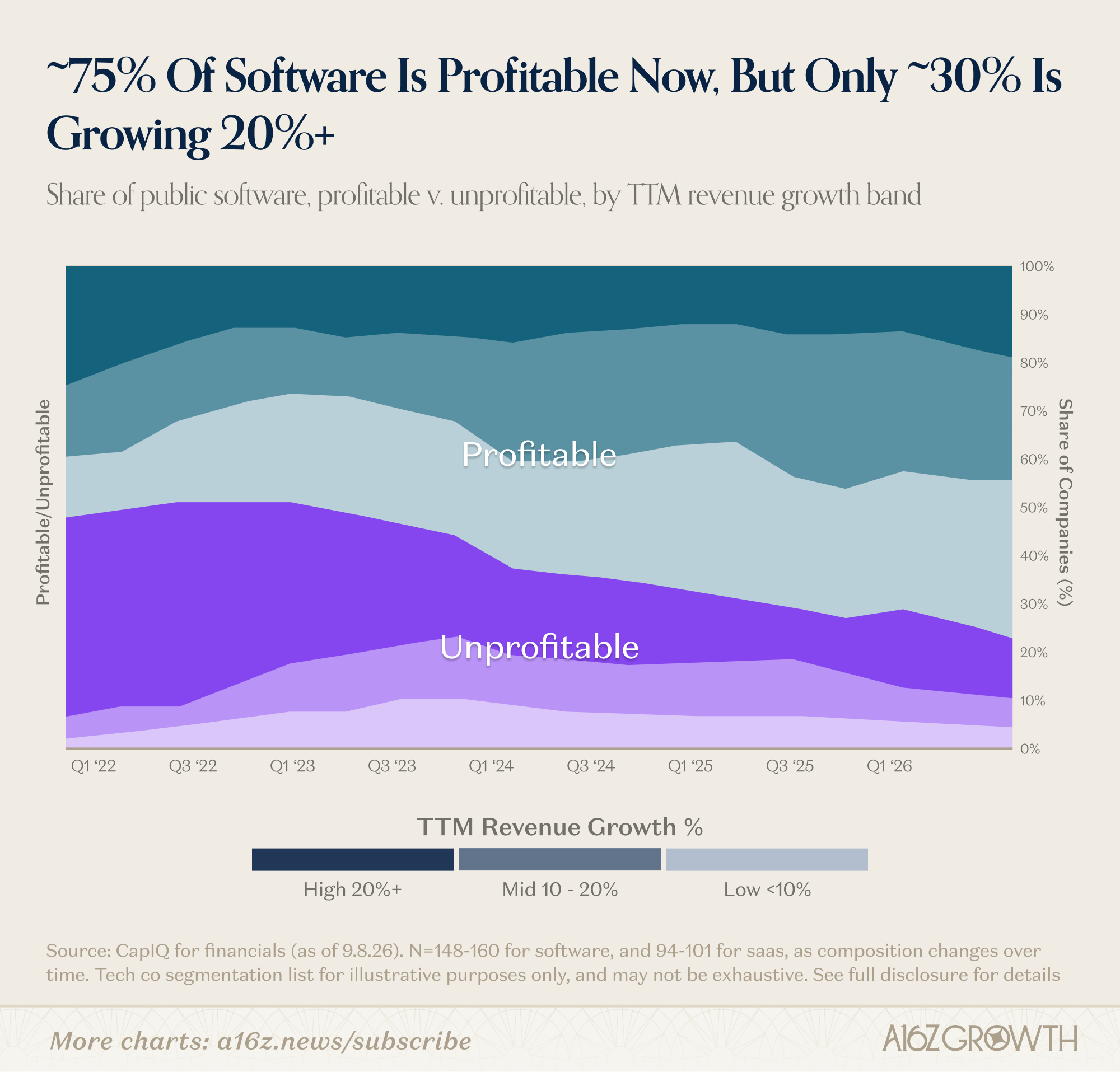
Since the end of ZIRP, techcos (but not just techcos) traded growth for profitability. Back in ‘22, the market was full of high-growth, mostly unprofitable software businesses, but by 2026, the story has inverted: ~75% are profitable, but only ~30% are growing 20%+.
It makes sense, insofar as higher interest rates are intended to make capital relatively scarce, and so companies wisely pivoted from loss-making growth, to a more self-sustainable, slower-and-steadier growth. That’s all well and good, but slower-growth companies do not beget high-growth multiples, at least not for long, and eventually the new “slower-growth” normal caught up to software.
Not for everyone, of course. Fast-growing companies are still trading at multiples in line with historical averages (albeit not ZIRP peaks), but there are simply fewer of those now, so the sector as a whole was broadly repriced.
There’s been no apocalypse for software, but there has definitely been a “prove it.”
Looking Ahead At Where Things May Go
And finally, while the lion’s share of the presentation covers what’s been, we’d be remiss if we didn’t offer some thoughts on where we think things may be going:
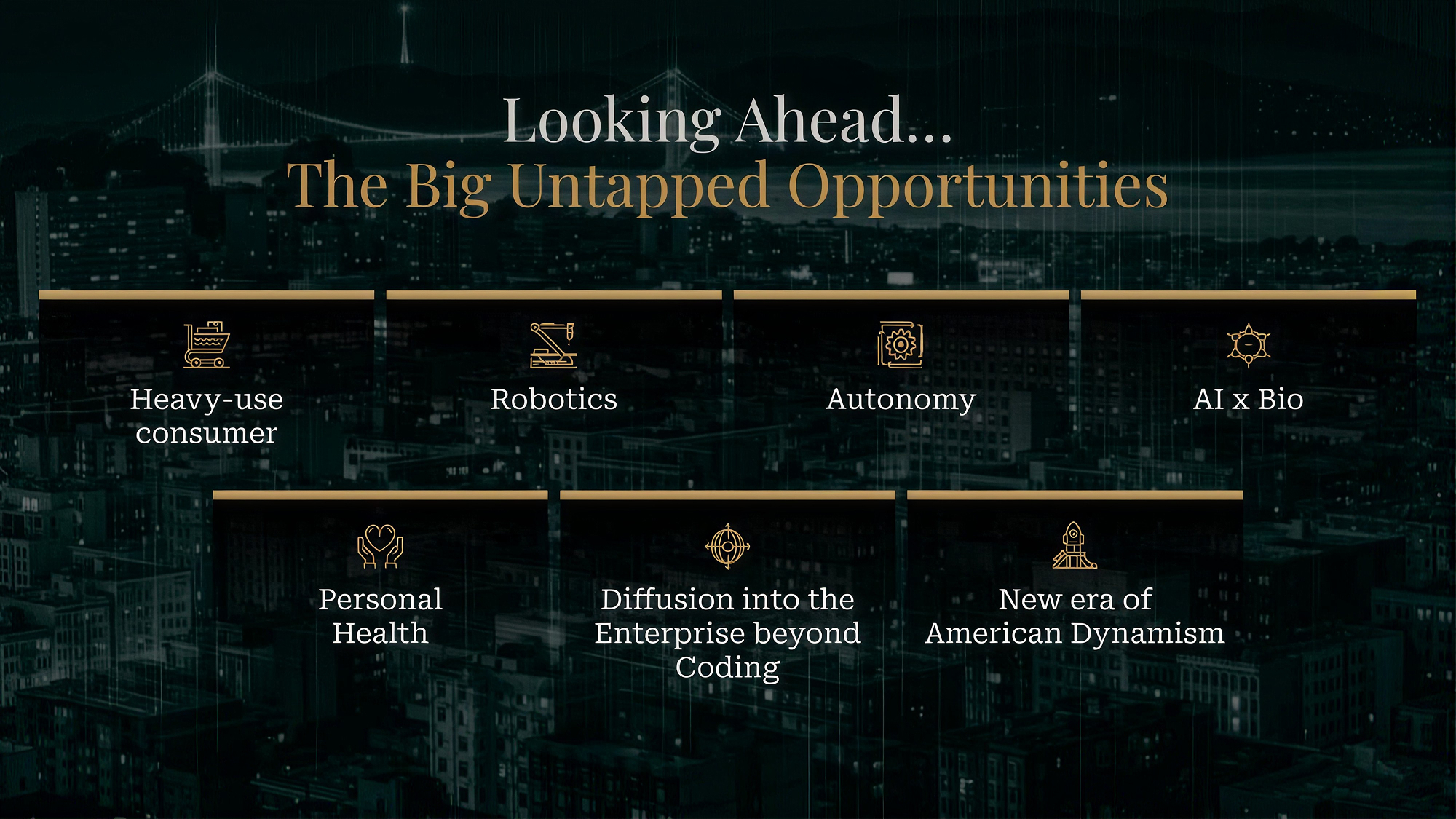
We expect that AI will expand the surface area of demand. That means advancing towards more mature adoption across enterprise and consumer, but also pushing out into entirely new frontiers in robotics, biotech, health and AD.
In general, the technology is improving at an exponential pace, and while no one can predict the future, given the rate and pace of change, we’re pretty confident that this cycle isn’t going to be like any previous cycle.
