Last year, I wrote about how YouTube is a pretty great herald of what we can expect to happen to coding. YouTube launching in 2005 didn’t seem to fill an obvious content gap, and yet two decades later it’s a $550bn business that’s more culturally relevant than traditional TV.
We’re now seeing the same long-tail creation wave for software.
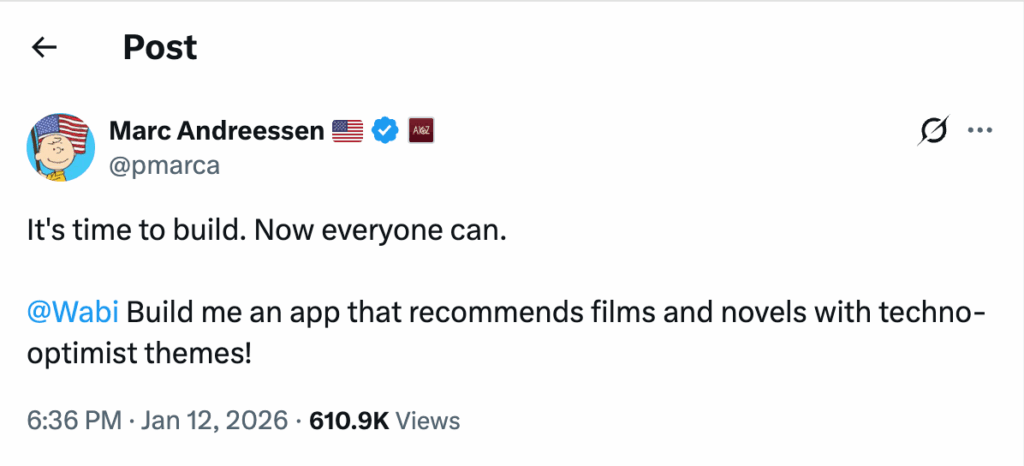
If you’ve been on X the past few weeks, you’ve seen it happening: Tobi built a custom MRI dashboard that (according to the professionals) should’ve required commercial software to view. Marc is generating a techno-optimist movie and novel recommender with Wabi. Levelsio and Joe Weisenthal are architecting apps live for an audience. People are shipping entire ad campaigns from the CLI. If you previously had excuses for not building something, they just got a lot less convincing.
Before LLMs, all of these apps might have never existed. Who had the time to dig through unfamiliar API documentation, or write custom medical imaging software, or allocate what might take weeks of time to build software that may never leave localhost? Especially if you weren’t a programmer, there were seemingly insurmountable barriers to creation. You had to learn how to code, for one. And then you had to stay up-to-date with a whole catalogue of frameworks, and if you stopped paying attention, the industry would move on without you.
Tools like Cursor, Codex, Claude Code, Replit and Wabi have compressed the time from idea to working app from weeks to hours. If you programmed years ago but aren’t current on Next.js releases, it doesn’t matter anymore. If you’ve never programmed, you can type into a text box and see what happens. Today, anyone can ship an app.
What YouTube Teaches Us
Think about video creation as a medium. For most of its history, directors needed a green light and funding. In the late 80s and early 90s, the reins loosened: directors like PTA, Soderbergh, and Tarantino all got started with small budgets and non-professional crews. In the 2000s, barriers collapsed further when everyone got a camera in their pocket and platforms like YouTube changed what could qualify as entertainment.
It took a few years for YouTube to evolve from cat videos to Mr. Beast challenges. But after that evolution, we entered the media ecosystem we’re in now, where it’s as common for entertainment to come from creators on YouTube as from traditional broadcasters.
Software is following the same path: the Hollywood era (deep expertise, tens of millions to build anything) gave way to the 90s indie director era (YC founders like Chesky and Armstrong as outsiders breaking in) which led to the YouTube era (an LLM at everyone’s fingertips).
Three implications for software
The internet (partially thanks to YouTube) has given rise to personality-driven media: pretty much everyone, from VCs to journalists to founders to politicians are encouraged to write more posts, appear on all the hot podcasts, find an audience, and create an empire. But until recently, software hasn’t been a form of personal expression or empire-building. This is going to change for three big reasons:
- The addressable market for “builders” just expanded dramatically. For a while, software excited only a small slice of the population: people keyed into Tech/VC X feeds, consuming the same podcasts and Substacks, and quoting Paul Graham essays. Now you don’t need to be “interested in software” to build software. You just need to be interested in good ideas.
- Software becomes a medium for expression, not just utility. Think about developers like Riley Walz who’ve built a name shipping zeitgeisty projects, like visualizing SF’s parking cops, or rendering the Epstein files. I expect LLMs will make this kind of entertaining, of-the-moment software much more accessible. People will create funny software with about as much effort as a funny post on X.
- Software value compounds; content value decays. Creators on YouTube need to keep churning out videos to stay relevant: most content follows a 2-5 year depreciation schedule. Software can launch once and accrue value indefinitely as users come onboard. This is an underappreciated advantage of the medium.
Our decisions are mimetic. Many creators say their drive to produce content online comes from seeing others do it. If someone tells you they want to quit their job and make videos, you’d roll your eyes, not because it’s dumb, but because it’s so easy to just start, so why haven’t they?
The Kids Are Alright
Some people worry: shouldn’t kids aspire to be astronauts or doctors? I have a different read. The reason we have so many influencers is because it’s what you do if you’re entrepreneurial and want to take destiny into your own hands. Maybe it’s agency they’re emulating, not YouTubing specifically.
The same mimetic energy is now hitting software. You see your friends building things, and you want to do it too. Software is becoming a viral medium, and soon no one will have any excuses not to make it.
There’s a lot of angst about “the kids” these days. I have no angst, but maybe a little envy. AI has massively democratized leverage and productivity for creative people. There has never been a better time to be a young person with great ideas. I think the kids are gonna be alright.
