As a technical and product founder, this is likely one of the most emotional hires you’ll have to make. While you’ve already hired product managers or even a head of product, you’ve largely remained in charge of the product vision and roadmap. However, at some point, as you grow headcount, add product features or even new products (and, with it, technical debt), and serve more customers, you’ll realize that you can’t be both the day-to-day product leader and the company leader. You need to hire a more strategic product leader in order to free yourself up to scale as the company’s leader.
Handing over some control of your product can feel like letting someone hold your baby for the first time. Sometimes, other people recognize that you need the role before you do. When you start to get feedback or see signs that you need a CPO, it’s especially important to talk to outside product leaders who have come in and partnered with a CEO at successful growth-stage companies. This will help you better understand what it means to add a strategic product leader to your team and be ready to make room for that leader on your team.
TABLE OF CONTENTS
When to hire
TABLE OF CONTENTS
There are some key factors that can signal it’s time to consider hiring a strategic product leader:
- You’re expanding from a single product to multiple product lines and need a seasoned leader who can balance a focus on existing revenue streams and retention with adding new features to drive expansion.
- You’re scaling quickly and are presented with a lot of opportunities but need an external product leader with the experience, discipline, and discernment to craft a strategic, focused, and sustainable product roadmap—and who knows when to say no.
- You’re expanding into new territories. New territories generally require different go-to-market (GTM) motions, developing an approach to regulatory and compliance mandates, and localizing product and pricing strategies.
- Your customer experiences are disjointed across your products and life cycle. If this is the case, you’ll generally see more customers churning, your product roadmap will be unfocused, and your engineering team will be stuck processing one-off requests. In these instances, your CPO will bring a data-driven, customer-centric rigor to your product vision in order to streamline and unify the end-to-end customer experience.
- There’s a disconnect between sales and engineering. Your engineering team might be building features that your customers don’t need or be swamped with one-off customer requests and be unable to build strategically toward a cohesive product vision. The latter issue is a particularly common failure mode for companies that serve the enterprise. Many founders might want to chase larger and more complex deals, but those deals generally come with a lot of one-off requests. That’s when you need to bring in a leader who can implement a strategic framework to identify which opportunities are worth chasing.
It can be particularly difficult to give up the right level of control when bringing in a new product leader. You need to give up enough to empower them to identify what you should build, when you should build it, and why you should build it—and then work with everyone else in the company to execute on that roadmap. At the same time, as the company’s leader, you have to continue to set the quality bar and be the standard-bearer for the product vision, especially when it comes to innovative features and product experiences that your customers wouldn’t necessarily think to ask for.
A friend of mine led his company from nothing to over $1B in revenue in record time by relentlessly pursuing his product vision. He did so by intimately involving himself in the intricate details of his company’s product planning and execution. This worked brilliantly up to about 500 employees. Then, as the company continued to scale, things started to degenerate. He went from being the visionary product founder who kept cohesion and context across an increasingly complex product line to the seemingly arbitrary decision maker and product bottleneck. This frustrated employees and slowed development. In reaction to that problem and to help the company scale, he backed off and started delegating all the major product decisions and direction to the team. And then he ran smack into the Product CEO Paradox: “The only thing that will wreck a company faster than the product CEO being highly engaged in the product is the product CEO disengaging from the product.
—a16z cofounder Ben Horowitz in The Product CEO Paradox
Writing the MOC
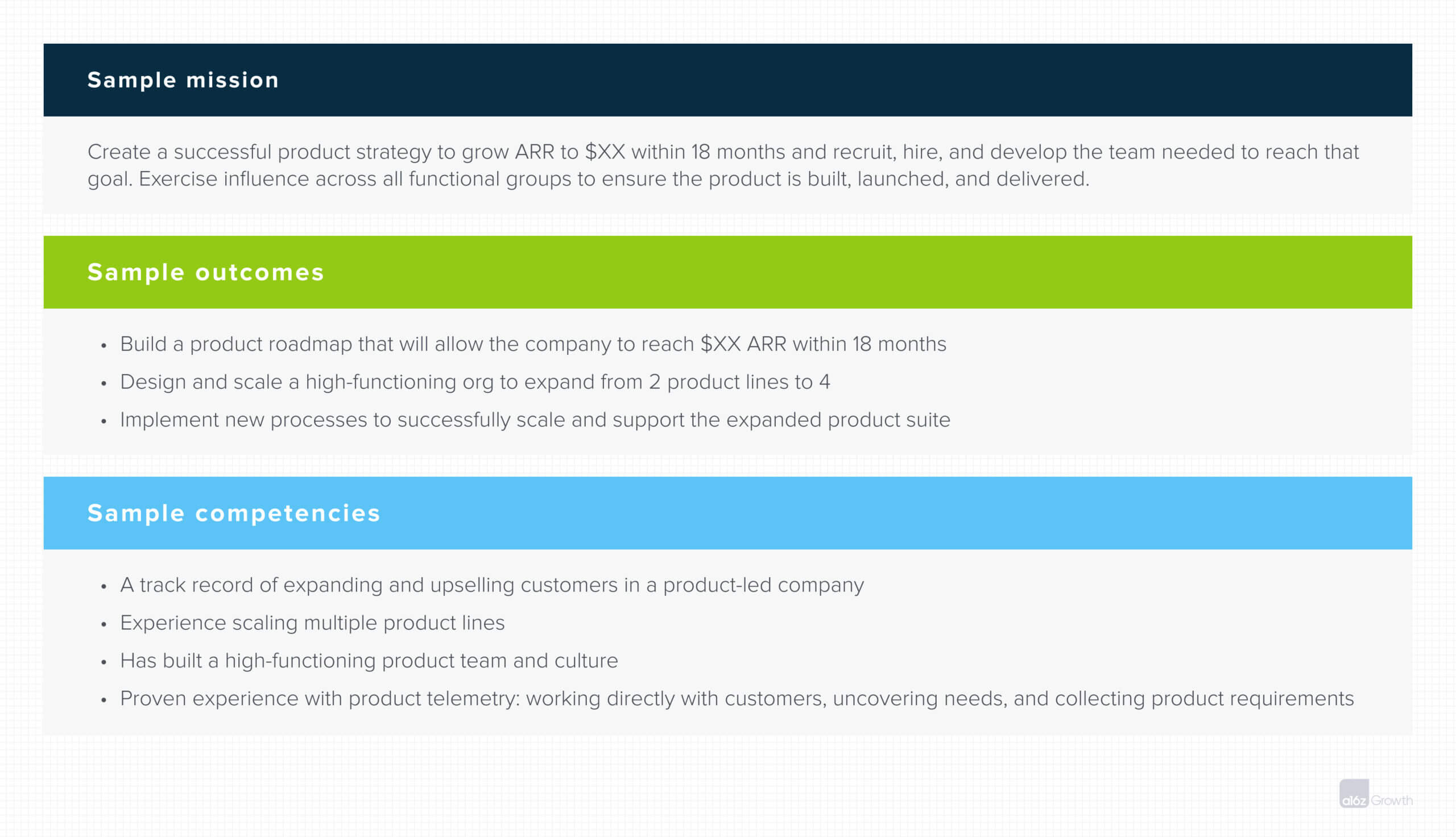
We discuss writing a mission–outcomes–competencies document (MOC) in greater detail in The Hiring Process.
What functions should your CPO own?
When drafting the MOC for a CPO, the single biggest consideration is how your new leader will complement, rather than replace, your skill set. Consider: what do you want your role, as founder, to look like after you make this hire?
We’ve generally found that founders, in addition to setting the high-level vision for their product, prefer either owning the macro—like learning about product improvements based on customer feedback and understanding where the product fits into the competitive landscape—or the micro, like diving in at every step of the UX and getting deeply into 1-to-n feature prioritization. This can be a helpful framework for identifying what you most need in a CPO. For instance, if you find that you excel at the more micro-level work of product UX but are building in a particularly crowded market or entering a new customer segment or territory, you’ll want a product leader who excels at partnering with the GTM org on product feedback and competitive analysis.
Generally, your CPO will manage the following functions:
- Product roadmap and strategy
- Customer insights
- Product analytics
Additionally—and especially in product-led companies—design, product marketing, and user research need to work in lockstep to produce a product that delights customers and drives upsells and expansion. Generally, we’ve seen:
- Product marketing report to the leader who’s the best at telling stories, whether that’s a CPO or a CMO.
- Design report to the CPO, if they’re credible in the design space and you want to expedite the rate of iteration and turning product ideas into UX mock-ups and prototypes.
- User research report to design to give designers the hands-on data they need to design user-forward products.
What core competencies should you look for in your CPO?
Any all-star CPO:
- Can translate what a customer says they want into what they actually want. The CPO can synthesize data from individual meetings, sales feedback, or usage trends into an overall thesis for what your customers want.
- Communicates and writes clearly. They’re deep thinkers who can get down into the low-level details, surface the most useful insights from a corpus of data, prioritize those insights based on the business need, and then cogently craft it into a roadmap that aligns the org around what you want to build.
- Has a demonstrated track record of setting the vision for product strategy. They weren’t bit-players in the product roadmaps in their previous roles: they owned the roadmap, made hard decisions about trade-offs, and created new opportunities for the company.
- Knows how to develop pricing and packaging to drive revenue. The best product leaders understand how product decisions impact the overall company, including how you price and package your product. They know which features are critical to move a customer from one tier to the next, or how to bundle a set of new features to expand your company into new target markets.
- Is a terrific cross-functional collaborator. The CPO role is a fundamentally leveraged role, which means that they must get other leaders on board with their vision in order to be successful. They need to establish credibility quickly, since they’ll likely assume responsibility for parts of the product that were previously owned by the founder and because most everyone in the company will have an opinion on what needs to go on the product roadmap. The best CPOs prioritize, manage and allocate resources, effectively communicate across functions, and garner organization-wide support to meet launch dates.
In the case of consumer products and product-led growth products that have taken off virally and then had a company built around them, your product leader will also likely need to:
- Cultivate a community of users who share feedback on their product, give each other tips and tricks on using the product, and give testimonials for sales enablement and marketing materials.
- Parse and prioritize product metrics, usage, telemetry, and customer feedback—in addition to or instead of sales metrics—to maintain the product’s value to individual users driving organic growth, while also building the enterprise feature to win deals.
- Map packages to the user journey with an understanding of what features will motivate an individual user or set of users to upgrade. They also understand the importance of delivering value, even in the free tier, to drive organic adoption and a healthy pipeline and avoid pricing and packaging that create disincentives for adoption within the enterprise. While your marketing leader will map the user journey and identify key touchpoints where the product team can improve the UX, your CPO will map product-use metrics onto the funnel.
Sample MOC
Setting up your CPO for success
We cover best practices in The Hiring Process, but we’ve included some role-specific considerations below for you to keep in mind when making this hire and integrating them into your org.
What are products in your space you love?
When starting to recruit, you could point your recruiter in the direction of a product you love in or adjacent to your space and explain why you love it. This gives your recruiter a much more specific profile of product leader to look for. A good recruiter will then do the legwork to understand who, specifically, was responsible for making a product successful, if recruiting from those companies.
Are you able to trust this person with product decisions?
When you’re interviewing candidates, discuss your vision for the company extensively. You won’t be able to hand over the reins unless you trust the candidate to put your vision first. You should also be clear on how you will make decisions together. Can you trust this person enough to bring difficult product decisions to them, and can you trust them if they tell you you’re not thinking about the decision the right way?
I spent essentially five hours before I even agreed to interview at Square with our CEO just getting to know him and what his vision is for the company, what he cares about and what he doesn’t, how he works, what his philosophy is. You can interview all you want, but this is such an important and critical role, you have to spend time with them.
—Gokul Rajaram, on the a16z Podcast: How Founders Hire a VP of Product
Can your candidate and engineering leader work well together?
For a CPO to succeed, they have to work with your engineering leader to create a roadmap that is ambitious but realistic. Most often, this relationship is best tested in a working session that requires the 2 leaders to prioritize product features on different horizons. For instance, you may challenge a candidate to look at the current product and meet with the engineering leader with an initial proposal for what to prioritize in the next 3 months, the next year, and the next 3–5 years. They won’t have all the context needed to get the priorities right, but you will learn a lot from how they think through the question and how reasonable their expectations may be for what can be built with the existing resources.
Additionally, your company’s engineers need to trust that your candidate has the technical chops for the job. References from all-star engineers, not just engineering leaders, can help vet the candidate’s technical depth and how they’ve built relationships with engineering in the past. If you’re building an especially technically sophisticated product and think your CPO will need a commensurate level of technical proficiency, you might also consider including a top engineer in the hiring process.
Does your candidate have the right strategic chops?
One of the biggest failure modes when hiring a CPO is hiring someone from a company that builds great products but who wasn’t personally responsible for making the product great. This can particularly be the case for candidates who worked at large companies. When running reference checks, you want to assess whether your candidate was a strategic leader who drove the roadmap. Consider asking: who owned the vision? When you needed to make a difficult decision, who did you turn to? Did things run smoothly or poorly, and who was responsible for that cadence?
When you are very early as a startup, you have very short time horizons that you need to plan. You can figure out something and then go get it done. A great product leader allows you to start planning for those longer time horizons.
—Vijay Balasubramaniyan, CEO of Pindrop on the a16z Podcast: How Founders Hire a VP of Product
Can your candidate develop healthy feedback loops with sales?
Your CPO should demonstrate a healthy respect for sales since they bring in concrete feedback about how products are performing with customers. Your leader can then translate that feedback into the product roadmap. They will need to be able to work with your sales leader to make sure customer feedback informs the product roadmap, and stay in lockstep with sales on when different features will launch, so that what they sell matches what you are building. Consider having your sales leader interview candidates with a focus on how they set up communication cadences with sales, how often they expect to be in front of customers, and possibly a working session to test how they run a customer interview to gather feedback.
Many thanks to Jason Rosenthal for contributing his hard-earned wisdom and expertise to this guide.
Further reading
We’ve drawn insights from some of our previously published content and other sources, listed below. In some instances, we’ve repurposed the most compelling or useful advice from a16z posts directly into this guide.
From Technical to Product to Sales CEO: Hard-Earned Lessons Learned, David Ulevitch and Sonal Chokshi
Ulevitch discusses finding the balance between being the product visionary and the product manager, when to scale your leadership team, and how to identify what’s working (and what isn’t).
You want to know what you’re hiring for. Because there are product managers that are much more analytical, and there are product managers much more visionary. You might need different kinds of people at different kinds of times. I think you have to be self-aware and be really intellectually honest. Because, if you actually need someone who is more visionary, then you’re going to have to deal with the fact that you’re going to be going to battle and sitting in a room and duking it out over ideas.
How Founders Hire a VP of Product, a16z podcast with Vijay Balasubramaniyan, Shishir Mehrotra, Gokul Rajaram, Alan Schaaf, and Martin Casado
Hiring a VP of product feels like handing your baby over to someone else. Learn how to pick the right person for the job, avoid common pitfalls, and integrate your new VP of product into your company.
Good Product Manager/Bad Product Manager, Ben Horowitz
Your product manager is the CEO of your product, but what does a good product manager look like? Learn the traits and tendencies of a good (and bad) product manager so you can make the best hiring decisions.
The Research Mentality … And How to Adopt It for Product-Led Growth, Jennifer Li
In a product-led world, research is now a core competency for the entire organization. Here, Li lays out how research impacts your product team and how to adopt a “research mentality” to gain a competitive advantage. While this article doesn’t specifically address hiring, it does give product-led growth companies a framework for your research approach, which can inform your hiring decisions.
a16z Infra #3: What Microsoft Can Teach Us about Technical Product Leadership at Scale, a16z Live with Steven Sinofsky, Bob Muglia, Martin Casado, Ben Fathi, and Anshu Sharma
Microsoft has succeeded in a number of product categories, including enterprise software, consumer gaming, and the cloud. Go deep under the surface of modern stacks with 2 of Microsoft’s early leaders and the a16z enterprise team as they talk about foundational technology and technical product leadership at scale.
Why Founders Fail: The Product CEO Paradox, Ben Horowitz
For various reasons, founders may fail to successfully scale the companies they started. Here, Horowitz dives into the product CEO paradox and why you can’t hold on too tightly to your product or completely let go.
The only thing that will wreck a company faster than the product CEO being highly engaged in the product is the product CEO disengaging from the product.
Bottom-Up Pricing & Packaging: Let the User Journey Be Your Guide, Jennifer Li and Martin Casado
While bottom-up is the GTM motion of choice for many B2B companies, most traditional pricing and packaging advice isn’t relevant for this motion. Without a buyer or a sales team, where do you start? This 9-step process focuses on the user journey to determine product tiers, differentiate them, and establish pricing.


