Your company chooses your health insurance, and you have to live with it. For the first time in decades, one of healthcare’s stickiest markets is opening up as premiums keep rising, consumers expect more, and AI makes a different kind of health plan possible.
Employer-sponsored (AKA “commercial”) healthcare is peculiar – the buyer and user are different people. The company you work for chooses one or two health insurance options and subsidizes most or all of the premiums. Healthcare is typically the company’s second largest expense after payroll, while you cover co-pays, deductibles, co-insurance, and other out-of-pocket costs. And because you change insurance plans when you change jobs every few years, the incentives aren’t long-term aligned. The plan paying for your care today may not benefit much from keeping you healthy years from now. It’s one reason employer-sponsored insurance has been called healthcare’s original sin.
But it’s a massive market, with $1T worth of spend across 150M+ Americans and highly sticky products. Employers have kept renewing contracts with legacy insurance providers, even as premiums rise by 10% or more every year. Much of that price inflation has come from the rising costs of healthcare itself, including specialty drugs and administrative bloat, and a market with historically high barriers to entry. At the same time, the consumer experience continues to be expensive, opaque, and full of surprise bills.


That has been the status quo for decades. But now, three things are happening at the same time:
- First, employer healthcare economics have risen to the point that the majority of employers are shopping for alternatives, either to switch to lower cost health plans or drop traditional health insurance entirely.
- Second, consumers have an increasingly high standard for care when it comes to access, cost, experience, personalization, and quality. This is partly the result of abundant DTC and now AI-native healthcare services that have normalized consumers seeking care directly and paying out of pocket, then asking insurers and employers if they’ll cover or reimburse it.
- Third, AI is lowering the fixed-cost barrier to building and operating a health plan. Supporting plan members, helping with care navigation, underwriting risk, reviewing claims, remitting payments – all of these functions historically required large teams to execute, but AI is now the leverage to do all of these more efficiently.
These shifts are spurring a generational replacement cycle in commercial health insurance, in which employers are increasingly looking to move to Alternative Health Plans, or AHPs.
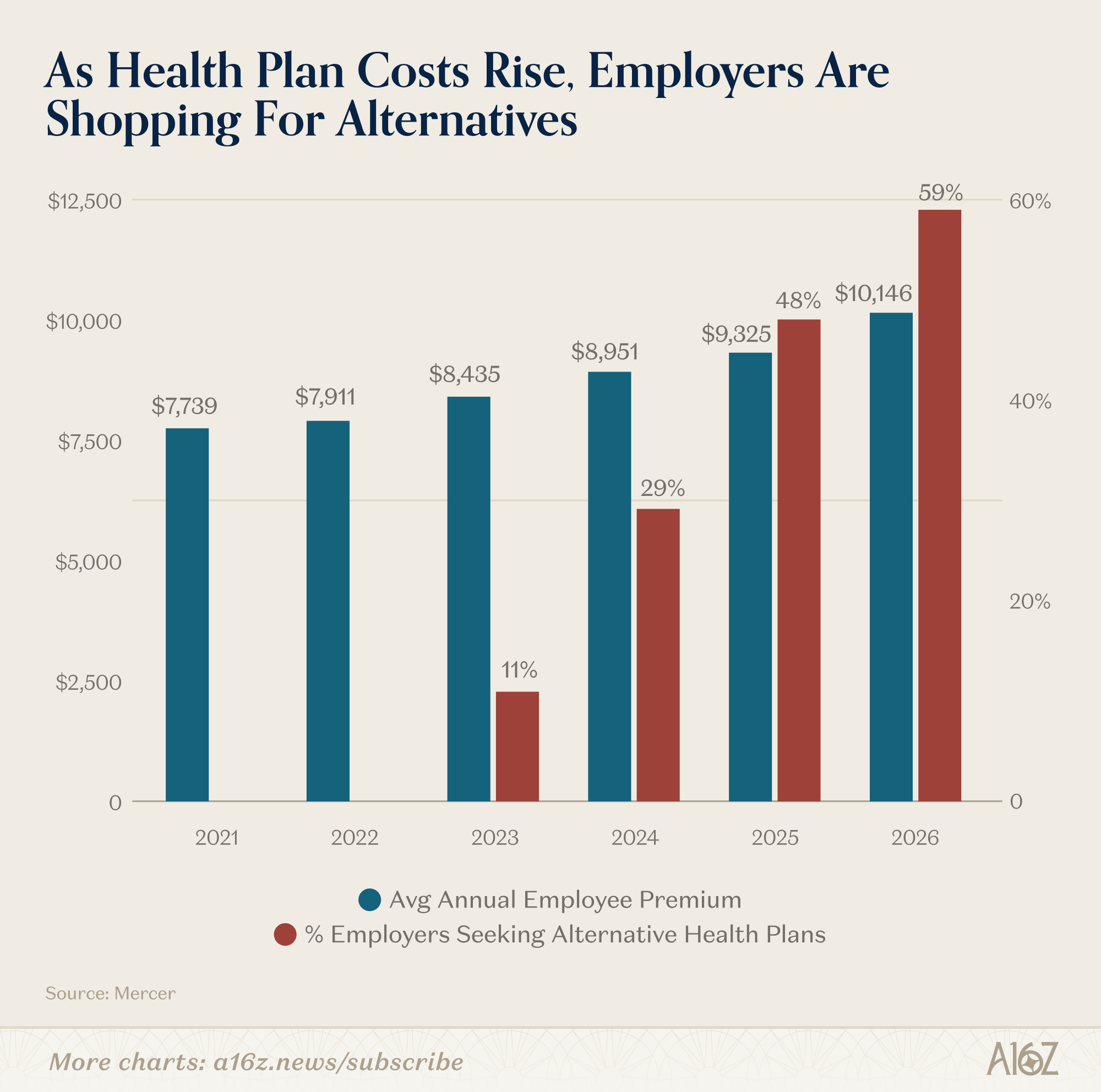
A new wave of challenger health plans, challenger PBMs, and modern infrastructure platforms have emerged to meet the demand for better employer-sponsored healthcare. Their challenge and opportunity is to serve their two audiences at once – improving employer economics and risk while meeting the higher standard employees now have for their healthcare experience. Many of these emerging companies have the opportunity to be both AI-native and AI-proof.
And the plans that replace the traditional options might look pretty different. If we look at the various ways challenger health plans are trying to compete, a common theme is that plans are becoming more upstream, personalized, and proactive. They’re becoming more involved in how consumers actually navigate seeking and receiving care instead of just financing and administering it. AI helps enable the evolution from passive to active across these dimensions.
So this is a generational moment to rebuild the commercial health plan. But in an increasingly crowded market of startups, the question is not whether there’s a compelling “why now” – it’s which of these levers, or combination of them, can become a real, durable advantage.
How Challenger Health Plans Can Compete
A challenger health plan might get attention with a superior customer experience or lower admin fees, but the ultimate test is whether it can keep its members healthier and control the total cost of care. Across the health insurance plan ‘stack,’ there are a few places where an upstart can build a meaningful advantage:
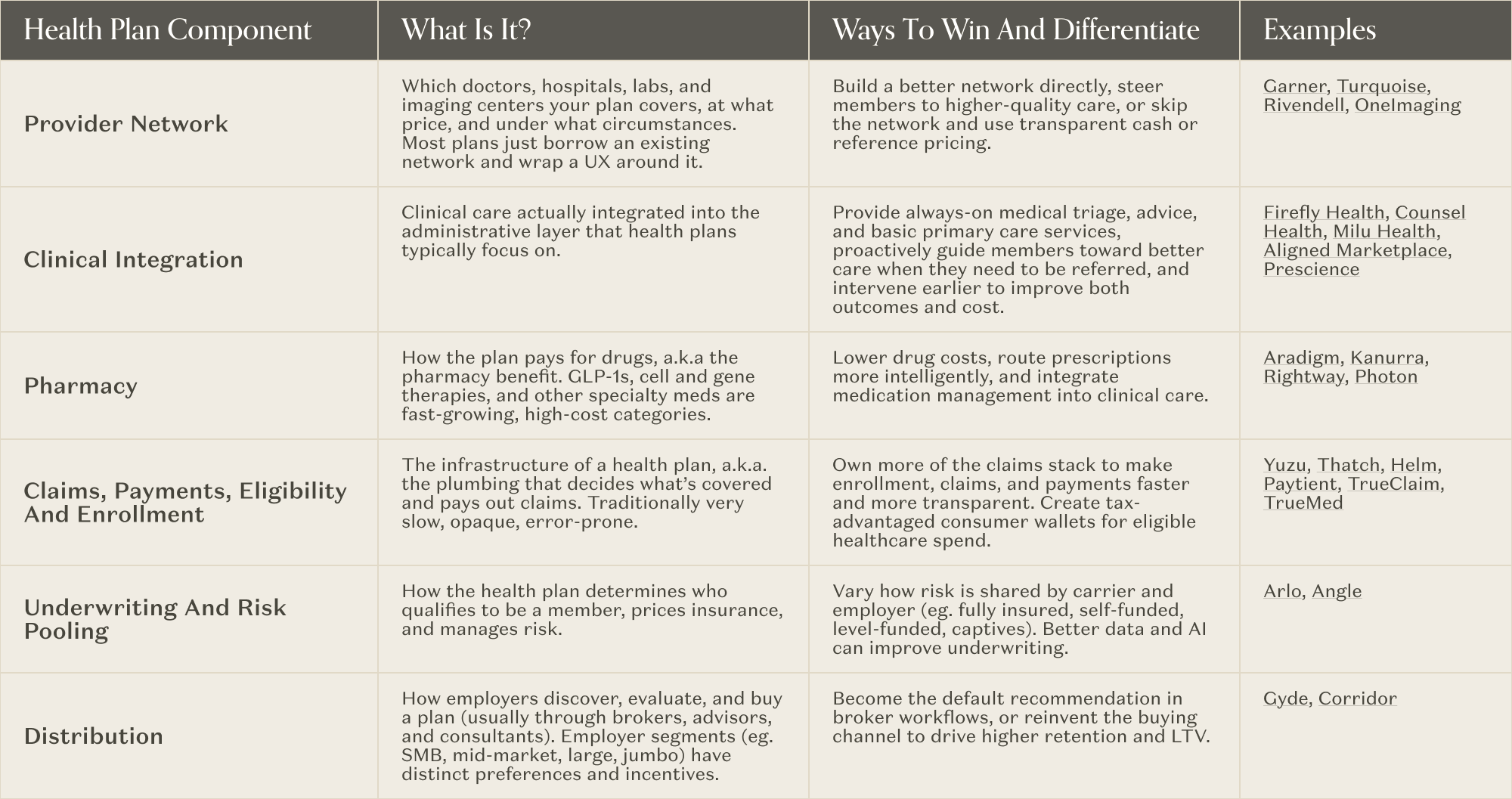
And of course, a company can integrate several of these components into a full-stack health plan offering. Given the massive market opportunity, any one of these components could support a standalone company, or become a superpower within a full-stack health plan. And each segment of the employer market, from SMB to jumbo, is a big enough prospect base for a company to focus there for years and still grow significantly before expanding beyond.
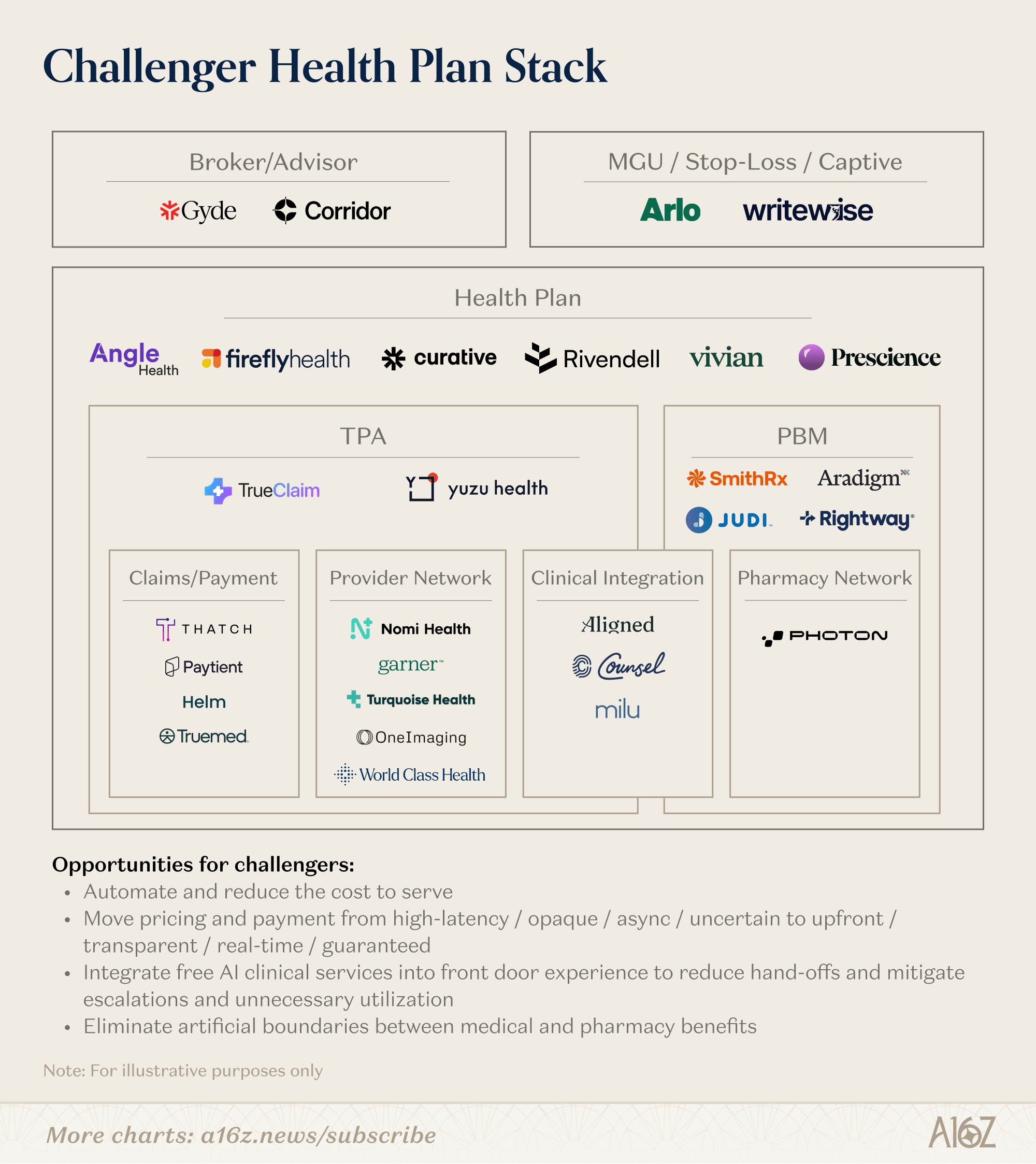
Rising costs are forcing employers to shop, just as AI is making health plans smarter and cheaper to build, and consumers are expecting more from them. Health plans have to compete again, and a previously impenetrable market category is now addressable for startups.
Commercial health insurance is one of the largest markets in healthtech. It’s a control vector for how healthcare is priced, accessed, and experienced, and it’s one of the hardest layers to rebuild. For the first time in decades, employers are ready to buy something fundamentally different – and builders have better tools to deliver it.
If you are building a challenger health plan, we’d love to hear from you. Let us know the one or two levers where your approach is structurally different, and why that difference compounds as you scale.
Special thanks to Colin Morelli, Seth Cohen, and Eva Steinman for their contributions to this piece.