One of the biggest ways that AI is transforming work (and also one of the most taboo subjects inside companies at the moment) is that most work discussions are being recorded now by default. This wasn’t debated – it just happened. And you should probably assume that everything you say at work is getting recorded for here on out.
This naturally freaks a lot of people out. But I don’t think it’s a reversible trend. There are just too many bottom-up advantages for productive individuals, and too many top-down advantages for leaders, to put the genie back in the bottle.
From a technology perspective, it’s clear that a new kind of system of record is going to get built out of this living company context, and we may as well get to that future as fast as we can.
The key insight is that you need to onboard AI like you would onboard employees. You don’t tell a new employee to pour over your existing CRM system or company wiki and expect them to get up to speed. You invite them to meetings and let them learn through osmosis. This is because meetings are where culture resides, where expectations live, where edge case handling gets done. The (previously) unwritten context for how a company actually operates. Turns out AI operates the exact same way, except it can attend every meeting, reason over every interaction and never get bored. Ultimately, this latent context is what is going to empower AI agents to do productive work across companies. And this promise of AI productivity is going to dramatically outweigh any fear / prior cultural norms.
Bridgewater was ahead of its time here. Recording everything as institutional policy looked eccentric for years, and it turns out it was prescient. OpenAI now runs with essentially everything recorded, with agents standing in for senior leaders in meetings they can’t attend. The model that’s ingested two years of your company’s internal discussion is simply a better assistant than the one that only read your documentation. Granola is the clearest example I have: it has better context on a16z’s culture, our investments, and how we actually think than almost any other tool we use, because it’s been in the room.
What’s emerging is a new category of enterprise software, organized around voice instead of text. The system of record today is structured data: CRM entries, tickets, docs. But the highest-value context lives in conversation: the nuance on a customer call, the real argument in a product review, the offhand comment in a leadership meeting that quietly changes the roadmap. LLMs are uniquely good at taking that unstructured voice data and making it structured, searchable, and queryable. That’s a large enterprise opportunity, and we’re still early in understanding what the software layer looks like and who owns it.
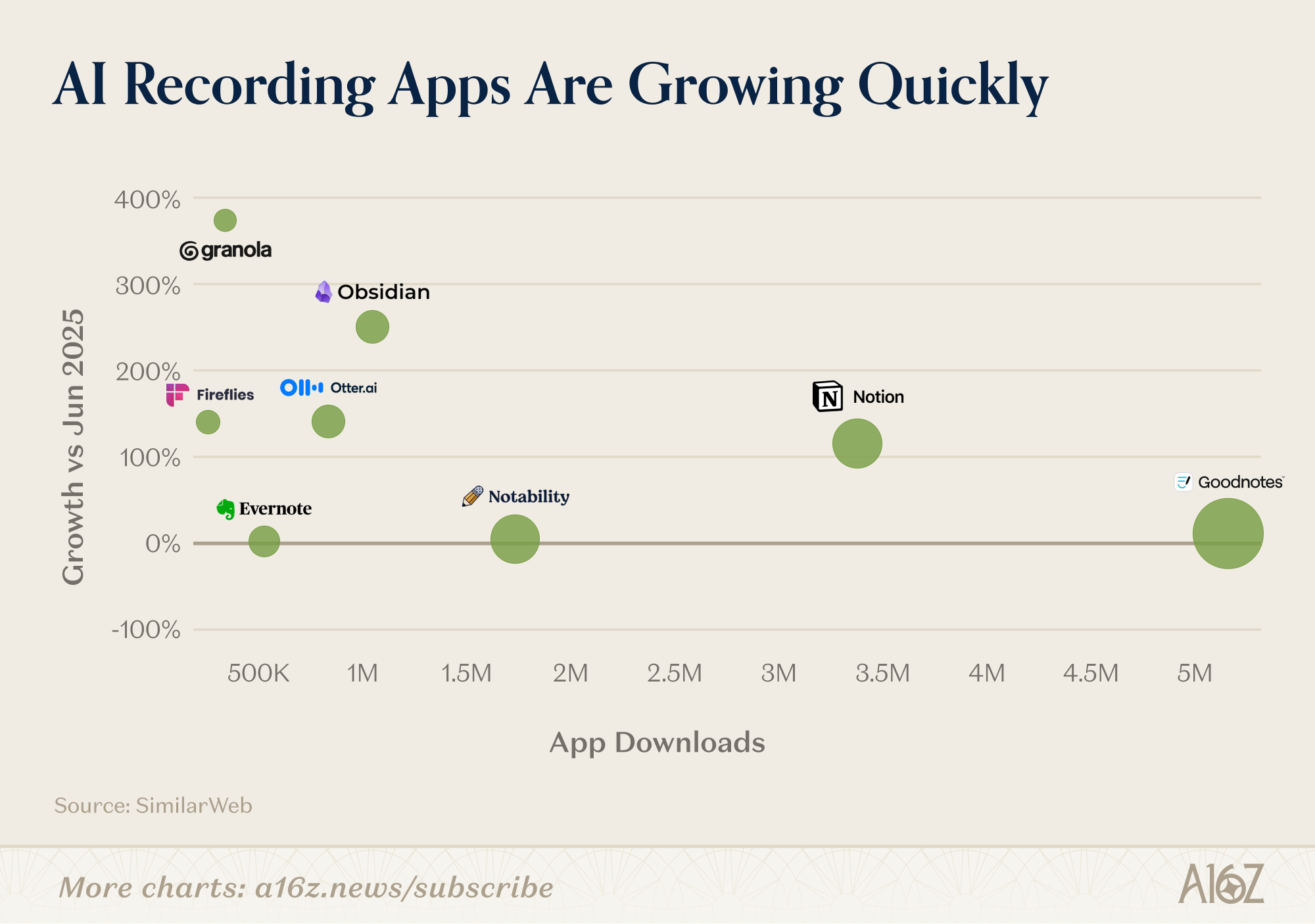
There are two advantages you give up by not recording. The first is bottoms-up: an AI that knows the full company context is a force multiplier for the ICs who can see how to make the company better. Everyone gets this one. The second gets discussed less but matters just as much: top-down oversight. AI might make your best ICs 10x more productive, but it doesn’t solve the alignment problem inside a company, and un-shipping something is far more expensive than shipping it. Execs need a handle on what’s getting built, and the obvious mechanism is to have their AI present in the meetings they can’t make, flagging what matters. Both advantages compound. Every recorded meeting makes the system smarter.
There’s a cultural dimension I don’t think gets enough attention. Companies cluster into verbal cultures and written cultures. Verbal cultures, the Shopifys and OpenAIs, have a compounding advantage in an AI-native world, where written cultures like Stripe or Anthropic already capture most of their context by construction. The historical bottleneck for verbal cultures was that the important context happened in conversation and then evaporated. When AI can attend every meeting and synthesize what happened, verbal culture finally scales. That’s not to say that written culture companies won’t benefit too: giving AI access to thoughtful writing is obviously also a good way to get it up to speed on what matters in the company. But, overall, I think AI is going to promote and enhance verbal culture disproportionately.
This is where the inevitability comes from. The default is going to flip, from “don’t record unless you opt in” to “assume you’re being recorded unless a meeting is explicitly designated otherwise.” I’d bet this is far less contested six months from now than it is today. The deeper reason is that the old principle already applies to everything else: never put anything in writing you wouldn’t want made public. Screenshots get forwarded. Emails get subpoenaed. Slack messages end up in discovery. Most professionals already operate on that assumption for text. Meeting recording is the same principle, applied to conversation.
That makes recording a decisive wedge between smaller, AI-native companies, for whom it’s the obvious default, and incumbents that have to overcome the inertia of not doing it. When I raise this with people at big companies, they ask some version of “have you ever been sued before?” Which is fair. But the cost of not doing it, measured in competitive advantage forgone, is enormous. We’ll probably land on special designations for sensitive meetings, HR and legal, something like “AC Priv”: don’t record, and if you do, that’s a violation. It’ll be gameable, the way these things always are. My bet is that widespread recording simply happens, because it’s too hard to stop, and the controls get retrofitted on top.
It’s a great time to be an operator and an investor here, and an interesting time to be a board member. The big tradeoffs around how, and how much, a company records itself are exactly the kind of problem a board should help with. The living context layer is being built inside companies right now, whether they’re paying attention or not. The question isn’t whether this happens. It’s whether you get there first, and build the right governance around it while you still have the advantage of choosing.