That logo you’re chasing is costing you your market.
Founders with great AI products are spending months courting their first Fortune 100 customers, burning through funding rounds, and tying up their teams on deals that will never convert. They chase these logos not because the deals are big, but because a marquee name on a sales deck supposedly makes every deal after it easier. So founders focus all their attention on them, and often even offer steep discounts (or pay customers to use them!) to land them. The founders don’t care that the revenue barely registers. The logo is the whole point. Meanwhile the buyers who actually need the software, and would pay full price for it, have never heard the company’s name.
It’s not that there’s no logic to this. AI is new, so founders assume they have to educate the market, and they default to the Lighthouse strategy: win a few marquee customers, build social proof, and reassure the buyer who’s afraid of making the wrong call. But for a lot of AI companies that instinct is exactly backwards. Their buyers already understand the problem and aren’t afraid of getting it wrong. They just need the math to work, and every week spent chasing prestigious logos is a week a competitor spends selling in Ohio. Those companies would be better off pursuing the Landgrab strategy: win on math, move fast, and sign the largest number of customers possible, logo be damned.
There are two GTM playbooks for AI companies selling into the enterprise: the Lighthouse and the Landgrab. The difference between them isn’t about product quality or team strength. It’s about what you’re selling and who you’re selling to.
The Lighthouse
Category creation is when AI enables work that couldn’t be done before. This kind of solution has no precedent inside the buyer’s organization, no incumbent to displace, and no existing mental model in the buyer’s head. You’re not replacing Salesforce but inventing something new, and that often means you’re asking buyers to take a leap. Social proof is everything so you need lighthouse customers whose adoption signals that this category is real and you’re the one to bet on.
Harvey built AI for legal professionals, a category that now feels entrenched but only a few years ago had no players, let alone customers. Law firms were buying research tools from Thomson Reuters and LexisNexis, which surface information for an associate to interpret. Meanwhile, Harvey does all that work itself: drafting, research, and due diligence across thousands of documents. Lawyers are trained to avoid risk, so no firm wanted to go first, but when Allen & Overy signed in late 2022, followed by Paul Weiss in early 2023, every peer took notice. Today Harvey has hundreds of millions in ARR and an $11 billion valuation, but it first needed A&O and Paul Weiss to tell the legal industry AI-powered legal work was real.
Hebbia ran the same playbook in financial services, building an AI intelligence platform for firms whose teams spend 60+ hour weeks poring over high-stakes data rooms. In this world of highly confidential deals and guarded reputations, no fund wanted to go first either. Hebbia broke through with the world’s largest private equity firms, hedge funds, and consultancies as early customers and then expanded to more than 40% of the largest asset managers by AUM, including KKR and BlackRock. Just as with Harvey, marquee names went first and the market followed.
Capturing lighthouses is a small-team, founder-led, and high-touch effort. Applied in the right markets, it lands large deals: six figure ACVs at least, often seven figures early on. Sales cycles can run three to six months (or longer) because you’re navigating POCs, custom work, and buyers wary of costly mistakes. The team that closes the deal is often the same team that delivers the product, which is expensive and unscalable by design. Going first can come with outsized rewards for buyers, so the best lighthouse sellers make the leap feel like a chance to win big instead of a chance to be wrong.
The Landgrab
The game flips entirely when the buyer already knows the problem and a mistake won’t cost them their job. They understand what you’re selling, and the pitch is simple: “I replace Y at a lower cost or with a better outcome.” You don’t need Stripe’s CTO vouching for you to get a meeting. You get the meeting by showing a VP of Support their current spend and saying “we cut this in half.” Social proof still helps you close faster here, but the market already believes in what you’re selling.
In these markets, sacrificing speed is deadly because founders are not only competing with other startups, but also with incumbents building AI. Sure, Zendesk adding an AI copilot is fundamentally different from Decagon replacing the entire support function with agents. But the incumbent already owns the customer, and the more AI it adds each quarter (whether it’s make or buy), the harder it becomes to pull that customer away. That is why speed is the whole game. In the words of our colleague Alex Rampell: you need to get distribution before the incumbent gets innovation. The way you do that is with a landgrab.
Take Stuut, which automates accounts receivable: collections, payments, cash application, and dispute resolution. SAP and Oracle ship AR modules in their ERP suites, and players like HighRadius have sold point solutions since the early 2000s. Yet teams still lose countless hours chasing invoices. Stuut finally solves this: customers increase cash flow by 40%, cut manual tasks by 70%, and lower their collection period by 37%. The company went wide early, leaning into the lower middle market over Fortune 100 logos, and now serves manufacturers, distributors, and logistics companies across Michigan, Ohio, Texas, and beyond, deploying in under a week against the 6 to 18 months of a traditional rollout.
Decagon used a similar motion to win in customer support. The founders ran roughly a hundred customer conversations in a month before building their product, then sold on rapid deployment and immediate ROI, scaling from 0 to 8 figures in ARR in 18 months. In 2025 alone, the company signed more than 100 new enterprise customers across travel, finance, health, and retail, tripling its valuation to $4.5 billion in under six months.
Landgrab selling is demo-driven and relies on a larger team. The product needs to be standardized enough that a customer can onboard fast and see value quickly. Implementation is driven by forward-deployed teams specialized in delivery, rather than discovery. The unit economics have to work at volume because volume is the whole strategy.
Picking Your Strategy
Enterprise sales is fundamentally about risk and reward. Behind every deal is a person who has to sign their name to the decision, and who wants the same thing all of us want: for the thing they approved to work, and to still have their job next year. Instead of evaluating your product in the abstract, they’re deciding how much personal exposure it creates, and what evidence would make that exposure bearable.
That’s why two questions help you draw the map and decide which strategy you should pick.
How exposed is the buyer who signs? Not every mistake costs the same. In customer support or AR automation, a faulty reply or misstated invoice annoys a customer and gets fixed – the buyer’s downside is a bad quarter, not a bad career. A buyer’s exposure climbs with three things: whether the industry is regulated enough that a vendor mistake becomes the buyer’s compliance problem, whether you’re replacing a system of record or adding a tool alongside one, and whether the output faces the outside world (a filed document or customer-facing answer vs. an internal draft someone reviews). In law and financial services all three run hot, and one fabricated figure can misprice a position or sink a deal. For those buyers, the ROI math is beside the point. They’re managing personal downside no discount can offset.
Does social proof travel? In some markets, reputation carries well, while in others it does not. In financial services and law, firms watch each other obsessively, status is legible, and landing two marquee firms moves the whole market: whoever went first has effectively done the risk assessment for everyone behind them. In AR at mid-market firms, the controller in Des Moines does not care that a household-name brand uses your product and is never going to hear about it anyway. Buyers there don’t watch each other closely, so each sale starts from zero and a marquee logo buys you less. Concentrated, status-driven markets carry proof while fragmented ones make you earn every deal on the math.
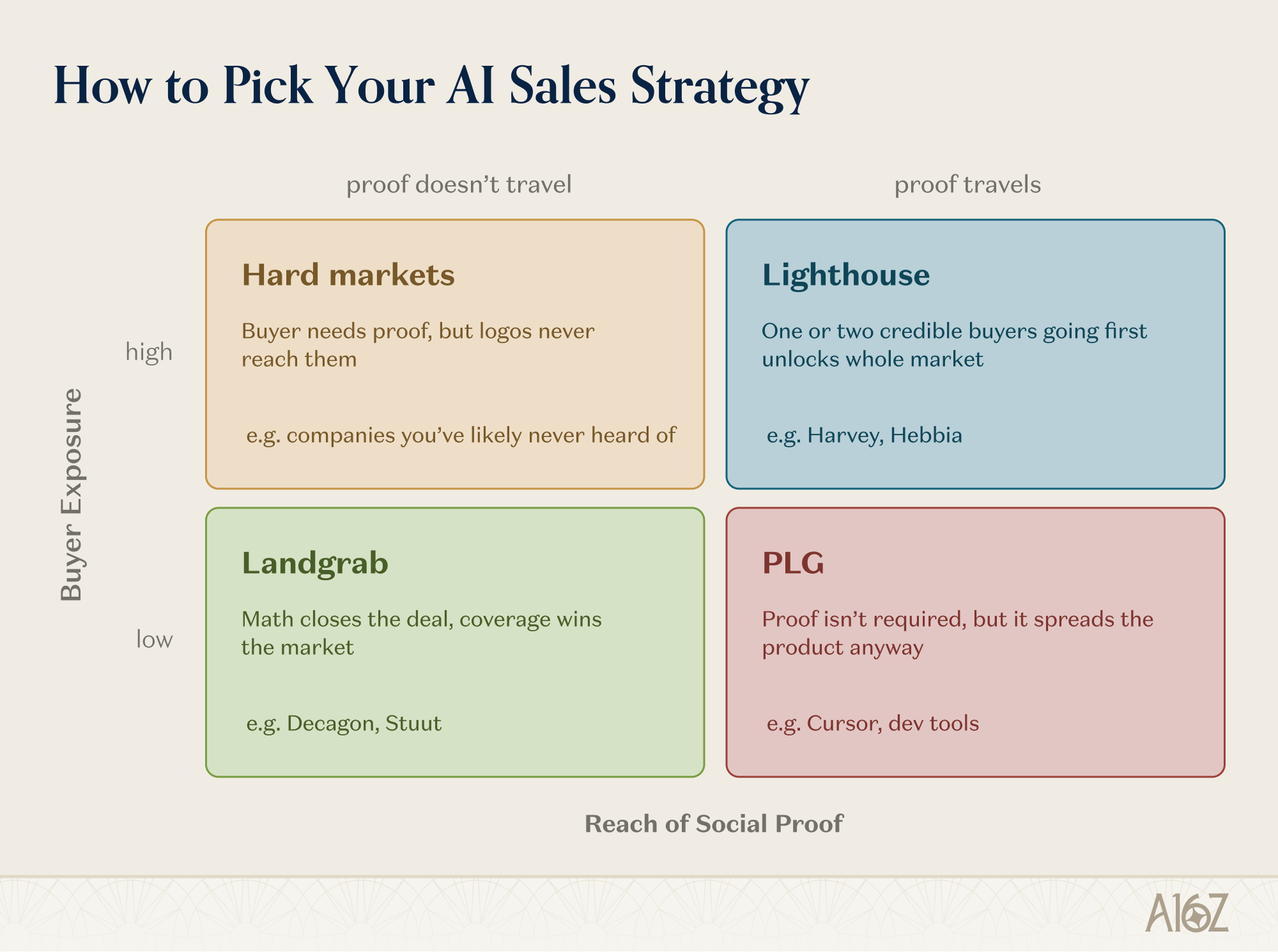
Put these two questions together and you have the map. When exposure is high and proof travels, you’re in lighthouse territory: a few credible buyers going first unlock the whole market, the way it played out in legal work and financial research. When mistakes are recoverable and proof travels less, you’re in landgrab territory: math closes the deal, and coverage wins the market, which is what is happening in customer support and AR automation. The other two corners matter less to enterprise sellers but are worth naming. When proof travels but isn’t required, you may not initially need a large sales team; the product spreads itself, for instance engineer to engineer, the way dev tools do, and category creation happens bottom-up. Finally, when the buyer needs proof but the logos never reach them, you’re in a hard market and you likely haven’t heard of the companies stuck there.
You’ll notice other patterns that seem to predict the motion: SMB skews landgrab, risk-averse industries skew lighthouse, additive tools move faster than system-of-record replacements. Trace any of these back far enough and you land on exposure or proof. The controller at a 200-person distributor is a landgrab buyer because her market is fragmented and her deal is small. The industry code on the account never entered into it.
Markets don’t always fall cleanly into one bucket, and the two questions above lead to the clearest conclusion at the extremes. For the ambiguous cases, a few other factors are also worth weighing. For instance, an existing budget and napkin ROI usually confirm you’re in landgrab territory, but only after the exposure question clears. A buyer can have the budget, see the math, and still refuse to move until someone credible goes first. When the two point in opposite directions, exposure wins every time.
Sales cycles can provide another gut check to identify which territory you’re in. If they run longer than 60 days, if you’re doing custom work to prove the concept, if the buyer asks “is this safe?” before “what does it cost?”, your buyers need proof, and you need to run the lighthouse. The more common mistake right now is the opposite: assuming buyers need proof just because the technology is AI and therefore feels new. But the controller whose worst case is a misstated invoice isn’t managing career risk. Show up with a marquee logo instead of a number and you’ve answered a question they never asked.
The Traps
Lighthouse Traps
Becoming a hostage to the logo. Everyone wants the same marquee logos, and you end up in a brutal fight for the same 500 accounts that every other AI startup is pitching while the logos extract concessions because they know you’re desperate. Lighthouse customers are a means to an end. Get a few trusted names, then run the table. The vast majority of revenue sits in companies no one’s heard of.
Prestige without payback. The wrong customer won’t collaborate on repeatable software (you become a consulting shop), won’t pay recurring (unsustainable economics), or won’t pay high enough ACVs (the math breaks). Worst case: a prestigious logo that teaches you nothing replicable and underpays, and you’ve traded time for a vanity metric.
Pilot purgatory. Big logos love pilots. Six-month POCs that never convert, burning your best people on deals that were never real. The fix is time-boxed pilots with clear milestones and auto-converting contracts.
A lighthouse for one. You over-rotate on your lighthouse customer’s requests and build a product perfect for them and useless for everyone else. You win the lighthouse but no other ships follow the light in.
Landgrab Traps
Dying of indigestion. When you can sell to anyone the discipline is saying no. Some customers are poison: hard to onboard, hard to drive results for, low ACV. Without qualification discipline and a deal desk, you wake up with 200 customers and 50 underwater.
Grabbing land you can’t hold. You’re selling at volume, and if you scale coverage before the product is ready you create detractors at scale. 50 unhappy customers means churn. 500 is a reputation problem.
Mistaking the valley for the market. Canvassing every bus stop in a major metro isn’t grabbing land. The real opportunity is figuring out how to show your ROI to the 50,000 companies outside of normal networks.
Sequencing: Lighthouse to Landgrab
The best companies don’t stay in one mode forever. They sequence from lighthouse to landgrab deliberately, getting a bellwether in one vertical, dominating that vertical, and then finding adjacent verticals that look similar. At Affirm (a story worth its own post), the breakthrough was Casper. Once they had one mattress company they got every mattress company, and then they went to exercise equipment, and then to things that look like exercise equipment but aren’t. Mattresses and Pelotons have nothing in common except that they’re big-ticket items people want to pay for over time, and Affirm saw that before the market did.
Eventually, new categories turn into recognized ones because the lighthouse customers define them. But you have to earn the transition. Going wide before the category is established burns cash and credibility. The signal that you’ve earned it is buyers approaching you with allocated budgets and asking for a demo rather than asking who went first. When that happens, the lighthouse worked, and it’s time to run the landgrab.
Closing
Every AI founder believes they’re inventing the future. And they are! But your buyer doesn’t purchase the future; they purchase either proof or math. If they need proof, go win the logo that gives it to them. If they need math, get on a plane and show it to them before your competitor or the incumbent does.
The founders who get this wrong won’t fail because they built the wrong product or picked the wrong strategy off a menu. They’ll fail because they never asked which game they were in, and in a market moving this fast, you only get to ask it once.
Thank you to Alex Rampell, Justin Kahl, Santiago Rodriguez, Spencer Wiedeman, Frank Golden, and Elena Burger for their thoughts on this post.