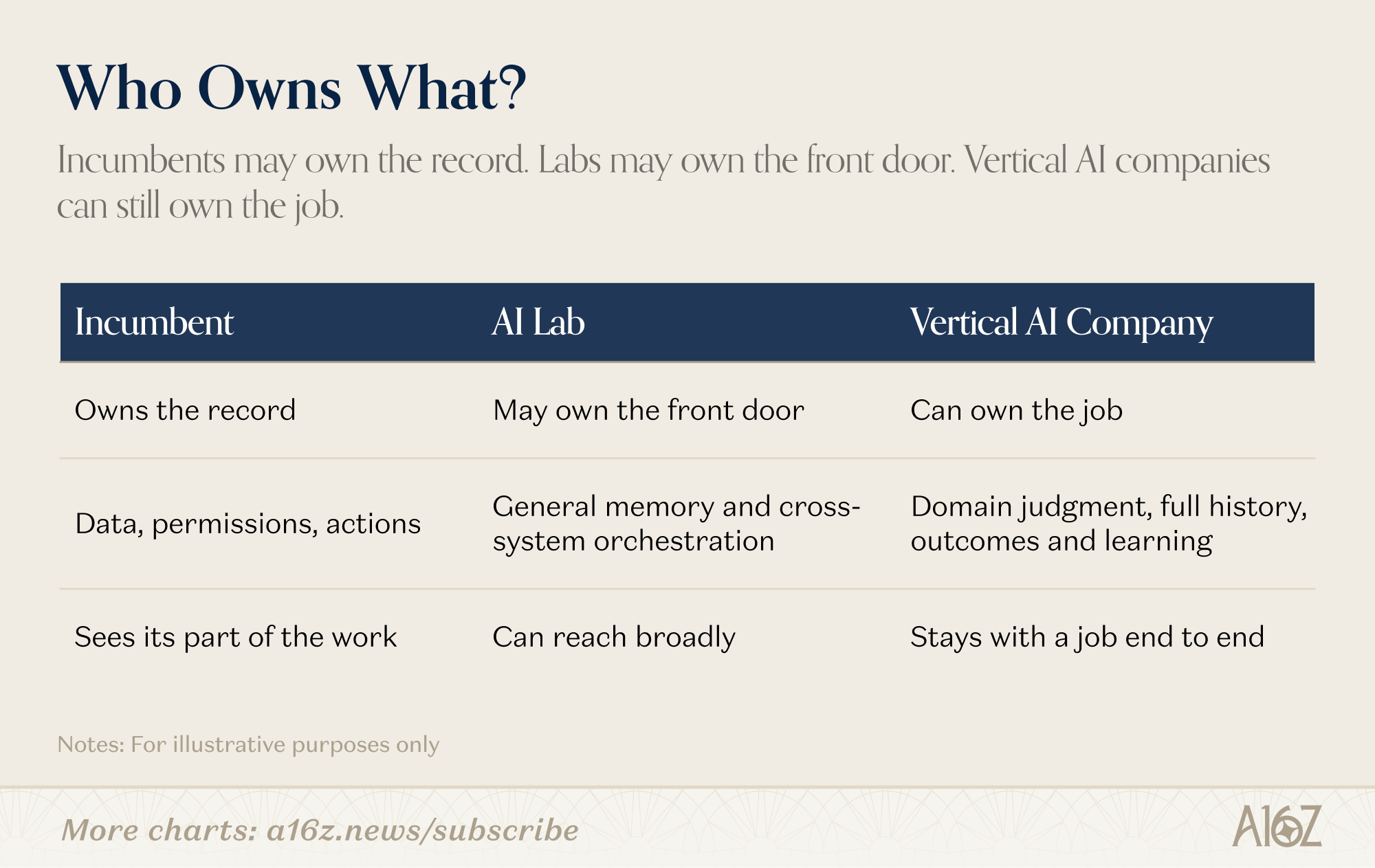
The bullish case for incumbent systems of record is that AI makes systems of record get more important, not less. Why? Because in theory the customer can now pipe the system’s data into Claude or Codex and skip the AI-native app.
As agents do more work through these systems, the data and actions they control become more valuable. An incumbent system of record plus a general agent (or an agent built by the incumbent) therefore might be enough to get the work done. This is what Salesforce just announced in partnership with Anthropic:. Claudeforce lets you work with the Salesforce CRM from inside Claude without having to open Salesforce (or so they claim!).
The argument is partly correct. The incumbents aren’t sitting idly.
The incumbents have an incentive to control and charge for access to their data, and now to push their own agents forward too. We’re already seeing incumbents market products that move from simply storing information toward doing more of the work itself. Docusign’s Iris reviews contracts, Atlassian’s Rovo aims to resolve and route requests, and Klaviyo’s Composer builds campaigns and assesses marketing performance. These products move incumbents beyond the “slap on a chatbot” strategy and into taking action.
At the same time, Claude is starting to coordinate work across applications, making it possible for general-purpose agents to act as a layer above the incumbents. Claudeforce shows what that can look like: Claude can become the front door to the job while Salesforce still controls the underlying CRM data and actions. The interface and the system of record look like they’re unbundling, creating an opening for AI-native startups to rebundle around the job.
So where can startups still compete?
The vertical AI-native company has to win through focus. It has to perform a specific cross-system job better than an incumbent’s purpose-built agent or a general-purpose agent like Claude, which will be able to reconstruct it from the underlying tools. Focus can earn the vertical startup deeper access, a deliberate data asset, more specific context, and a learning loop that builds a better understanding over time of what good work looks like for a given job.
The agent hierarchy
To see where incumbents are strongest and where vertical AI companies may have an advantage, it’s helpful to think about the four types of application-level agents, distinguished by how much autonomy and judgment each requires.
Retrieval assistants find information, summarize documents, answer questions, and draft responses. Process agents carry out rule-based work like updating records or routing approvals, using limited judgment to interpret the task, and act. Policy agents apply the rules in an organization’s playbooks, precedents, and thresholds to ambiguous cases. Principal agents make judgment calls about what the organization should do, often with open-ended tradeoffs around strategy, risk, and resources.
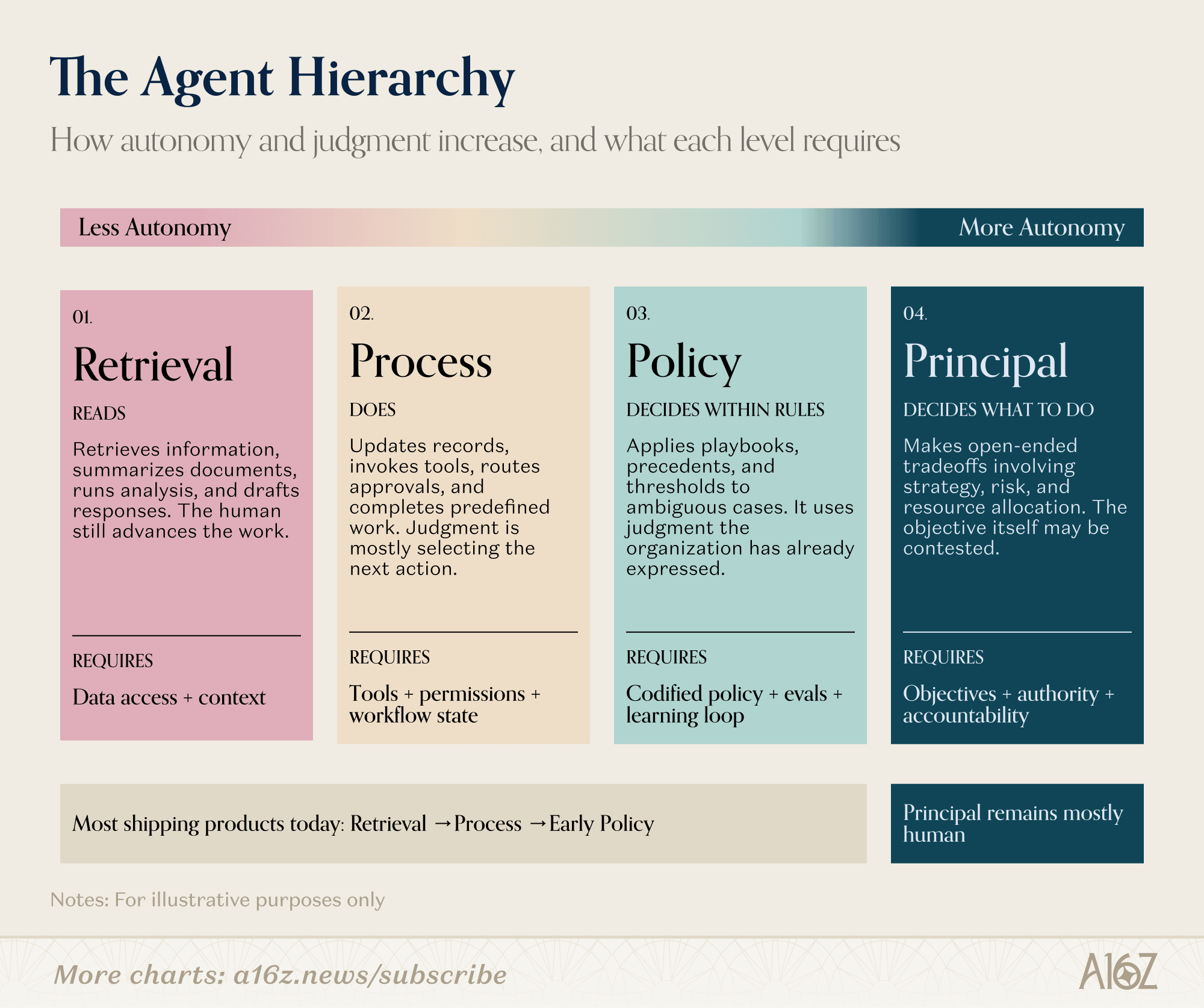
A year ago, most incumbents’ AI products were still at the retrieval stage, if that. They functioned mostly as chatbots and analytical tools pulling from existing records. Now, more can take action based on the workflows, permissions, and rules already embedded in their products. A few are beginning to apply narrow, human-defined policy. Judgment gets harder when the decision depends on information outside the record that the incumbent manages.
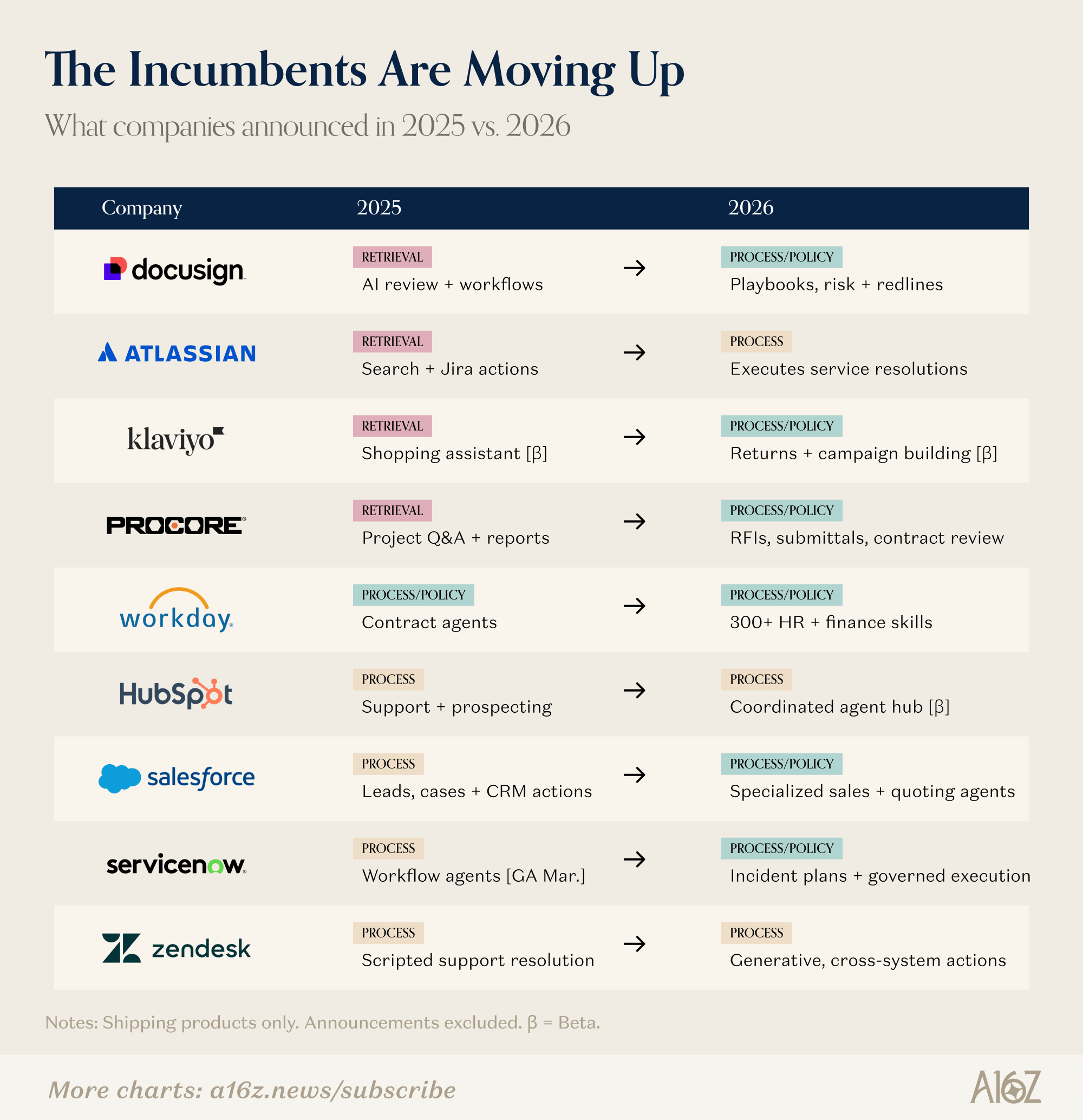
The broad shift we’re seeing is incumbents moving up the hierarchy, from retrieval and process toward more judgment through policy, like Docusign’s Iris applying a legal team’s playbook. But that judgment is still largely bounded by the record the incumbent owns.
The job is bigger than the record
An incumbent can automate more of the work around its core record, but the customer’s job to be done is bigger than the record. This isn’t a hard technical boundary because incumbents can pull in outside data and add workflows, but their work still expands outward from the record they already own.
A customer’s work gets done through a combination of its people, processes and software. The contract is not the legal matter, the ticket is not the customer’s resolution, and the opportunity is not the sale. The full job crosses applications, teams, and even companies. Different parties may hold different information, and want different outcomes. The incumbent is limited to building a “local system of work” but the larger opportunity is to manage the job across boundaries, including all of the parties, the people, the documents, decisions, revisions, and the final result.
A general purpose agent like Claude or Codex may be able to reach across all these systems, but access alone doesn’t mean it can perform the job well. Even using MCP, pulling info across applications has latency, and each application may describe the same customer, contract, or transaction differently. Even if a general purpose agent can access every app in one company, it doesn’t automatically have access to information held by external parties (e.g. between buyers and suppliers).
Even with these limitations, Claude can still sit above systems of record. Claudeforce makes Claude the front door to the job while Salesforce still owns the CRM data and actions. And Claude can keep gaining context through deeper integrations blessed by the incumbents.
How vertical AI learns
Owning more of the job matters because it lets startups see the decisions and corrections that produced the final result. A model performs better on a specific job via a vertical harness with the right context, tools, workflows and evals. The learning loop is what improves the system – the model + harness – after each job, using the agent’s work, expert feedback, and outcomes themselves to improve the next attempt.
Completed records alone don’t automatically suffice as a training curriculum for the work. A signed contract shows what the parties agreed to, but not every alternative considered or every reason for an exception. A closed ticket shows the resolution, but not every hypothesis the support team tested.
Remembering vs. learning
The labs are also building general-purpose memory, so preserving context alone is not a durable advantage. Remembering and learning are different. Memory can help a general purpose agent recall a customer’s preferences or a decision made last week. But it doesn’t tell the agent whether the work was good or why an expert changed it or what to change next time. Focus lets the company see more examples of the same job, learn faster, and get better at measuring improvement.
Profession and Institution
There are two kinds of learning. Learning how a good professional does the work. A company can begin teaching that with assignments created by experts, realistic examples, and standards for a good result.
Learning how a particular firm or customer does the work, including its templates and precedents, risk thresholds and escalation rules. That can begin with the customer’s existing materials and improve through corrections and exceptions in the training process. Some lessons about the profession can improve the product for every customer, but lessons about one firm may just improve the product only for that firm.
To learn both the profession and the institution, the startup doesn’t need to start with the largest stock of historical data. It can manufacture a curriculum for the profession, then use production to learn the institution. As open-weight models and post-training increase, assembling the right data and evals becomes even more important.
Long running agents especially benefit from learning loops. When an agent does work over hours or days, through a complex logic chain with many intermediate decisions and handoffs, the quality of the learning loop matters even more. The longer horizon task can be unbundled and evaluated through a set of checkpoints.
To be clear, incumbents will also learn from the work performed inside their products. But that learning will cover only their part of the job: the contract review inside Docusign, the ticket resolution inside Jira, or the pipeline update inside Salesforce.
How Harvey manufactured the curriculum
Harvey’s work on Tenet shows what the path for vertical AI can look like. Harvey post-trained an open-weight model using synthetic data, public legal data, and human-expert created data, without using customer data to start. It created roughly 1,750 legal-task environments, each simulating a partner-assigned matter, complete with documents and tools and an expert rubric for a high-quality result. The average assignment had about 50 specific criteria. Instead of waiting years to accumulate enough customer history, Harvey manufactured a curriculum it could use to train and evaluate its model.
Harvey’s broader work also shows how a vertical company can train a model for different parts of the job, including industry-specific capabilities like M&A diligence and understanding a firm’s total knowledge.
The startup’s opportunity is to put it all together. Vertical specificity helps the startup to break the work into specific capabilities, tackle the practical frictions around data rights, systems, and permissioning, and fits the product into the customer’s daily work. Eventually, it can feel comfortable taking responsibility for the result. Deployment and responsibility are key here!
What makes a good vertical AI market?
Using Harvey as one example, here are a few axes for evaluating potential vertical AI markets.
- Can an expert quickly tell what the AI got right or wrong, and explain how to improve it?
- Is the work hard enough that judgment matters (vs. simple rules)?
- Does the work happen often enough for the product to learn?
- Can the startup begin with one assignment and grow into doing an entire job?
The strongest vertical AI markets tend to meet all four, giving them a strong learning loop.
Many workflows in legal, tax, and accounting meet this test because the work repeats, requires judgment, and experts already review the results. This pattern also shows up in less obvious markets like industrial work. When a manufacturing defect appears, a quality engineer has to gather test results, supplier documents, equipment logs, and the plant rules, then decide what’s acceptable and what needs to change. That information may sit across several systems. One incumbent may store the defect report, but no single product owns the full investigation. A startup could begin with one piece of this work (e.g. drafting the investigation report) and over time own the end-to-end resolution. To do this, it would need to learn both how a good quality engineer investigates a problem and how a particular plant or customer or auditor does it well.
The job is still up for grabs
There are jobs where a system of record plus a general-purpose agent will be enough, but there’s still meaningful opportunity for vertical AI-native startups! The strongest vertical opportunities exist where the work happens often, expert judgment matters, and the learning loop is strong. The incumbent may own the record and the lab may control the front door, but the vertical AI company can still win by becoming the best at doing the job itself.