Traditionally, calling your internet provider’s support hotline about an outage went something like this. A robotic voice greeted you as a valued customer, then made you spend several minutes on phone menus (“press 3 for technical support, 2 for internet, then 4 for all other issues”). You were put on hold, feeling forgotten, until a service representative finally picked up and asked for your name, account number and issue. If restarting your router didn’t fix the problem, you were put on hold again, only to tell another representative the whole story a second time before receiving a technician appointment.
AI is already transforming support interactions like this one. Instead of grappling with a robotic voice and several service representatives, an AI agent can now pick up right away. It can see your account, check whether other customers in your area are also affected and either resolve simple problems directly or book a technician. No more “all our service representatives are currently busy” and no more hold music. Until recently, this was the technological limit.
But now, new capabilities are allowing agents to follow threads and execute tasks over longer horizons. We believe this will allow AI companies to go beyond individual customer interactions and rethink how to address complex customer journeys that run over weeks and months. AI will guide insurance customers from an initial call to payout, mortgage borrowers from pre-approval to closing, and enterprise leads from their first demo to signature. This will not only create better outcomes for those customers, but also let the AI vendor get paid for the resulting revenue expansion, not just for cost savings.
Value Only Appears At The End Of The Relay Race
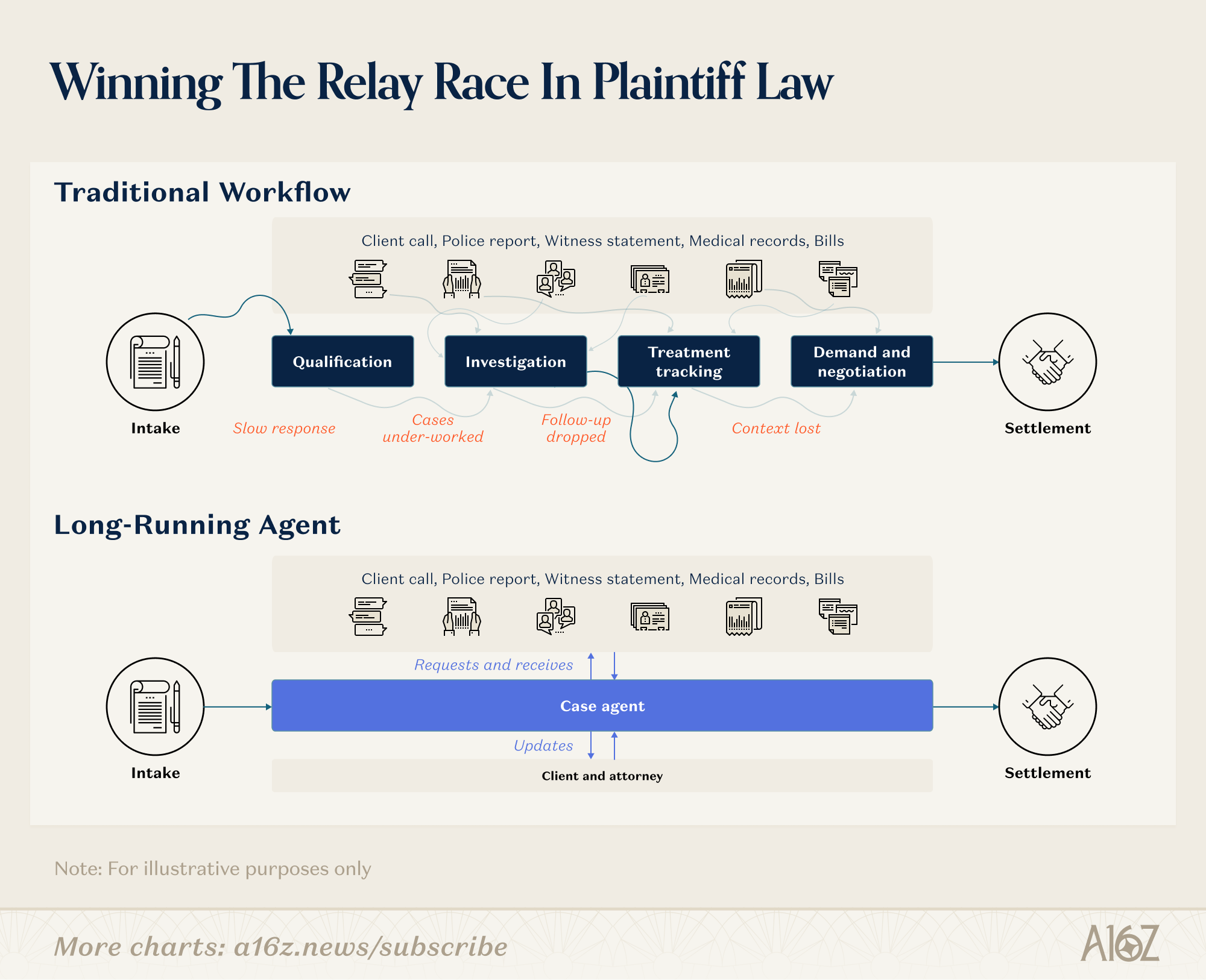
There are many kinds of businesses where creating value for customers takes many steps, over weeks and months. Let’s take the traditional plaintiff law case preparation journey as an example. Prospective cases often arrive as leads by phone, where intake specialists gather the key facts and pass them to an attorney who evaluates whether to take on a client. Once a firm signs a case, investigation and evidence collection follow: Paralegals order police reports, try to get in contact with witnesses, and send spoliation letters to defendants to preserve evidence while keeping clients updated on progress. Firms then wait for client medical treatment to conclude before drafting a medical chronology and handing information to attorneys to finalize the demand letter.
This process is what we historically would have called a “relay race”: a long journey with risk of drop-off or value leakage at each handoff. Potential clients usually call several personal injury firms and often sign with the firm that gets back to them the quickest. So cases can drop out of the funnel if clients only reach voicemail or if the qualification decision is slow. Once a client is signed, evidence collection involves many parallel threads at once and firms may not have the persistence to call a potential witness for the fifth time after the previous four attempts went unanswered. In addition, labor constraints can keep firms from reviewing every piece of evidence in detail, especially for seemingly routine, low-value claims. A firm may accept the first offer when a detailed read of the doctor’s note would have surfaced indicators of a brain injury, increasing settlement value. Finally, cases can run for months, require numerous contributors, and involve information distributed across documents, stakeholders, and systems. This makes it nearly impossible to maintain the full picture on every client. As a result, important bills may not be reflected in the demand letter or treatment gaps may remain unexplained, driving lower settlement value.
The Long-Running Agent Opportunity
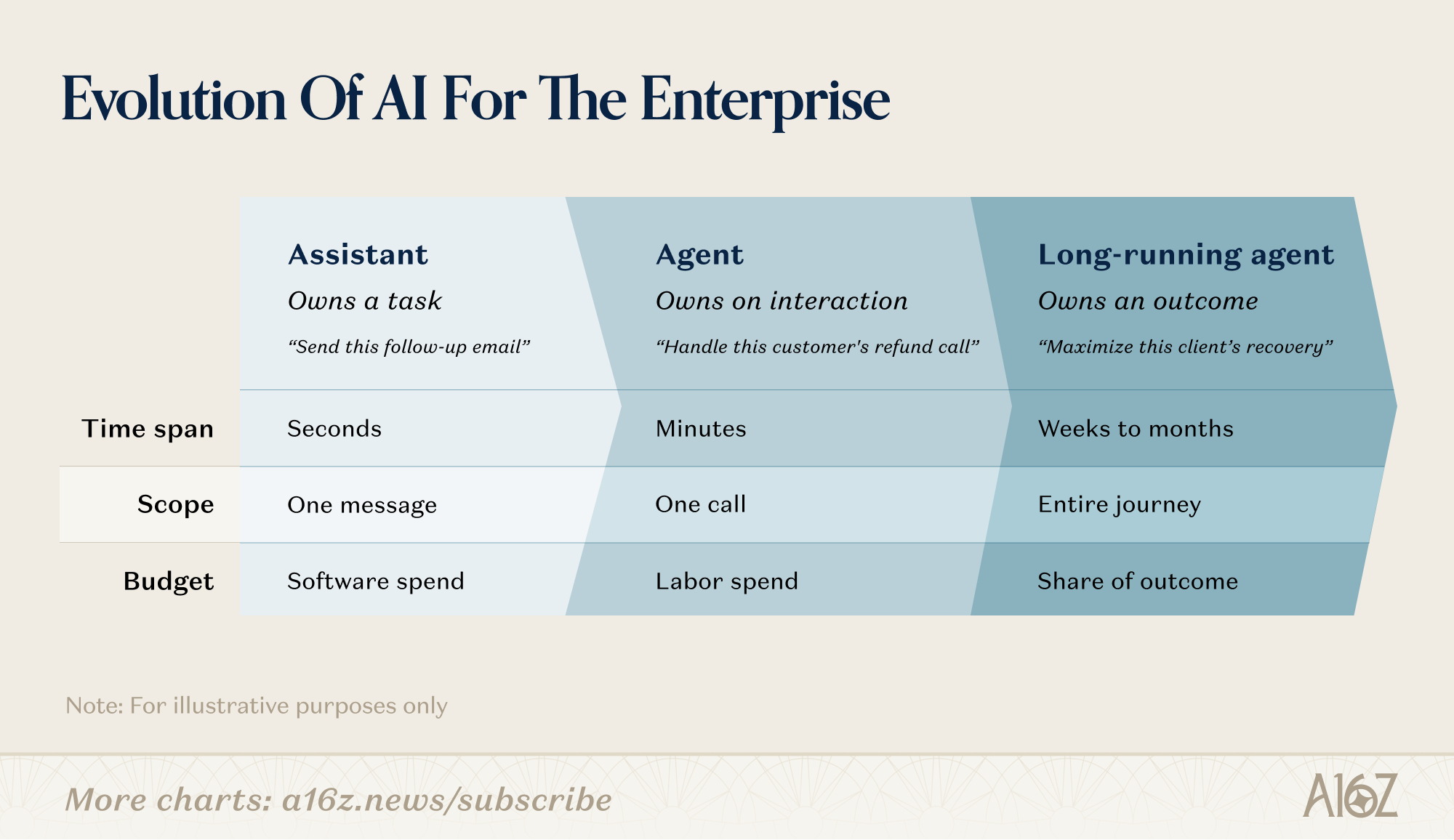
Until recently, AI agents mostly handled bounded tasks (“Send this follow-up email”, “Summarize that call”, “Create this document”) and narrow interactions. For instance, customer support has been a great early AI use case because the problem space is well-defined, making high reliability achievable, while still allowing for customization based on company-specific policies. Interactions are brief, outcomes are verifiable and if AI agents encounter edge cases they cannot handle, existing support teams are usually still in place for escalations.
Now, long-running agents are able to pursue goals across dozens of steps, modalities, and longer time horizons, allowing them to take on relay races from start to finish. In the plaintiff law example, a long-running agent could be assigned to a case from the initial intake call with the goal of maximizing the client’s recovery. The agent would save and retrieve context on the case as needed. It wakes based on events or deadlines, proactively dispatches sub-agents to contact witnesses, update the client, and interact with attorneys across phone, email, or text. It then consolidates findings, plans subsequent moves, drafts documents for review, and drives the case towards the best possible outcome. Across clients, it keeps learning, as each case generates data which helps the agent process the next case better than the current one.
The agent addresses key value leaks observed in today’s relay race. At the start of the journey, clients are no longer lost to slow case evaluation as the agent is available regardless of the hour or weekday and can assess cases nearly instantaneously. Evidence collection is no longer bounded by human capacity, as the case agent can spin up an additional sub-agent at any moment to place the fifth, tenth, or even twentieth phone call. As agents are nearly infinitely scalable, even seemingly routine cases get worked fully and each piece of evidence is reviewed in detail, surfacing the potential brain injury that might otherwise have been missed. And finally, the agent keeps a complete record of the case, from witness phone call transcripts to police reports and medical records, making sure no information gets lost.
Getting Paid For Outcomes
Beyond closing these leaks, owning the full customer journey can change the economics for the agent vendor. As agents help deliver outcomes with higher quality at greater speed, they can drive revenue uplift, not just cost reduction for customers. More importantly, as impact is observable and attributable to agents, vendors can participate in the upside they create by pricing based on work products or outcomes. In plaintiff law, for instance, a single case is a discrete unit of work and the value of the resulting outcome, the settlement amount, is clearly identifiable. In addition, outcomes can be linked to agents more easily as they drive a larger share of the final work product. Vendors may then share in topline expansion, reaching contract values previously unattainable by solely focusing on cost reduction.
Admittedly, switching to outcome-based pricing is not frictionless. In plaintiff law, most states prohibit non-lawyers from sharing in legal fees, so pricing would need to align with settlement values without taking a direct share of them. In other verticals, vendors may face objections from procurement teams who do not yet have precedents for outcome-based contracts. And even though agents move closer to fully owning outcomes, attribution debates will likely surface initially. Successfully deploying long-running agents will therefore be a commercial challenge as much as a technical one.
Still, getting paid for outcomes on high-value customer journeys is not a new idea.
The Case For An AI-native Red Ventures
Red Ventures (RV) is a great historical example. RV was founded by Ric Elias and Dan Feldstein and pioneered digital end-to-end outsourced sales operations for long-term consumer contracts. As an example, for insurance policies, RV would collect details on customers when they were searching for these products (by owning sites like homeinsurance.com), reach out, walk them through coverage options, and close the policy. By fully owning this journey, RV collected a payment from the insurer for each policy it closed. This used to work extremely well: according to S&P Global, RV generated ~$370M in EBITDA on ~$1.4B in sales in 2022.
Now, this model seems structurally under threat. At the top of the funnel, consumers are changing how they discover products. Instead of relying on Google search or comparison sites to explore and compare products, they can now ask a personal agent like Meta’s Muse or Instinct for product recommendations directly, lowering the value of owning traditional exploration sites. Further downstream, instead of hundreds of humans running linear funnels, long-running agents can work across far more complex journeys. They will do so across products, and communication modalities, in parallel, in any language and at scale, with infinite persistence. RV’s EBITDA decline to an estimated ~$160M in 2025, driven by customer churn and softer ad spend, provides an early indication of the model’s vulnerability as AI will transform the industry further going forward.
Three Ways To Market
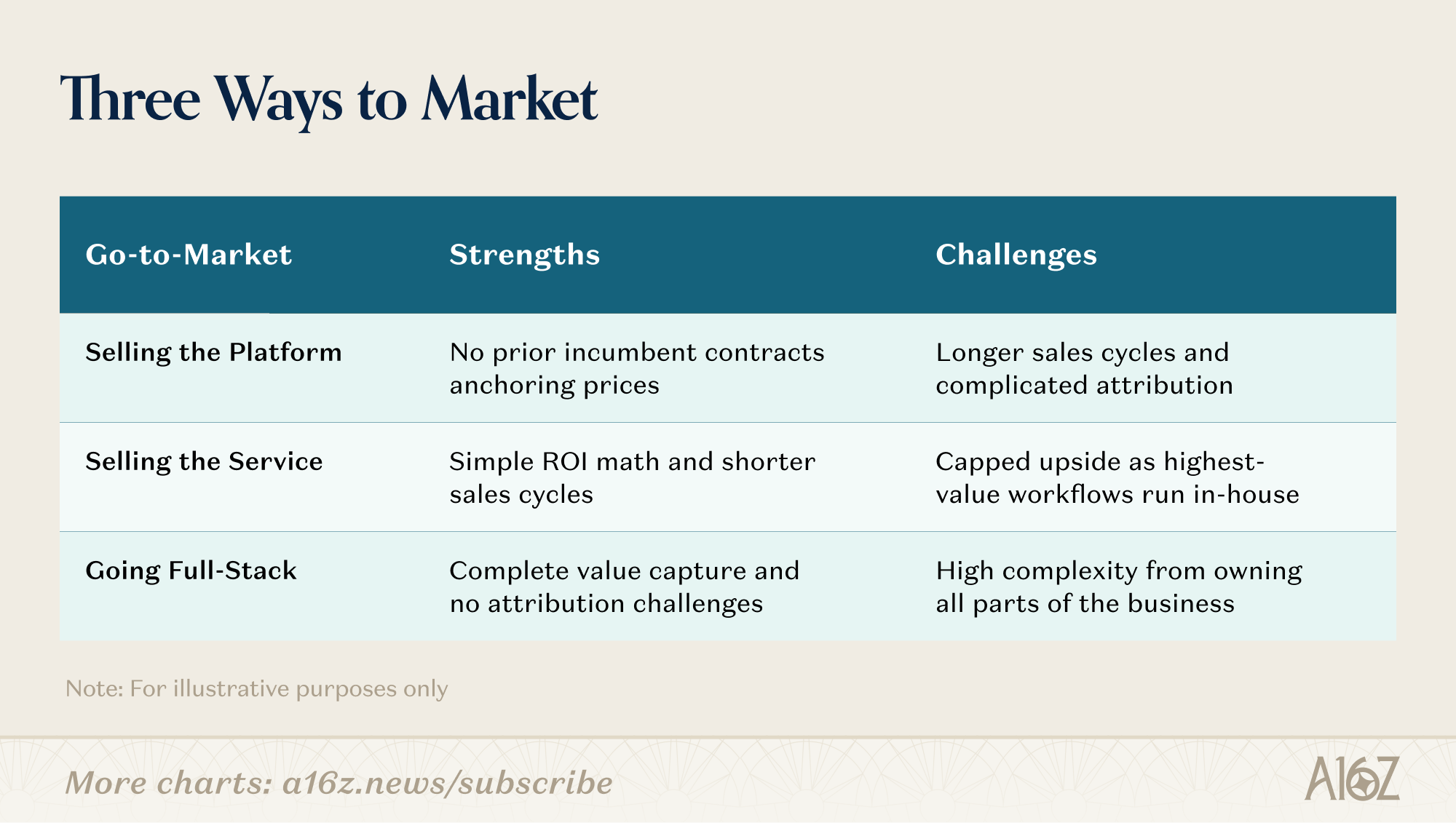
There are different ways to bring long-running agents to market.
(1) Selling the Platform: Under this motion, the vendor sells the long-running agent as software, supporting the enterprise in its existing operations. The plaintiff law case agent integrating with an existing team and their workflows is a good example. Selling a platform allows for revenue upside as there are often no comparable software or outsourced services contracts in place anchoring prices. This, however, also extends sales cycles as new budget lines need to be created, and it is harder to clearly attribute outcomes to an agent that interfaces with several departments across the enterprise.
(2) Selling the Service: Here, the vendor takes over an already outsourced service to deliver a desired outcome more effectively, just like Red Ventures owning the entire customer acquisition journey for an insurance carrier. This approach shortens sales cycles as the ROI math for buyers is simple and budget lines for BPOs already exist. However, existing, pre-AI pricing models may not reflect the true value the long-running agent can deliver and many high-value journeys are run in-house today, limiting the reach of this approach.
(3) Going Full-Stack: A full-stack approach means vertically integrating and becoming an AI-native player. For instance, instead of selling a long-running agent to a debt collection firm, you could buy debt portfolios and collect them yourself, allowing you to fully capture any AI upside created and address attribution problems. However, this also means owning parts of the service like licensing or compliance which are outside the actual customer journey, adding distractions and operational complexity.
It is too early to tell which of these approaches will prevail, but we are convinced that long-running agents will win the relay race at scale and expand the market addressable by AI from a share of labor budgets to a share of revenue. Plaintiff case preparation is only one example and we expect to see agents drive outcomes across other high-value journeys like mortgage origination, insurance claims processing, complex enterprise sales and countless others. If you are working on capturing this opportunity, we would love to hear from you!